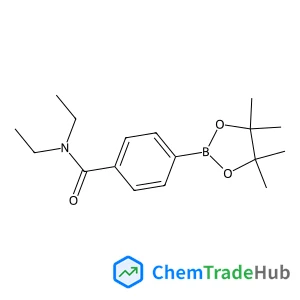
N,N-Diethyl-4-(4,4,5,5-tetramethyl-1,3,2-dioxaborolan-2-yl)benzamide
CAS Number:
325142-99-2
Molecular Formula:
C17H26BNO3
Edvinas Radiunas, Manvydas Dapkevičius, Steponas Raišys, Saulius Juršėnas, Augustina Jozeliūnaitė, Tomas Javorskis, Ugnė Šinkevičiūtė, Edvinas Orentas, Karolis Kazlauskas
Solid state NIR-to-visible photon upconversion (UC) mediated by triplet–triplet annihilation (TTA) is necessitated by numerous practical applications. Yet, efficient TTA-UC remains a highly challenging task. In this work palladium phthalocyanine-sensitized NIR-to-vis solid UC films based on a popular rubrene emitter are thoroughly studied with the primary focus on revealing the impact of t-butyl substitution in rubrene on the TTA-UC performance. The solution-processed UC films were additionally doped with a small amount of emissive singlet sink tetraphenyldibenzoperiflanthene (DBP) for collecting upconverted singlets from rubrene and in this way diminishing detrimental singlet fission. Irrespective of the excitation conditions used, t-butyl-substituted rubrene (TBR) was found to exhibit enhanced TTA-UC performance as compared to that of rubrene at an optimal emitter doping of 80 wt% in polystyrene films. Explicitly, in the TTA dominated regime attained at high excitation densities, 4-fold higher UC quantum yield (ΦUC) achieved in TBR-based films was caused by the reduced fluorescence concentration quenching mainly due to suppressed singlet fission. Under low light conditions, i.e. in the regime governed by spontaneous triplet decay, even though triplet exciton diffusion was obstructed in TBR films by t-butyl moieties, the subsequently reduced TTA rate was counterbalanced by both suppressed singlet fission and non-radiative triplet quenching, still ensuring higher ΦUC of these films as compared to those of unsubstituted rubrene films.

Coloration Technology

Journal of Medical Biochemistry

Green Chemistry

Physical Chemistry Chemical Physics

Journal of Enzyme inhibition and Medicinal Chemistry

Current Pharmaceutical Biotechnology

Molecular Diversity

Environmental Toxicology and Pharmacology

Advanced Engineering Materials

Nature Reviews Drug Discovery
Wenhao Yuan, Tianyu Li, Wei Li, Jiuzhong Yang
DOI: 10.1039/C7CP08518D
Junyao Li, Narcisse T. Tsona, Lin Du
DOI: 10.1039/C7CP05008A
Riley J. Hickman, Robert A. Lang, Tao Zeng
DOI: 10.1039/C8CP01394B
Jinpeng Lv, Xingji Li
DOI: 10.1039/C8CP01855C
Francesco Silvio Gentile, Simone Salustro, Anna Maria Ferrari, Philippe D'Arco, Roberto Dovesi
DOI: 10.1039/C8CP00596F
Peng Zhang, Nathan W. Yee, Sorin V. Filip, Casey E. Hetrick, Bin Yang, William H. Green
DOI: 10.1039/C7CP07058F
Nikolay G. Petrik, Greg A. Kimmel
DOI: 10.1039/C8CP01284A
Rafael Grande-Aztatzi, Jose M. Mercero, Jesus M. Ugalde
DOI: 10.1039/C8CP91727B
Dinesh Mishra, Vladislav Lobodin, Chengqi Zhang, Fadi Aldeek, Eric Lochner, Hedi Mattoussi
DOI: 10.1039/C7CP08682B
Xianming Cheng, Yane Zheng
DOI: 10.1039/C7CP08376A
This compound is mainly used as an intermediate in the synthesis of antipsychoti...
Waste containing 1-(D-Ribofuranosyl)-1,4-dihydro-3-pyridinecarboxamide (CAS: 191...
2-Methyl-2-propanyl 3-bromo-3-(hydroxymethyl)-1-azetidinecarboxylate (CAS: 20079...
N-(4-Chloro-2-pyridinyl)acetamide (CAS: 245056-66-0) is a chemical compound with...
5-Chloro-2-hydroxybenzoic acid, also known as 5-chlorosalicylic acid, is an arom...
When handling 1,1-Dichloro-1-fluoroethane (CAS: 1717-00-6), it is important to u...
Fmoc-(2S,3R)-3-phenylpyrrolidine-2-carboxylic acid is a white crystalline solid ...
4-Amino-5-bromo-2-pyridinecarboxylic acid is primarily used as a precursor in th...
Handling this compound should be done with personal protective equipment (PPE) i...
When handling 8-bromo-2,2-dimethyl-3,4-dihydro-2H-1,4-benzoxazin-3-one, use prop...
Physical Chemistry Chemical Physics (PCCP) is an international journal co-owned by 19 physical chemistry and physics societies from around the world. This journal publishes original, cutting-edge research in physical chemistry, chemical physics and biophysical chemistry. To be suitable for publication in PCCP, articles must include significant innovation and/or insight into physical chemistry; this is the most important criterion that reviewers and Editors will judge against when evaluating submissions. The journal has a broad scope and welcomes contributions spanning experiment, theory, computation and data science. Topical coverage includes spectroscopy, dynamics, kinetics, statistical mechanics, thermodynamics, electrochemistry, catalysis, surface science, quantum mechanics, quantum computing and machine learning. Interdisciplinary research areas such as polymers and soft matter, materials, nanoscience, energy, surfaces/interfaces, and biophysical chemistry are welcomed if they demonstrate significant innovation and/or insight into physical chemistry. Joined experimental/theoretical studies are particularly appreciated when complementary and based on up-to-date approaches.
![tert-Butyl N-[(2-chloropyridin-4-yl)methyl]carbamate structure](https://static.chemtradehub.com/structs/916/916210-27-0-9f95.webp "tert-Butyl N-[(2-chloropyridin-4-yl)methyl]carbamate structure")