












![1-[3-(4-Morpholinylsulfonyl)phenyl]methanamine structure](https://static.chemtradehub.com/structs/933/933989-32-3-51af.webp "1-[3-(4-Morpholinylsulfonyl)phenyl]methanamine structure")
Modeling study of the anti-knock tendency of substituted phenols as additives: an application of the reaction mechanism generator (RMG)
Literature Information
Publication Date
2018-01-02
DOI
10.1039/C7CP07058F
Impact Factor
3.676
Authors
Peng Zhang, Nathan W. Yee, Sorin V. Filip, Casey E. Hetrick, Bin Yang, William H. Green
View Original
Abstract
This work presents kinetic modeling efforts to evaluate the anti-knock tendency of several substituted phenols if used as gasoline additives. They are p-cresol, m-cresol, o-cresol, 2,4-xylenol, 2-ethylphenol, and guaiacol. A detailed kinetic model was constructed to predict the ignition of blends of the phenols in n-butane with the help of reaction mechanism generator (RMG), an open-source software package. The resulting model, which has 1465 species and 27 428 reactions, was validated against literature n-butane ignition data in the low-to-intermediate temperature range. To rank the anti-knock tendency of the additives, engine-like simulations were performed in a closed adiabatic homogenous batch reactor with a volume history derived from the pressure profile of a real research octane number (RON) engine test. The ignition timings of the additive blends were compared to that of primary reference fuels (PRFs) to quantitatively predict the anti-knock ability. The model predictions agree well with experimental determinations of the changes in RON induced by the additives. This study explains the chemical mechanism by which methyl-substituted phenols increase RON, and demonstrates how fundamental chemical kinetics can be used to evaluate practical fuel additive performance.
Related Literature
Metal alloy solid-state nanopores for single nanoparticle detection
Diego Coglitore, Andrea Merenda, Nicoletta Giamblanco, Ludovic F. Dumée, Jean-Marc Janot, Sébastien Balme
2018-04-03
Paper
DOI: 10.1039/C8CP01787E
Correction: New carbon allotropes in sp + sp3 bonding networks consisting of C8 cubes
Changfeng Chen, Hiroshi Mizuseki
2018-04-27
Correction
DOI: 10.1039/C8CP91749C
Factors impacting the aggregation/agglomeration and photocatalytic activity of highly crystalline spheroid- and rod-shaped TiO2 nanoparticles in aqueous solutions
Thomas Degabriel, Elodie Colaço, Rute F. Domingos, Karim El Kirat, Dalil Brouri, Sandra Casale, Jessem Landoulsi, Jolanda Spadavecchia
2018-04-05
Paper
DOI: 10.1039/C7CP08054A
Halogen-like properties of the Al13 cluster mimicking astatine
B. Molina, J. R. Soto, J. J. Castro
2018-04-04
Communication
DOI: 10.1039/C8CP00494C
Local crystal structure in the vicinity of Cr in doped AlN thin films studied by X-ray absorption spectroscopy
Padmalochan Panda, R. Ramaseshan, Madhusmita Sahoo, Nanda Gopala Krishna, A. K. Yadav, S. N. Jha, D. Bhattacharyya
2018-04-24
Paper
DOI: 10.1039/C8CP01686K
Theoretical insight into the vibrational spectra of metal–water interfaces from density functional theory based molecular dynamics
Jiabo Le, Qiyuan Fan, Angel Cuesta
2018-04-09
Communication
DOI: 10.1039/C8CP00615F
Enhancing radical molecular beams by skimmer cooling
Hao Wu, David Reens, Tim Langen, Yuval Shagam, Daniela Fontecha, Jun Ye
2018-04-06
Paper
DOI: 10.1039/C8CP00962G
Optical absorption and photoconductivity in iodine-excess ionic liquids: the case of 1-alkyl-3-methyl imidazolium iodides
Masami Aono, Hisashi Miyazaki, Takahiro Takekiyo, Seiji Tsuzuki, Hiroshi Abe
2018-01-25
Paper
DOI: 10.1039/C7CP07387A
Monitoring photo-induced population dynamics in metastable linkage isomer crystals: a crystallographic kinetic study of [Pd(Bu4dien)NO2]BPh4
Lauren E. Hatcher, Jonathan M. Skelton, Mark R. Warren, Clare Stubbs, E. Lora da Silva, Paul R. Raithby
2018-01-31
Paper
DOI: 10.1039/C7CP05422J
Ultrasonication-induced sp3 hybridization defects in Langmuir–Schaefer layers of turbostratic graphene
K. Rytel, M. Widelicka, D. Łukawski, F. Lisiecki, K. Kędzierski, D. Wróbel
2018-04-13
Paper
DOI: 10.1039/C8CP01363B
You might also like
Compound Q&A
What are the main uses of 1-(3-Aminophenyl)-3-[(3R)-1-(3,3-dimethyl-2-oxobutyl)-2-oxo-5-(2-pyridinyl)-2,3-dihydro-1H-1,4-benzodiazepin-3-yl]urea (CAS: 155412-88-7)?
This compound is mainly used as an intermediate in the synthesis of antipsychoti...
155412-88-71-(3-Aminophenyl)-3-...
Compound Q&A
How should waste containing 1-(D-Ribofuranosyl)-1,4-dihydro-3-pyridinecarboxamide (CAS: 19132-12-8) be handled?
Waste containing 1-(D-Ribofuranosyl)-1,4-dihydro-3-pyridinecarboxamide (CAS: 191...
19132-12-81-(D-Ribofuranosyl)-...
Compound Q&A
What regulatory guidelines apply to 2-Methyl-2-propanyl 3-bromo-3-(hydroxymethyl)-1-azetidinecarboxylate (CAS: 2007919-81-3)?
2-Methyl-2-propanyl 3-bromo-3-(hydroxymethyl)-1-azetidinecarboxylate (CAS: 20079...
2007919-81-32-Methyl-2-propanyl ...
Compound Q&A
What is N-(4-Chloro-2-pyridinyl)acetamide (CAS: 245056-66-0)?
N-(4-Chloro-2-pyridinyl)acetamide (CAS: 245056-66-0) is a chemical compound with...
245056-66-0N-(4-Chloro-2-pyridi...
Compound Q&A
What is 5-Chloro-2-hydroxybenzoic acid (CAS: 321-14-2)?
5-Chloro-2-hydroxybenzoic acid, also known as 5-chlorosalicylic acid, is an arom...
321-14-25-Chloro-2-hydroxybe...
Compound Q&A
What precautions should be taken when handling 1,1-Dichloro-1-fluoroethane (CAS: 1717-00-6)?
When handling 1,1-Dichloro-1-fluoroethane (CAS: 1717-00-6), it is important to u...
1717-00-61,1-Dichloro-1-fluor...
Compound Q&A
What are the physical and chemical properties of Fmoc-(2S,3R)-3-phenylpyrrolidine-2-carboxylic acid (CAS: 281655-32-1)?
Fmoc-(2S,3R)-3-phenylpyrrolidine-2-carboxylic acid is a white crystalline solid ...
281655-32-1Fmoc-(2S,3R)-3-pheny...
Compound Q&A
What are the main uses of 4-Amino-5-bromo-2-pyridinecarboxylic acid (CAS: 1363381-01-4)?
4-Amino-5-bromo-2-pyridinecarboxylic acid is primarily used as a precursor in th...
1363381-01-44-Amino-5-bromo-2-py...
Compound Q&A
What precautions should be taken when handling (S)-tert-butyl 2-((2-(4-bromophenyl)-2-oxoethyl)carbamoyl)pyrrolidine-1-carboxylate (CAS: 1007881-98-2)?
Handling this compound should be done with personal protective equipment (PPE) i...
1007881-98-2(S)-tert-butyl 2-((2...
Compound Q&A
What precautions should be taken when handling 8-bromo-2,2-dimethyl-3,4-dihydro-2H-1,4-benzoxazin-3-one (CAS: 688363-73-7)?
When handling 8-bromo-2,2-dimethyl-3,4-dihydro-2H-1,4-benzoxazin-3-one, use prop...
688363-73-78-bromo-2,2-dimethyl...
Source Journal
Physical Chemistry Chemical Physics

CiteScore:
5.5
Self-citation Rate:
10.3%
Articles per Year:
3036
Physical Chemistry Chemical Physics (PCCP) is an international journal co-owned by 19 physical chemistry and physics societies from around the world. This journal publishes original, cutting-edge research in physical chemistry, chemical physics and biophysical chemistry. To be suitable for publication in PCCP, articles must include significant innovation and/or insight into physical chemistry; this is the most important criterion that reviewers and Editors will judge against when evaluating submissions. The journal has a broad scope and welcomes contributions spanning experiment, theory, computation and data science. Topical coverage includes spectroscopy, dynamics, kinetics, statistical mechanics, thermodynamics, electrochemistry, catalysis, surface science, quantum mechanics, quantum computing and machine learning. Interdisciplinary research areas such as polymers and soft matter, materials, nanoscience, energy, surfaces/interfaces, and biophysical chemistry are welcomed if they demonstrate significant innovation and/or insight into physical chemistry. Joined experimental/theoretical studies are particularly appreciated when complementary and based on up-to-date approaches.
Recommended Compounds
![tert-Butyl N-[(2-chloropyridin-4-yl)methyl]carbamate structure](https://static.chemtradehub.com/structs/916/916210-27-0-9f95.webp "tert-Butyl N-[(2-chloropyridin-4-yl)methyl]carbamate structure")
tert-Butyl N-[(2-chloropyridin-4-yl)methyl]carbamate
CAS Number:
916210-27-0
Molecular Formula:
C11H15ClN2O2
![Methyl 4-({[(2-methyl-2-propanyl)oxy]carbonyl}amino)bicyclo[2.2.2]octane-1-carboxylate structure](https://static.chemtradehub.com/structs/943/943845-74-7-b7e5.webp "Methyl 4-({[(2-methyl-2-propanyl)oxy]carbonyl}amino)bicyclo[2.2.2]octane-1-carboxylate structure")
Methyl 4-({[(2-methyl-2-propanyl)oxy]carbonyl}amino)bicyclo[2.2.2]octane-1-carboxylate
CAS Number:
943845-74-7
Molecular Formula:
C15H25NO4
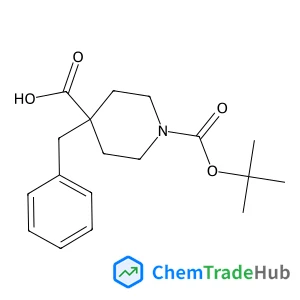
4-Benzyl-1-(tert-butoxycarbonyl)piperidine-4-carboxylic acid
CAS Number:
170838-87-6
Molecular Formula:
C18H25NO4
Recommended Suppliers






Disclaimer
This page provides academic journal information for reference and research purposes only. We are not affiliated with any journal publishers and do not handle publication submissions. For publication-related inquiries, please contact the respective journal publishers directly.
If you notice any inaccuracies in the information displayed, please contact us at support@chemtradehub.com. We will promptly review and address your concerns.