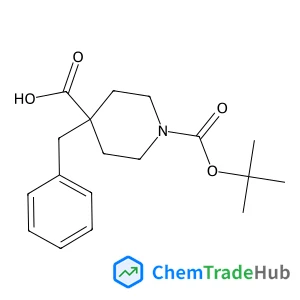
4-Benzyl-1-(tert-butoxycarbonyl)piperidine-4-carboxylic acid
CAS Number:
170838-87-6
Molecular Formula:
C18H25NO4
Dinesh Mishra, Vladislav Lobodin, Chengqi Zhang, Fadi Aldeek, Eric Lochner, Hedi Mattoussi
We detail the characterization of atomically precise, luminescent silver and gold bimetallic nanoclusters (Ag and AgAuNCs) grown in the presence of bidentate lipoic acid (LA, the oxidized form) and dihydrolipoic acid (DHLA, the reduced form) ligands. We found that while doping AuNCs with Ag or Cu precursors using up to a 50% molar fraction (during growth) did not lead to any photoluminescence enhancement, doping of AgNCs with Au resulted in a six-fold enhancement of the PL emission compared to undoped AgNCs. The effect of doping is also reflected in the optical absorption and PL excitation spectra of the gold-doped NCs (AgAuNCs), where a clear blue shift in the absorbance features with respect to the pure AgNCs has been measured. Mass spectrometry measurements using ESI-MS showed that the AgNCs and Au-doped AgNCs had the compositions Ag29(DHLA)12 and Ag28Au(DHLA)12, respectively. The bimetallic nature of the AgAuNC cores was further supported by X-ray Photoelectron Spectroscopy (XPS) measurements. Data showed that the binding energies of the Ag and Au atoms measured from the nanoclusters were shifted with respect to those of the Ag and Au metals. Furthermore, the change in the Ag binding energy was affected by the presence of Au atoms. DOSY-NMR measurements performed on both sets of nanoclusters yielded no change in the hydrodynamic radius measured for either set of NCs when capped with the same ligands.
J. Kłos, S. D. Le Picard
DOI: 10.1039/C7CP05092E
Jiabo Le, Qiyuan Fan, Angel Cuesta
DOI: 10.1039/C8CP00615F
Padmalochan Panda, R. Ramaseshan, Madhusmita Sahoo, Nanda Gopala Krishna, A. K. Yadav, S. N. Jha, D. Bhattacharyya
DOI: 10.1039/C8CP01686K
Kang Wang, Ye Chen, Xiangjun Gong, Jianlong Xia, Junpeng Zhao, Lei Shen
DOI: 10.1039/C8CP00887F
Daehyeon Choi, Joonhee Kang, Jinwoo Park, Byungchan Han
DOI: 10.1039/C7CP08037A
Daiki Asakawa, Hidenori Takahashi, Shinichi Iwamoto, Koichi Tanaka
DOI: 10.1039/C8CP00733K
Chang Liu, Hang Zhai, Ying Sun, Weiguang Gong, Yan Yan, Quan Li, Weitao Zheng
DOI: 10.1039/C8CP00205C
Xiaolu Xiong, Guangshi Li, Hongwei Cheng, Qian Xu
DOI: 10.1039/C8CP00873F
Longteng Tang, Yanli Wang, Liangdong Zhu, Karen Kallio, S. James Remington, Chong Fang
DOI: 10.1039/C8CP01907J
This compound is mainly used as an intermediate in the synthesis of antipsychoti...
Waste containing 1-(D-Ribofuranosyl)-1,4-dihydro-3-pyridinecarboxamide (CAS: 191...
2-Methyl-2-propanyl 3-bromo-3-(hydroxymethyl)-1-azetidinecarboxylate (CAS: 20079...
N-(4-Chloro-2-pyridinyl)acetamide (CAS: 245056-66-0) is a chemical compound with...
5-Chloro-2-hydroxybenzoic acid, also known as 5-chlorosalicylic acid, is an arom...
When handling 1,1-Dichloro-1-fluoroethane (CAS: 1717-00-6), it is important to u...
Fmoc-(2S,3R)-3-phenylpyrrolidine-2-carboxylic acid is a white crystalline solid ...
4-Amino-5-bromo-2-pyridinecarboxylic acid is primarily used as a precursor in th...
Handling this compound should be done with personal protective equipment (PPE) i...
When handling 8-bromo-2,2-dimethyl-3,4-dihydro-2H-1,4-benzoxazin-3-one, use prop...

Physical Chemistry Chemical Physics (PCCP) is an international journal co-owned by 19 physical chemistry and physics societies from around the world. This journal publishes original, cutting-edge research in physical chemistry, chemical physics and biophysical chemistry. To be suitable for publication in PCCP, articles must include significant innovation and/or insight into physical chemistry; this is the most important criterion that reviewers and Editors will judge against when evaluating submissions. The journal has a broad scope and welcomes contributions spanning experiment, theory, computation and data science. Topical coverage includes spectroscopy, dynamics, kinetics, statistical mechanics, thermodynamics, electrochemistry, catalysis, surface science, quantum mechanics, quantum computing and machine learning. Interdisciplinary research areas such as polymers and soft matter, materials, nanoscience, energy, surfaces/interfaces, and biophysical chemistry are welcomed if they demonstrate significant innovation and/or insight into physical chemistry. Joined experimental/theoretical studies are particularly appreciated when complementary and based on up-to-date approaches.
![2,6-Bis({(2R)-2-[hydroxy(diphenyl)methyl]-1-pyrrolidinyl}methyl)-4-methylphenol structure](https://static.chemtradehub.com/structs/877/877395-58-9-70bf.webp "2,6-Bis({(2R)-2-[hydroxy(diphenyl)methyl]-1-pyrrolidinyl}methyl)-4-methylphenol structure")
![1-[3-(4-Morpholinylsulfonyl)phenyl]methanamine structure](https://static.chemtradehub.com/structs/933/933989-32-3-51af.webp "1-[3-(4-Morpholinylsulfonyl)phenyl]methanamine structure")