


General formalism for vibronic Hamiltonians in tetragonal symmetry and beyond
Literature Information
Publication Date
2018-04-03
DOI
10.1039/C8CP01394B
Impact Factor
3.676
Authors
Riley J. Hickman, Robert A. Lang, Tao Zeng
View Original
Abstract
We derive general expansion formulas in vibrational coordinates for all bimodal Jahn–Teller and pseudo-Jahn–Teller Hamiltonians in tetragonal symmetry. Symmetry information of all the vibronic Hamiltonian matrix elements is fully carried by up to only 4 eigenvalues of symmetry operators. This problem-to-eigenvalue reduction enables us to handle thousands of vibronic problems in one work. The derived bimodal formulas can be easily extended to cover problems with one or more than two vibrational modes. They lay a solid foundation for future vibronic coupling studies of tetragonal systems. More importantly, the efficient derivation can be applied to handle (pseudo-)Jahn–Teller Hamiltonians for all problems with one principal symmetry axis.
Recommended Journals

Journal of the Chinese Chemical Society

Advances in Colloid and Interface Science

Bulletin of the Chemical Society of Japan

Ferroelectrics

Chemical & Pharmaceutical Bulletin

Analyst

Chemistry of Heterocyclic Compounds

Accounts of Chemical Research

Cement and Concrete Research

Anti-Corrosion Methods and Materials
Related Literature
Monitoring photo-induced population dynamics in metastable linkage isomer crystals: a crystallographic kinetic study of [Pd(Bu4dien)NO2]BPh4
Lauren E. Hatcher, Jonathan M. Skelton, Mark R. Warren, Clare Stubbs, E. Lora da Silva, Paul R. Raithby
2018-01-31
Paper
DOI: 10.1039/C7CP05422J
Computational analysis of carbohydrate recognition based on hybrid QM/MM modeling: a case study of norovirus capsid protein in complex with Lewis antigen
2018-01-09
Paper
DOI: 10.1039/C7CP07701G
Local crystal structure in the vicinity of Cr in doped AlN thin films studied by X-ray absorption spectroscopy
Padmalochan Panda, R. Ramaseshan, Madhusmita Sahoo, Nanda Gopala Krishna, A. K. Yadav, S. N. Jha, D. Bhattacharyya
2018-04-24
Paper
DOI: 10.1039/C8CP01686K
Thermal equilibration between excited states or solvent effects: unveiling the origins of anomalous emissions in heteroleptic Ru(ii) complexes
Denis Jacquemin, Daniel Escudero
2018-04-04
Communication
DOI: 10.1039/C8CP01101J
Origin of the overpotentials for HCOO− and CO formation in the electroreduction of CO2 on Cu(211): the reductive desorption processes decide
Ling Liu, Chungen Liu
2018-01-25
Paper
DOI: 10.1039/C7CP08440D
Precursor non-stoichiometry to enable improved CH3NH3PbBr3 nanocrystal LED performance
Sjoerd A. Veldhuis, Xin Yu Chin, Natalia Yantara, Xiaodong Chen
2018-01-24
Paper
DOI: 10.1039/C7CP07827G
Real time monitoring of the minute dynamic variation at the crude oil–water interface
Ziling Ding, Yan Xiong
2018-01-26
Paper
DOI: 10.1039/C7CP07491C
Multi-color electrochromism containing green color based on electrochemically polymerized star-shaped phenyl bithiophene
Yujie Dong, Feifei Luo, Lan Chen, Feiya Yuan, Yuejiao Hou, Weijun Li, Shuanma Yan, Yuyu Dai, Mi Ouyang, Cheng Zhang
2018-04-10
Paper
DOI: 10.1039/C8CP00338F
Unusual photoresponses in the upper critical solution temperature of polymer solutions mediated by changes in intermolecular interactions in an azo-doped liquid crystalline solvent
Takahiro Yamamoto, Hideyuki Kihara, Yasuhisa Yamamura, Kazuya Saito, Kohji Ohno
2018-01-22
Paper
DOI: 10.1039/C7CP08335A
You might also like
Compound Q&A
What are the main uses of 1-(3-Aminophenyl)-3-[(3R)-1-(3,3-dimethyl-2-oxobutyl)-2-oxo-5-(2-pyridinyl)-2,3-dihydro-1H-1,4-benzodiazepin-3-yl]urea (CAS: 155412-88-7)?
This compound is mainly used as an intermediate in the synthesis of antipsychoti...
155412-88-71-(3-Aminophenyl)-3-...
Compound Q&A
How should waste containing 1-(D-Ribofuranosyl)-1,4-dihydro-3-pyridinecarboxamide (CAS: 19132-12-8) be handled?
Waste containing 1-(D-Ribofuranosyl)-1,4-dihydro-3-pyridinecarboxamide (CAS: 191...
19132-12-81-(D-Ribofuranosyl)-...
Compound Q&A
What regulatory guidelines apply to 2-Methyl-2-propanyl 3-bromo-3-(hydroxymethyl)-1-azetidinecarboxylate (CAS: 2007919-81-3)?
2-Methyl-2-propanyl 3-bromo-3-(hydroxymethyl)-1-azetidinecarboxylate (CAS: 20079...
2007919-81-32-Methyl-2-propanyl ...
Compound Q&A
What is N-(4-Chloro-2-pyridinyl)acetamide (CAS: 245056-66-0)?
N-(4-Chloro-2-pyridinyl)acetamide (CAS: 245056-66-0) is a chemical compound with...
245056-66-0N-(4-Chloro-2-pyridi...
Compound Q&A
What is 5-Chloro-2-hydroxybenzoic acid (CAS: 321-14-2)?
5-Chloro-2-hydroxybenzoic acid, also known as 5-chlorosalicylic acid, is an arom...
321-14-25-Chloro-2-hydroxybe...
Compound Q&A
What precautions should be taken when handling 1,1-Dichloro-1-fluoroethane (CAS: 1717-00-6)?
When handling 1,1-Dichloro-1-fluoroethane (CAS: 1717-00-6), it is important to u...
1717-00-61,1-Dichloro-1-fluor...
Compound Q&A
What are the physical and chemical properties of Fmoc-(2S,3R)-3-phenylpyrrolidine-2-carboxylic acid (CAS: 281655-32-1)?
Fmoc-(2S,3R)-3-phenylpyrrolidine-2-carboxylic acid is a white crystalline solid ...
281655-32-1Fmoc-(2S,3R)-3-pheny...
Compound Q&A
What are the main uses of 4-Amino-5-bromo-2-pyridinecarboxylic acid (CAS: 1363381-01-4)?
4-Amino-5-bromo-2-pyridinecarboxylic acid is primarily used as a precursor in th...
1363381-01-44-Amino-5-bromo-2-py...
Compound Q&A
What precautions should be taken when handling (S)-tert-butyl 2-((2-(4-bromophenyl)-2-oxoethyl)carbamoyl)pyrrolidine-1-carboxylate (CAS: 1007881-98-2)?
Handling this compound should be done with personal protective equipment (PPE) i...
1007881-98-2(S)-tert-butyl 2-((2...
Compound Q&A
What precautions should be taken when handling 8-bromo-2,2-dimethyl-3,4-dihydro-2H-1,4-benzoxazin-3-one (CAS: 688363-73-7)?
When handling 8-bromo-2,2-dimethyl-3,4-dihydro-2H-1,4-benzoxazin-3-one, use prop...
688363-73-78-bromo-2,2-dimethyl...
Source Journal
Physical Chemistry Chemical Physics

CiteScore:
5.5
Self-citation Rate:
10.3%
Articles per Year:
3036
Physical Chemistry Chemical Physics (PCCP) is an international journal co-owned by 19 physical chemistry and physics societies from around the world. This journal publishes original, cutting-edge research in physical chemistry, chemical physics and biophysical chemistry. To be suitable for publication in PCCP, articles must include significant innovation and/or insight into physical chemistry; this is the most important criterion that reviewers and Editors will judge against when evaluating submissions. The journal has a broad scope and welcomes contributions spanning experiment, theory, computation and data science. Topical coverage includes spectroscopy, dynamics, kinetics, statistical mechanics, thermodynamics, electrochemistry, catalysis, surface science, quantum mechanics, quantum computing and machine learning. Interdisciplinary research areas such as polymers and soft matter, materials, nanoscience, energy, surfaces/interfaces, and biophysical chemistry are welcomed if they demonstrate significant innovation and/or insight into physical chemistry. Joined experimental/theoretical studies are particularly appreciated when complementary and based on up-to-date approaches.
Recommended Compounds
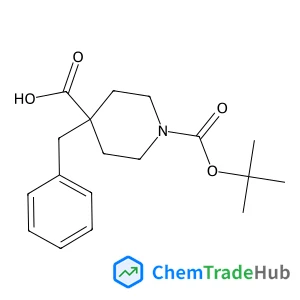
4-Benzyl-1-(tert-butoxycarbonyl)piperidine-4-carboxylic acid
CAS Number:
170838-87-6
Molecular Formula:
C18H25NO4
Recommended Suppliers







Disclaimer
This page provides academic journal information for reference and research purposes only. We are not affiliated with any journal publishers and do not handle publication submissions. For publication-related inquiries, please contact the respective journal publishers directly.
If you notice any inaccuracies in the information displayed, please contact us at support@chemtradehub.com. We will promptly review and address your concerns.