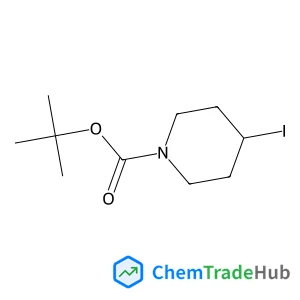
2-Methyl-2-propanyl 4-iodo-1-piperidinecarboxylate
CAS Number:
301673-14-3
Molecular Formula:
C10H18INO2
Takeshi Maehara, Ryo Sekiya, Kentaro Harada, Takeharu Haino
Controlling and tuning the molecular recognition properties is a crucial task in host–guest chemistry. The size and dimension of the guest-binding space inside self-assembled capsules 1a–c is successfully determined by installing the substituents at the 6′-position of 2,2′-bipyridyl arms. X-ray diffraction analysis and DFT calculations at the M06-2X/6-31G(d,p)+LanL2DZ level of theory demonstrate that the p-methoxyphenyl group expands the dihedral angle of the 2,2′-bipyridyl arms through its π-stacking interaction to the 2,2′-bipyridyl arm, whereas the steric interaction of the isopropyl group to the neighboring bipyridyl arm slightly reduces the dihedral angle of the two bipyridyl groups. The Cu(I)-united 2,2′-bipyridyl arms function as a hinge; accordingly, installing the p-methoxyphenyl group extends the cavity by ca. 2 Å, whereas the isopropyl group shrinks the cavity more than that of the capsule 1a with methyl groups at the 6′-positions. These steric interactions influence the molecular recognition of the capsules 1a–c for rigid ditopic guest 2a as well as flexible ones 2b–f. The guest selectivity inside the enforced cavity is determined by varying the substituents.
DOI: 10.1039/B316170F
Brendan F. Hayward, Hans Riesen
DOI: 10.1039/B502079D
Hansong Cheng, Virpul Parekh, Brian Peterson, Kamil Klier
DOI: 10.1039/B400322E
James B. Burkholder, R. W. Portmann, A. R. Ravishankara
DOI: 10.1039/B503332B
B. Berge, W. Mikosch, E. Rühl
DOI: 10.1039/B401807A
Thomas F. Miller, III, David C. Clary
DOI: 10.1039/B314644H
DOI: 10.1039/B401884B
Stefania Cinelli, Alessio De Francesco, Giuseppe Onori, Alessandro Paciaroni
DOI: 10.1039/B402003K
Jun Li, Shuhua Li
DOI: 10.1039/B700161D
Caterina Benzi, Maurizio Cossi, Vincenzo Barone
DOI: 10.1039/B316718F
Waste containing (6-Bromo-2-naphthyl)oxy](dimethyl)(2-methyl-2-propanyl)silane (...
7-Fluoro-4-isoquinolinecarboxylic acid can be synthesized via a multi-step proce...
2,3,5,6-Tetrabromothieno[3,2-b]thiophene is a crystalline compound with a high m...
1-[4-(Benzylamino)-7,8-dihydro-5H-pyrano[4,3-d]pyrimidin-2-yl]-2-methyl-1H-indol...
The market for imidazo[5,1-d]-1,2,3,5-tetrazine-8-carboxylic acid, 3,4-dihydro-3...
3-(Triisopropylsilyl)propiolaldehyde is a synthetic organic compound with the CA...
6-Nitro-2H-1,4-benzoxazin-3(4H)-one (CAS: 81721-87-1) is subject to various regu...
Waste containing (3-Fluorophenyl)(4-{[(2-methyl-2-propanyl)oxy]carbonyl}-1-piper...
N,N'-4,4'-Biphenyldiyldiisonicotinamide is a white crystalline solid with a mole...
6-Bromo-8-fluoro-2-quinazolinol is primarily used in the pharmaceutical industry...

Organic Chemistry Frontiers publishes high-quality research from across organic chemistry. Emphases are placed on studies that make significant contributions to the field of organic chemistry by reporting either new or significantly improved protocols or methodologies. Topics include, but are not limited to the following: Organic synthesis Development of synthetic methodologies Catalysis Natural products Functional organic materials Supramolecular and macromolecular chemistry Physical and computational organic chemistry
![2,2'-{2,2-Propanediylbis[(2,6-dibromo-4,1-phenylene)oxy]}diethanol structure](https://static.chemtradehub.com/structs/416/4162-45-2-b3d6.webp "2,2'-{2,2-Propanediylbis[(2,6-dibromo-4,1-phenylene)oxy]}diethanol structure")