












Growth and auto-oxidation of Pd on single-layer AgOx/Ag(111)
Literature Information
Publication Date
2020-02-25
DOI
10.1039/C9CP06973A
Impact Factor
3.676
Authors
Vikram Mehar, Christopher R. O’Connor, Mustafa Karatok, Robert J. Madix, Jason F. Weaver
View Original
Abstract
We investigated the growth and auto-oxidation of Pd deposited onto a AgOx single-layer on Ag(111) using scanning tunneling microscopy (STM) and X-ray photoelectron spectroscopy (XPS). Palladium initially grows as well-dispersed, single-layer clusters that adopt the same triangular shape and orientation of Agn units in the underlying AgOx layer. Bi-layer clusters preferentially form upon increasing the Pd coverage to ∼0.30 ML (monolayer) and continue to develop until aggregating and forming a nearly conformal Pd bi-layer at a coverage near 2 ML. Analysis of the STM images provides quantitative evidence of a transition from single to bi-layer Pd growth on the AgOx layer, and a continuation of bi-layer growth with increasing Pd coverage from ∼0.3 to 2 ML. XPS further demonstrates that the AgOx layer efficiently transfers oxygen to Pd at 300 K, and that the fraction of Pd that oxidizes is approximately equal to the local oxygen coverage in the AgOx layer for Pd coverages up to at least ∼0.7 ML. Our results show that oxygen in the initial AgOx layer mediates the growth and structural properties of Pd on the AgOx/Ag(111) surface, enabling the preparation of model PdAg surfaces with uniformly distributed single or bi-layer Pd clusters. Facile auto-oxidation of Pd by AgOx further suggests that oxygen transfer from Ag to Pd could play a role in promoting oxidation chemistry of adsorbed molecules on PdAg surfaces.
Related Literature
Hydroamination of ethylene with NH3 induced by non-thermal atmospheric plasma
Julien Dieu, François Jérôme, Catherine Batiot-Dupeyrat
2021-11-02
Communication
DOI: 10.1039/D1RE00407G
Concentric annular liquid–liquid phase separation for flow chemistry and continuous processing
Bin Feng, Heather O'Connor, Denis Dowling, Geoff Gibson, Kevin P. Girard
2021-06-24
Paper
DOI: 10.1039/D1RE00119A
Exponential growth of functional poly(glutamic acid)dendrimers with variable stereochemistry
Sebastian Hartwig, Mary M. Nguyen, Stefan Hecht
2009-11-25
Communication
DOI: 10.1039/B9PY00217K
3D printed nickel catalytic static mixers made by corrosive chemical treatment for use in continuous flow hydrogenation
Milan Kundra, Yutong Zhu, Xuan Nguyen, Darren Fraser, Christian H. Hornung, John Tsanaktsidis
2021-11-15
Paper
DOI: 10.1039/D1RE00456E
Efficient N-sulfopropylation of chitosan with 1,3-propane sultone in aqueous solutions: neutral pH as the key condition
Abolfazl Heydari, Mahdieh Darroudi
2021-07-22
Paper
DOI: 10.1039/D1RE00089F
Process intensification of ozonolysis reactions using dedicated microstructured reactors
Dominique M. Roberge, Paul Hanselmann, Petteri Elsner
2021-08-18
Communication
DOI: 10.1039/D1RE00264C
Kinetic and mechanistic insights into Ni-AlKIT-6 catalyzed ethylene oligomerization
Remi Beucher, Vasile Hulea, Claudia Cammarano
2021-10-11
Paper
DOI: 10.1039/D1RE00258A
DFT study of phenol alkylation with propylene on H-BEA in the absence and presence of water
Sajal Kanti Dutta
2021-09-10
Paper
DOI: 10.1039/D1RE00201E
You might also like
Compound Q&A
What precautions should be taken when handling lithium chloride hydrate (1:1:1) (CAS: 16712-20-2)?
When handling lithium chloride hydrate (1:1:1) (CAS: 16712-20-2), it is importan...
16712-20-2Lithium chloride hyd...
Compound Q&A
Is 4-(4H-1,2,4-Triazol-4-yl)piperidine (CAS: 690261-92-8) safe?
4-(4H-1,2,4-Triazol-4-yl)piperidine is generally considered safe for use in phar...
690261-92-84-(4H-1,2,4-Triazol-...
Compound Q&A
How should waste containing 1,3-Thiazole-2-carboxamide (CAS: 16733-85-0) be handled?
Waste containing 1,3-Thiazole-2-carboxamide (CAS: 16733-85-0) should be collecte...
16733-85-01,3-Thiazole-2-carbo...
Compound Q&A
What regulatory guidelines apply to 5-(Difluoromethyl)-2-fluorobenzonitrile (CAS: 934175-58-3)?
5-(Difluoromethyl)-2-fluorobenzonitrile (CAS: 934175-58-3) is subject to regulat...
934175-58-35-(Difluoromethyl)-2...
Compound Q&A
How is Methyl 3-acetamido-2-thiophenecarboxylate (CAS: 22288-79-5) typically synthesized?
Methyl 3-acetamido-2-thiophenecarboxylate can be synthesized by the reaction of ...
22288-79-5Methyl 3-acetamido-2...
Compound Q&A
What is 4-Isoquinolinecarbonitrile (CAS: 34846-65-6)?
4-Isoquinolinecarbonitrile is a chemical compound with the CAS number 34846-65-6...
34846-65-64-Isoquinolinecarbon...
Compound Q&A
How should Methyl 1H-1,2,3-triazole-4-carboxylate (CAS: 877309-59-6) be stored?
Store Methyl 1H-1,2,3-triazole-4-carboxylate (CAS: 877309-59-6) in a cool, dry p...
877309-59-6Methyl 1H-1,2,3-tria...
Compound Q&A
What regulatory guidelines apply to 6-Bromo[1,3]thiazolo[5,4-b]pyridin-2-amine (CAS: 1160791-13-8)?
6-Bromo[1,3]thiazolo[5,4-b]pyridin-2-amine (CAS: 1160791-13-8) is subject to the...
1160791-13-86-Bromo[1,3]thiazolo...
Compound Q&A
Is (2S,3S)-2-Ammonio-3-(3,4-dihydroxyphenyl)-3-hydroxypropanoate (CAS: 23651-95-8) safe?
(2S,3S)-2-Ammonio-3-(3,4-dihydroxyphenyl)-3-hydroxypropanoate (CAS: 23651-95-8) ...
23651-95-8(2S,3S)-2-Ammonio-3-...
Compound Q&A
What are the physical and chemical properties of 7-bromo-3-methyl-3,4-dihydroquinazolin-4-one (CAS: 1293987-84-4)?
7-Bromo-3-methyl-3,4-dihydroquinazolin-4-one is a solid with a crystalline form....
1293987-84-47-bromo-3-methyl-3,4...
Source Journal
Physical Chemistry Chemical Physics

CiteScore:
5.5
Self-citation Rate:
10.3%
Articles per Year:
3036
Physical Chemistry Chemical Physics (PCCP) is an international journal co-owned by 19 physical chemistry and physics societies from around the world. This journal publishes original, cutting-edge research in physical chemistry, chemical physics and biophysical chemistry. To be suitable for publication in PCCP, articles must include significant innovation and/or insight into physical chemistry; this is the most important criterion that reviewers and Editors will judge against when evaluating submissions. The journal has a broad scope and welcomes contributions spanning experiment, theory, computation and data science. Topical coverage includes spectroscopy, dynamics, kinetics, statistical mechanics, thermodynamics, electrochemistry, catalysis, surface science, quantum mechanics, quantum computing and machine learning. Interdisciplinary research areas such as polymers and soft matter, materials, nanoscience, energy, surfaces/interfaces, and biophysical chemistry are welcomed if they demonstrate significant innovation and/or insight into physical chemistry. Joined experimental/theoretical studies are particularly appreciated when complementary and based on up-to-date approaches.
Recommended Compounds
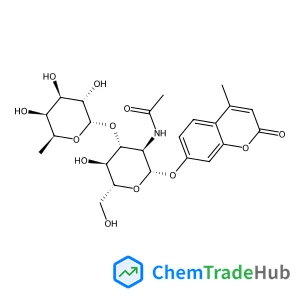
4-Methyl-2-oxo-2H-chromen-7-yl 2-acetamido-2-deoxy-3-O-(6-deoxy-alpha-L-galactopyranosyl)-beta-D-glucopyranoside
CAS Number:
383160-12-1
Molecular Formula:
C24H31NO12
Recommended Suppliers




Disclaimer
This page provides academic journal information for reference and research purposes only. We are not affiliated with any journal publishers and do not handle publication submissions. For publication-related inquiries, please contact the respective journal publishers directly.
If you notice any inaccuracies in the information displayed, please contact us at support@chemtradehub.com. We will promptly review and address your concerns.