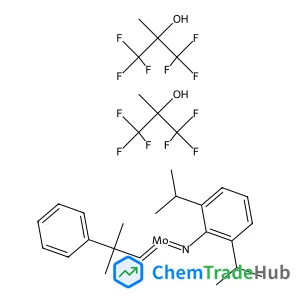
2,6-Diisopropylphenylimidoneophylidene molybdenum(VI) bis(hexafluoro-t-butoxide)
CAS Number:
139220-25-0
Molecular Formula:
C30H37F12MoNO2
Xiao Ma, Jipeng Li, Chensheng Lin, Guoliang Chai, Yangbin Xie, Wei Huang, Dayu Wu, Wai-Yeung Wong
Organic mechanochromic luminescent (ML) materials have attracted extensive interest due to their potential uses in displays, sensing, bioimaging and data storage. ML materials that distinctively respond to different mechanical stimuli are especially fascinating. A simple pyridinium-based white-light emitter (P1-PF6) exhibiting this sort of ML with room-temperature fluorescence–phosphorescence dual emission (rFPDE) was found to possess a 3.66% quantum yield. Interestingly, mechanical grinding induced phosphorescence disappearance owing to a collapse of the crystalline ordering. Grinding followed by adding a drop of ethanol resulted in an extraordinary tricolor emission switching between white, blue and pinkish orange. More interestingly, mechanical pressing induced phosphorescence enhancement, resulting in the emission color changing from white to pinkish orange. This novel phenomenon may be due to the fact that pressure facilitates a closer arrangement between adjacent molecules, thereby enhancing the intermolecular interactions. In sum, a very scarce example is herein reported. Moreover, because the pure organic pyridinium with rFPDE achieves reversible two-channel ML over a wide wavelength range, this material has potential applications in multi-dimensional sensors.

Proceedings of the National Academy of Sciences of the United States of America

Science Progress

Russian Chemical Reviews

Journal of Physics and Chemistry of Solids

Organic Preparations and Procedures International

Journal of Heterocyclic Chemistry

Planta Medica

Helvetica Chimica Acta

Journal of Organometallic Chemistry

Fibre Chemistry
Yikun Zhu, Zheng Wei, Marina A. Petrukhina, Harry L. Anderson
DOI: 10.1039/D3SC04251K
Jacqueline R. Santhouse, Jeremy M. G. Leung, Lillian T. Chong, W. Seth Horne
DOI: 10.1039/D3SC03976E
Kang-Jie Bian, David Nemoto, Jr, Xiao-Wei Chen, Shih-Chieh Kao, James Hooson, Julian G. West
DOI: 10.1039/D3SC05231A
Yeongseo An, Sayak Banerjee
DOI: 10.1039/D3SC02913A
Ilia B. Moroz, Yishay Feldman, Raanan Carmieli, Xinyu Liu, Michal Leskes
DOI: 10.1039/D3SC03456A
Ana Alcalde-Ordóñez, Natalia Barreiro-Piñeiro, Bríonna McGorman, Jacobo Gómez-González, David Bouzada, Francisco Rivadulla, M. Eugenio Vázquez, Andrew Kellett, José Martínez-Costas, Miguel Vázquez López
DOI: 10.1039/D3SC03303A
Jing Cao, Joshua L. Zhu, Karl A. Scheidt
DOI: 10.1039/D3SC05162E
Maria Chiara Storer, Katarzyna J. Zator, Derek P. Reynolds, Christopher A. Hunter
DOI: 10.1039/D3SC05690B
Tuan D. Samdin, Chelsea R. Jones, Gretchen Guaglianone, Adam G. Kreutzer, J. Alfredo Freites, Michał Wierzbicki
DOI: 10.1039/D3SC05185D
3-(2-Bromoimidazo[2,1-b]thiazol-6-yl)propanoic acid hydrochloride is typically s...
2-Isopropyl-1,3-dioxane-5-carboxylic acid is typically synthesized by the carbox...
Alisporivir (CAS: 254435-95-5) is an antiviral medication used in the treatment ...
[1,2,4]triazolo[3,4-a]phthalazine (CAS: 234-80-0) is a crystalline compound with...
Regulatory guidelines for (2S)-5-Hydroxy-2-(4-hydroxyphenyl)-4-oxo-3,4-dihydro-2...
2,2-Difluorocyclohexanamine hydrochloride is generally safe when handled under p...
3-Nitro-2-phenylthiophene is primarily used in the synthesis of other organic co...
1-(Trifluoroacetyl)-4-piperidinecarbonitrile (CAS: 77940-79-5) is a colorless to...
Research and market trends for 1,3,6,8-Tetranitro-9H-carbazole (CAS: 4543-33-3) ...
Waste containing Dibenzo[b,d]thiophen-1-ylboronic acid (CAS: 1245943-60-5) shoul...

Physical Chemistry Chemical Physics (PCCP) is an international journal co-owned by 19 physical chemistry and physics societies from around the world. This journal publishes original, cutting-edge research in physical chemistry, chemical physics and biophysical chemistry. To be suitable for publication in PCCP, articles must include significant innovation and/or insight into physical chemistry; this is the most important criterion that reviewers and Editors will judge against when evaluating submissions. The journal has a broad scope and welcomes contributions spanning experiment, theory, computation and data science. Topical coverage includes spectroscopy, dynamics, kinetics, statistical mechanics, thermodynamics, electrochemistry, catalysis, surface science, quantum mechanics, quantum computing and machine learning. Interdisciplinary research areas such as polymers and soft matter, materials, nanoscience, energy, surfaces/interfaces, and biophysical chemistry are welcomed if they demonstrate significant innovation and/or insight into physical chemistry. Joined experimental/theoretical studies are particularly appreciated when complementary and based on up-to-date approaches.