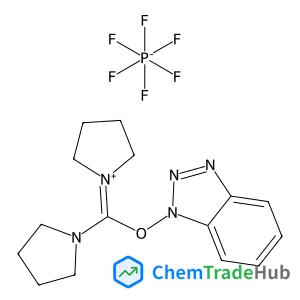
(1H-Benzotriazol-1-yloxy)(di-1-pyrrolidinyl)methylium hexafluorophosphate
CAS Number:
105379-24-6
Molecular Formula:
C15H21F6N5OP
Jing Cao, Joshua L. Zhu, Karl A. Scheidt
Ketones are ubiquitous motifs in the realm of pharmaceuticals and natural products. Traditional approaches to accessing these species involve the addition of metal reagents to carboxyl compounds under harsh conditions. Herein, we report a cerium-catalyzed acylation of unactivated C(sp3)–H bonds using bench-stable acyl azolium reagents under mild and operationally-friendly conditions. This reaction exhibits excellent generality, accommodating a wide range of feedstock chemicals such as cycloalkanes and acyclic compounds as well as facilitating the late-stage functionalization of pharmaceuticals. We demonstrate further applications of our strategy with a three-component radical relay reaction and an enantioselective N-heterocyclic carbene (NHC) and cerium dual-catalyzed reaction.

Journal of Heterocyclic Chemistry

Russian Chemical Reviews

European Journal of Wood and Wood Products

Proceedings of the National Academy of Sciences of the United States of America

Journal of Physics and Chemistry of Solids

Science

Pharmacological Reviews

Nature

Helvetica Chimica Acta

Molecular Pharmacology
P. Jasik, J. Kozicki, T. Kilich, J. E. Sienkiewicz, N. E. Henriksen
DOI: 10.1039/C8CP02551G
Hengxin Tan, Yuanchang Li
DOI: 10.1039/C8CP00990B
Xuewen Zhang, Chunjun Liang, Mengjie Sun, Huimin Zhang, Chao Ji, Zebang Guo, Yajun Xu, Fulin Sun, Qi Song, Zhiqun He
DOI: 10.1039/C8CP91812K
Yin Zhang, Jieqiong Wang, Xiaoqin Ke, Fanghua Tian, Chao Zhou, Sen Yang, Minxia Fang, Kaiyan Cao, Yu-Sheng Chen, Zhanbo Sun, Wen Guan, Xiaoping Song, Xiaobin Ren
DOI: 10.1039/C8CP02720J
Chaitanya V. Mungi, Sachin Kumar Singh, Sudha Rajamani
DOI: 10.1039/C8CP91818J
Pilar Herrasti
DOI: 10.1039/C8CP02513D
Graham C. Smith, Kathryn A. Whitehead
DOI: 10.1039/C8CP02196A
Sehee Na, Sascha Jurkovic, Thorsten Friedrich, Thorsten Koslowski
DOI: 10.1039/C8CP02420K
DOI: 10.1039/C8CP05106B
H. Fabio Busnengo
DOI: 10.1039/C8CP03515F
When handling 4-(2-Furylmethyl)thiomorpholine 1,1-dioxide (CAS: 79206-94-3), it ...
When handling 4-Chloro-N-[2-(4-morpholinyl)ethyl]benzamide (CAS: 71320-77-9), it...
Waste containing this compound (CAS: 62921-74-8) should be handled according to ...
Waste containing (S)-Methyl 2-amino-3-cyclohexylpropanoate should be collected i...
This compound can be synthesized using a multi-step process involving the conjug...
There are several alternatives to (2E)-3-(3,4-Dichlorophenyl)acrylic acid in syn...
Ethyl 6-(2-nitrophenyl)imidazo[2,1-b][1,3]thiazole-3-carboxylate (CAS: 925437-84...
Waste containing 2-(1,3-Thiazol-2-yl)ethanamine (CAS: 18453-07-1) should be coll...
Methyl 5-iodo-2-methylbenzoate can be synthesized through the iodination of meth...
5-Chloro[1,2,4]triazolo[1,5-a]pyridine is commonly synthesized via the condensat...

Our journal has a wide-ranging scope which covers the full breadth of the chemical sciences. The research we publish contains the sorts of novel ideas, challenging questions and progressive thinking that bring undiscovered breakthroughs within reach. Your paper could focus on a single area, or cross many. It could be beyond the accepted bounds of the chemical sciences. It might address an immediate challenge, contribute to a future breakthrough or be wholly conceptual. We’re a team from every field of the chemical sciences, and know from experience that breakthroughs that drive the solutions to global challenges can come from anywhere, at any time. You could even start an entirely new area of research. Too bold? Too progressive? No such thing