












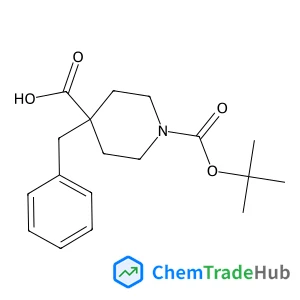
4-Benzyl-1-(tert-butoxycarbonyl)piperidine-4-carboxylic acid
CAS Number:
170838-87-6
Molecular Formula:
C18H25NO4
Yikun Zhu, Zheng Wei, Marina A. Petrukhina, Harry L. Anderson
[24]Paracyclophanetetraene is a classic example of a macrocyclic hydrocarbon that becomes globally aromatic on reduction to the di-anion, and switches to globally anti-aromatic in the tetra-anion. This redox activity makes it promising as an electrode material for batteries. Here, we report the solid-state structures of the di- and tetra-anions of this cyclophane, in several coordination environments. The changes in bond length on reduction yield insights into the global aromaticity of the di-anion (26π electrons), and anti-aromaticity of the tetra-anion (28π electrons), that were previously deduced from NMR spectra of species generated in situ. The experimental geometries of the aromatic di-anion and anti-aromatic tetra-anion from X-ray crystallographic data match well with gas-phase calculated structures, and reproduce the low symmetry expected in the anti-aromatic ring. Comparison of coordinated and naked anions confirms that metal coordination has little effect on the bond lengths. The UV-vis-NIR absorption spectra show a sharp intense peak at 878 nm for the di-anion, whereas the tetra-anion gives a broad spectrum typical of an anti-aromatic system.
Aya Tanaka, Yasutaka Matsuo, Yuichi Hashimoto, Kuniharu Ijiro
DOI: 10.1039/B805989F
Tingyang Dai, Xiujuan Jiang, Shouhu Hua, Xiaoshu Wang, Yun Lu
DOI: 10.1039/B807116K
Wei Zhao, Qin Tang, Hoi Shan Chan, Jianbin Xu, Ka Yuen Lo, Qian Miao
DOI: 10.1039/B806601A
Yangping Liu, Jay L. Zweier
DOI: 10.1039/B807406B
Anat Levin, Ilan Marek
DOI: 10.1039/B807635A
Junhong Qian, Xuhong Qian, Yufang Xu, Shenyi Zhang
DOI: 10.1039/B805876H
Henri Rudler, Andrée Parlier, Louis Hamon, Patrick Herson, Jean-Claude Daran
DOI: 10.1039/B807092J
Todd W. Hudnall, François P. Gabbaï
DOI: 10.1039/B808740G
Ming Wang, Deqing Zhang, Guanxin Zhang, Daoben Zhu
DOI: 10.1039/B808877B
Stuart T. Caldwell, Graeme Cooke, Shanika G. Hewage, Suhil Mabruk, Gouher Rabani, Vincent Rotello, Brian O. Smith, Chandramouleeswaran Subramani, Patrice Woisel
DOI: 10.1039/B809762C
When handling 4-(2-Furylmethyl)thiomorpholine 1,1-dioxide (CAS: 79206-94-3), it ...
When handling 4-Chloro-N-[2-(4-morpholinyl)ethyl]benzamide (CAS: 71320-77-9), it...
Waste containing this compound (CAS: 62921-74-8) should be handled according to ...
Waste containing (S)-Methyl 2-amino-3-cyclohexylpropanoate should be collected i...
This compound can be synthesized using a multi-step process involving the conjug...
There are several alternatives to (2E)-3-(3,4-Dichlorophenyl)acrylic acid in syn...
Ethyl 6-(2-nitrophenyl)imidazo[2,1-b][1,3]thiazole-3-carboxylate (CAS: 925437-84...
Waste containing 2-(1,3-Thiazol-2-yl)ethanamine (CAS: 18453-07-1) should be coll...
Methyl 5-iodo-2-methylbenzoate can be synthesized through the iodination of meth...
5-Chloro[1,2,4]triazolo[1,5-a]pyridine is commonly synthesized via the condensat...
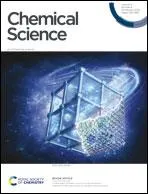
Our journal has a wide-ranging scope which covers the full breadth of the chemical sciences. The research we publish contains the sorts of novel ideas, challenging questions and progressive thinking that bring undiscovered breakthroughs within reach. Your paper could focus on a single area, or cross many. It could be beyond the accepted bounds of the chemical sciences. It might address an immediate challenge, contribute to a future breakthrough or be wholly conceptual. We’re a team from every field of the chemical sciences, and know from experience that breakthroughs that drive the solutions to global challenges can come from anywhere, at any time. You could even start an entirely new area of research. Too bold? Too progressive? No such thing
![Pyrazolo[1,5-a]pyridine-3-carbothioamide structure](https://static.chemtradehub.com/structs/885/885275-44-5-aae0.webp "Pyrazolo[1,5-a]pyridine-3-carbothioamide structure")
![1-[3-(4-Morpholinylsulfonyl)phenyl]methanamine structure](https://static.chemtradehub.com/structs/933/933989-32-3-51af.webp "1-[3-(4-Morpholinylsulfonyl)phenyl]methanamine structure")
![tert-Butyl N-[(2-chloropyridin-4-yl)methyl]carbamate structure](https://static.chemtradehub.com/structs/916/916210-27-0-9f95.webp "tert-Butyl N-[(2-chloropyridin-4-yl)methyl]carbamate structure")



