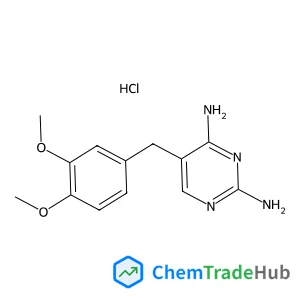
5-(3,4-Dimethoxybenzyl)-2,4-pyrimidinediamine hydrochloride (1:1)
CAS Number:
2507-23-5
Molecular Formula:
C13H17ClN4O2
Jye-Shane Yang, Guan-Jhih Huang, Yi-Hung Liu, Shie-Ming Peng
The Z → Ephotoisomerization and fluorescence quantum yields for the wild-type green fluorescence protein (GFP) chromophore (p-HBDI) and its meta- and para-amino analogues (m-ABDI and p-ABDI) in aprotic solvents (hexane, THF, and acetonitrile) and protic solvents (methanol and 10–20% H2O in THF) are reported. The dramatic decrease in the quantum yields on going from aprotic to protic solvents indicates the important role of solvent–solute hydrogen bonding in the nonradiative decay pathways. The enhanced fluorescence of m-ABDI is also discussed.

Pure and Applied Chemistry

Journal of Physics and Chemistry of Solids

Russian Chemical Reviews

Molecular Pharmacology

Pharmacological Reviews

Israel Journal of Chemistry

Nature

Planta Medica

Proceedings of the National Academy of Sciences of the United States of America

European Journal of Wood and Wood Products
Jian Jiang, Mark J. MacLachlan
DOI: 10.1039/B914564H
Mikiko Sodeoka, Yoshitaka Hamashima
DOI: 10.1039/B911015A
Leo Merz, Tobias Bauert, Manfred Parschau, Georg Koller, Jay S. Siegel
DOI: 10.1039/B911056A
Ian J. S. Fairlamb, Amanda G. Jarvis, Adam F. Lee, Christian Müller, John M. Slattery, Robert J. Thatcher, Dieter Vogt, Adrian C. Whitwood
DOI: 10.1039/B906823F
David H. Webber, Richard L. Brutchey
DOI: 10.1039/B912434A
Nicole S. Zacharia, Zaheen S. Sadeq, Geoffrey A. Ozin
DOI: 10.1039/B911561G
Honglin Li, Jiangli Fan, Jingyun Wang, Maozhong Tian, Jianjun Du, Shiguo Sun, Pingping Sun, Xiaojun Peng
DOI: 10.1039/B907511A
Xin-Ming Xu, Ming Xie, Jiazhu Li, Mei-Xiang Wang
DOI: 10.1039/D0QO01147A
Ling-Guo Meng, Bin Hu, Quan-Ping Wu, Mao Liang, Song Xue
DOI: 10.1039/B909279J
When considering alternatives to 1-(4-Chlorophenyl)-N-hydroxymethanimine (CAS: 3...
This compound should be stored in a cool, dry place away from direct sunlight. I...
3-(4-Bromophenyl)-5-(2-fluorophenyl)-1,2,4-oxadiazole is synthesized through a m...
5-Chloro-2-(4-chlorophenyl)-4-methyl-6-[3-(1-piperidinyl)propoxy]pyrimidine (CAS...
2-Chloro-4-(difluoromethoxy)pyridine is used in the pharmaceutical industry for ...
3-Chloro-6-methylpyridazine (CAS: 1121-79-5) is classified under the Globally Ha...
Several alternatives can be used in the synthesis of Methyl 4,5-dimethyl-2-nitro...
Alternatives to (2E,2'E)-3,3'-(1,4-Phenylene)bisacrylaldehyde include other acry...
3-Amino-5-chloropyridin-2-ol hydrochloride is an organic compound with the CAS n...
When handling 6,7-Difluoro-2,3-dihydro-4H-chromen-4-one, it is essential to wear...

ChemComm publishes urgent research which is of outstanding significance and interest to experts in the field, while also appealing to the journal’s broad chemistry readership. Our communication format is ideally suited to short, urgent studies that are of such importance that they require accelerated publication. Our scope covers all topics in chemistry, and research at the interface of chemistry and other disciplines (such as materials science, nanoscience, physics, engineering and biology) where there is a significant novelty in the chemistry aspects. Major topic areas covered include: Analytical Chemistry Catalysis Chemical Biology and medicinal chemistry Computational Chemistry and Machine Learning Energy and sustainable chemistry Environmental Chemistry Green Chemistry Inorganic Chemistry Materials Chemistry Nanoscience Organic Chemistry Physical Chemistry Polymer Chemistry Supramolecular Chemistry
![2-{[(1R,2S)-2-Aminocyclohexyl]amino}-4-{[3-(2H-1,2,3-triazol-2-yl)phenyl]amino}-5-pyrimidinecarboxamide structure](https://static.chemtradehub.com/structs/137/1370261-96-3-40df.webp "2-{[(1R,2S)-2-Aminocyclohexyl]amino}-4-{[3-(2H-1,2,3-triazol-2-yl)phenyl]amino}-5-pyrimidinecarboxamide structure")