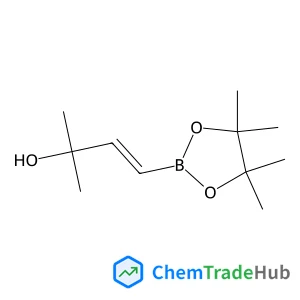
(E)-2-methyl-4-(4,4,5,5-tetramethyl-1,3,2-dioxaborolan-2-yl)but-3-en-2-ol
CAS Number:
581802-26-8
Molecular Formula:
C11H21BO3
Philippe C. Gros, Abdelatif Doudouh, Christopher Woltermann
A TMSCH2Li-based reagent promoted the first C-3 lithiation of DMAP opening a direct access to functional diversity in acylation catalysts.
David Curiel, Miriam Más-Montoya, Guzmán Sánchez, Raúl A. Orenes, Pedro Molina, Alberto Tárraga
DOI: 10.1039/C0OB00522C
Jan Spielmann, Michael Bolte, Sjoerd Harder
DOI: 10.1039/B914979A
James Garner, Katrina A. Jolliffe, Margaret M. Harding, Richard J. Payne
DOI: 10.1039/B918021D
Q. W. Jiang, G. R. Li, X. P. Gao
DOI: 10.1039/B912776C
Gerhard Bringmann, Tobias A. M. Gulder, Andreas Hamm, Michael Goodfellow, Hans-Peter Fiedler
DOI: 10.1039/B910501H
Fosca Conti, Enrico Negro, Vito Di Noto
DOI: 10.1039/B913870F
Min Li, Sergio L. De Rooy, David K. Bwambok, Bilal El-Zahab, John F. DiTusa, Isiah M. Warner
DOI: 10.1039/B917683G
Mike P. Williamson, Jim A Thomas
DOI: 10.1039/B924263E
Thelma Y. Garcia, James C. Fettinger, Marilyn M. Olmstead, Alan L. Balch
DOI: 10.1039/B915083H
Ondřej Páv, Ivana Košiová, Ivan Barvík, Radek Pohl, Miloš Buděšínský, Ivan Rosenberg
DOI: 10.1039/C1OB05488K
(1R,3S)-1,3-Cyclopentanediol finds applications in various industries. In the ph...
When handling N'-[4-(Dimethylamino)phenyl]-N,N-dimethyl-1,4-benzenediamine, it i...
There are several alternatives to 5-(2,4-Difluorophenyl)-2-methoxypyrimidine in ...
1-(3-Methoxyphenoxy)propan-2-ol (CAS: 382141-68-6) must comply with the Globally...
Tetrodotoxin Citrate is extremely dangerous and should be handled with extreme c...
2-Methyl-2-propanyl [(1R,3S)-3-hydroxycyclopentyl]carbamate (CAS: 225641-84-9) i...
Waste containing 4-(2-Hydroxyhexafluoroisopropyl)Benzoic Acid (CAS: 16261-80-6) ...
2-Methyl-2-proanyl {(2S)-1-[(benzyloxy)amino]-3-hydroxy-3-methyl-1-oxo-2-butanyl...
Benzeneethanamine, α-ethyl-, hydrochloride (1:1) is an organic compound with the...
In the synthesis of compounds similar to 3-{(E)-[4-(Dimethylamino)phenyl]diazeny...

ChemComm publishes urgent research which is of outstanding significance and interest to experts in the field, while also appealing to the journal’s broad chemistry readership. Our communication format is ideally suited to short, urgent studies that are of such importance that they require accelerated publication. Our scope covers all topics in chemistry, and research at the interface of chemistry and other disciplines (such as materials science, nanoscience, physics, engineering and biology) where there is a significant novelty in the chemistry aspects. Major topic areas covered include: Analytical Chemistry Catalysis Chemical Biology and medicinal chemistry Computational Chemistry and Machine Learning Energy and sustainable chemistry Environmental Chemistry Green Chemistry Inorganic Chemistry Materials Chemistry Nanoscience Organic Chemistry Physical Chemistry Polymer Chemistry Supramolecular Chemistry