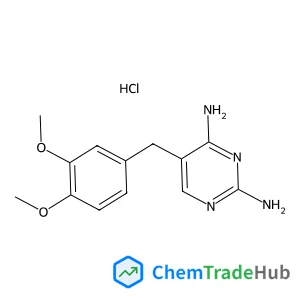
5-(3,4-Dimethoxybenzyl)-2,4-pyrimidinediamine hydrochloride (1:1)
CAS Number:
2507-23-5
Molecular Formula:
C13H17ClN4O2
Qi Zeng, Ping Cai, Zhen Li, Jingui Qin, Ben Zhong Tang
A new light-emitting polyacetylene bearing imidazole moieties in the side chain (P1), was conveniently prepared through a postfunctionalization strategy, as a sensory polymer to selectively report the presence of Cu2+ (with a detection limit of 1.48 ppm) based on the fluorescence “turn-off”. Interestingly, the quenched luminescence of P1 by Cu2+ could be turned on after the addition of CN−, making P1 a novel, sensitive, and selective cyanide probe.
Cai-Feng Wang, Dong-Ping Li, Xin Chen, Xiao-Ming Li, Yi-Zhi Li, Jing-Lin Zuo, Xiao-Zeng You
DOI: 10.1039/B916637H
Su-Mei Li, Liang Wu, Yong-Li Li, Lin Feng, Yun-Heng Shen, Jun-Mian Tian, Jian Tang, Ning Wang, Yonghong Liu, Wei-Dong Zhang
DOI: 10.1039/C001885F
Carine Diebold, Stéphane Schweizer, Jean-Michel Becht, Claude Le Drian
DOI: 10.1039/C0OB00523A
Kazuhito Tanabe, Eiji Matsumoto, Takeo Ito, Sei-ichi Nishimoto
DOI: 10.1039/C0OB00275E
Luis R. Domingo, Ramón J. Zaragozá, Manuel Arnó
DOI: 10.1039/C0OB00088D
Nicole Cathcart, Andrew J. Frank, Vladimir Kitaev
DOI: 10.1039/B916902D
Marco Bieri, Matthias Treier, Jinming Cai, Kamel Aït-Mansour, Pascal Ruffieux, Oliver Gröning, Pierangelo Gröning, Marcel Kastler, Ralph Rieger, Xinliang Feng, Klaus Müllen
DOI: 10.1039/B915190G
Burki Rajendar, Arivazhagan Rajendran, Zhiqiang Ye, Eriko Kanai, Yusuke Sato, Marek Sikorski
DOI: 10.1039/C0OB00057D
Alma R. Morales, Gheorghe Luchita, Ciceron O. Yanez, Mykhailo V. Bondar, Olga V. Przhonska
DOI: 10.1039/B925934A
James Garner, Katrina A. Jolliffe, Margaret M. Harding, Richard J. Payne
DOI: 10.1039/B918021D
(1R,3S)-1,3-Cyclopentanediol finds applications in various industries. In the ph...
When handling N'-[4-(Dimethylamino)phenyl]-N,N-dimethyl-1,4-benzenediamine, it i...
There are several alternatives to 5-(2,4-Difluorophenyl)-2-methoxypyrimidine in ...
1-(3-Methoxyphenoxy)propan-2-ol (CAS: 382141-68-6) must comply with the Globally...
Tetrodotoxin Citrate is extremely dangerous and should be handled with extreme c...
2-Methyl-2-propanyl [(1R,3S)-3-hydroxycyclopentyl]carbamate (CAS: 225641-84-9) i...
Waste containing 4-(2-Hydroxyhexafluoroisopropyl)Benzoic Acid (CAS: 16261-80-6) ...
2-Methyl-2-proanyl {(2S)-1-[(benzyloxy)amino]-3-hydroxy-3-methyl-1-oxo-2-butanyl...
Benzeneethanamine, α-ethyl-, hydrochloride (1:1) is an organic compound with the...
In the synthesis of compounds similar to 3-{(E)-[4-(Dimethylamino)phenyl]diazeny...

ChemComm publishes urgent research which is of outstanding significance and interest to experts in the field, while also appealing to the journal’s broad chemistry readership. Our communication format is ideally suited to short, urgent studies that are of such importance that they require accelerated publication. Our scope covers all topics in chemistry, and research at the interface of chemistry and other disciplines (such as materials science, nanoscience, physics, engineering and biology) where there is a significant novelty in the chemistry aspects. Major topic areas covered include: Analytical Chemistry Catalysis Chemical Biology and medicinal chemistry Computational Chemistry and Machine Learning Energy and sustainable chemistry Environmental Chemistry Green Chemistry Inorganic Chemistry Materials Chemistry Nanoscience Organic Chemistry Physical Chemistry Polymer Chemistry Supramolecular Chemistry
![(2S)-2-{[(9H-Fluoren-9-ylmethoxy)carbonyl]amino}-4-(methylselanyl)butanoic acid structure](https://static.chemtradehub.com/structs/121/1217852-49-7-f252.webp "(2S)-2-{[(9H-Fluoren-9-ylmethoxy)carbonyl]amino}-4-(methylselanyl)butanoic acid structure")