











An ultrasensitive and simple assay for the Hepatitis C virus using a reduced graphene oxide-assisted hybridization chain reaction
Literature Information
Publication Date
2019-05-16
DOI
10.1039/C9AN00179D
Impact Factor
4.616
Authors
Jialong Fan, Liqun Yuan, Qingxin Liu, Chunyi Tong, Wenmiao Wang, Feng Xiao, Bin Liu, Xuanming Liu
View Original
Abstract
Hepatitis C virus (HCV) is a major cause of chronic liver disease, which affects 2–3% of the world population. Until now, the early detection of HCV has been a great challenge, especially for those who live in developing countries. In this study, we developed a novel and ultrasensitive assay for the detection of HCV RNA based on the reduced graphene oxide nanosheets (rGONS) and hybridization chain reaction (HCR) amplification technique. This detection system contains a pair of single fluorophore-labeled hairpin probes that can freely exist in the solution in the absence of target RNA. The introduction of target RNA can robustly trigger a HCR with the two probes and produce long nanowires containing a double-stranded structure. The weak adsorption to rGONS makes the long nanowires emit a strong fluorescence. Using this enzyme-free amplification strategy, we developed a new method for the HCV RNA assay with a detection limit of 10 fM, which is far more sensitive than the common GO-based fluorescence method. Furthermore, the new method exhibits high selectivity for the discrimination of perfectly complementary and mismatched sequences. Finally, the new method was successfully used as a HCV RNA assay in biological samples with a strong anti-interference capability in complicated environments. In summary, these remarkable characteristics of the new method highlight its potential use in a clinical sample primary screening.
Related Literature
Direct synthesis of oxazolines from olefins and amides using t-BuOI
Satoshi Minakata, Yoshinobu Morino, Toshihiro Ide, Yoji Oderaotoshi, Mitsuo Komatsu
2007-06-07
Communication
DOI: 10.1039/B706572H
Large-diameter self-assembled dimers of α,γ-cyclic peptides, with the nanotubular solid-state structure of cyclo-[(l-Leu-d-MeN-γ-Acp)4-]·4CHCl2COOH
Roberto J. Brea, Luis Castedo, Juan R. Granja
2007-06-07
Communication
DOI: 10.1039/B703659K
Enantioselective rhodium-catalysed 1,4-additions of 2-heteroarylzinc donors using Me-DUPHOS
Jérôme Le Nôtre, Joseph C. Allen, Christopher G. Frost
2008-06-23
Communication
DOI: 10.1039/B806098C
Towards ‘bio-based’ Nylon: conversion of γ-valerolactone to methyl pentenoate under catalytic distillation conditions
Jean-Paul Lange, Jan Z. Vestering, René J. Haan
2007-06-15
Communication
DOI: 10.1039/B705782B
Ionic dimeric pyrogallol[4]arene capsules
Scott J. Dalgarno, Nicholas P. Power, Jerry L. Atwood
2007-07-26
Communication
DOI: 10.1039/B707009H
X-Shaped polyphilics: liquid crystal honeycombs with single-molecule walls
Robert Kieffer, Benjamin Glettner, Karsten Pelz, Ute Baumeister, Feng Liu, Xiangbing Zeng, Goran Ungar, Carsten Tschierske
2008-05-20
Communication
DOI: 10.1039/B804945A
Construction and micellization of a noncovalent double hydrophilic block copolymer
Jianguo Zeng, Keyu Shi, Yuying Zhang, Xuehui Sun, Baolong Zhang
2008-07-21
Communication
DOI: 10.1039/B806858E
Important news for authors of articles containing X-ray crystallography
2007-07-18
Editorial
DOI: 10.1039/B709949P
Direct generation of hydrogen peroxide from formic acid and O2 using heterogeneous Pd/γ-Al2O3catalysts
Mohammad S. Yalfani, Sandra Contreras, Francesc Medina, Jesus Sueiras
2008-06-27
Communication
DOI: 10.1039/B803149E
Highly efficient construction of large molecular cavity using 1,3-alternate tetraoxacalix[2]arene[2]triazine as a platform
Bao-Yong Hou, Qi-Yu Zheng, De-Xian Wang, Zhi-Tang Huang, Mei-Xiang Wang
2008-06-23
Communication
DOI: 10.1039/B805293J
You might also like
Compound Q&A
How should waste containing (6-Bromo-2-naphthyl)oxy](dimethyl)(2-methyl-2-propanyl)silane be handled?
Waste containing (6-Bromo-2-naphthyl)oxy](dimethyl)(2-methyl-2-propanyl)silane (...
100751-65-3[(6-Bromo-2-naphthyl...
Compound Q&A
How is 7-Fluoro-4-isoquinolinecarboxylic acid (CAS: 1841081-40-0) typically synthesized?
7-Fluoro-4-isoquinolinecarboxylic acid can be synthesized via a multi-step proce...
1841081-40-07-Fluoro-4-isoquinol...
Compound Q&A
What are the physical and chemical properties of 2,3,5,6-Tetrabromothieno[3,2-b]thiophene (CAS: 124638-53-5)?
2,3,5,6-Tetrabromothieno[3,2-b]thiophene is a crystalline compound with a high m...
124638-53-52,3,5,6-Tetrabromoth...
Compound Q&A
Is 1-[4-(Benzylamino)-7,8-dihydro-5H-pyrano[4,3-d]pyrimidin-2-yl]-2-methyl-1H-indole-4-carboxamide (CAS: 1542705-92-9) safe?
1-[4-(Benzylamino)-7,8-dihydro-5H-pyrano[4,3-d]pyrimidin-2-yl]-2-methyl-1H-indol...
1542705-92-91-[4-(Benzylamino)-7...
Compound Q&A
What is the market or research trend for imidazo[5,1-d]-1,2,3,5-tetrazine-8-carboxylic acid, 3,4-dihydro-3-methyl-4-oxo- (CAS: 113942-30-6)?
The market for imidazo[5,1-d]-1,2,3,5-tetrazine-8-carboxylic acid, 3,4-dihydro-3...
113942-30-6Imidazo[5,1-d]-1,2,3...
Compound Q&A
What is 3-(Triisopropylsilyl)propiolaldehyde (CAS: 163271-80-5)?
3-(Triisopropylsilyl)propiolaldehyde is a synthetic organic compound with the CA...
163271-80-53-(Triisopropylsilyl...
Compound Q&A
What regulatory guidelines apply to 6-Nitro-2H-1,4-benzoxazin-3(4H)-one (CAS: 81721-87-1)?
6-Nitro-2H-1,4-benzoxazin-3(4H)-one (CAS: 81721-87-1) is subject to various regu...
81721-87-16-Nitro-2H-1,4-benzo...
Compound Q&A
How should waste containing (3-Fluorophenyl)(4-{[(2-methyl-2-propanyl)oxy]carbonyl}-1-piperazinyl)acetic acid (CAS: 885272-91-3) be handled?
Waste containing (3-Fluorophenyl)(4-{[(2-methyl-2-propanyl)oxy]carbonyl}-1-piper...
885272-91-3(3-Fluorophenyl)(4-{...
Compound Q&A
What are the physical and chemical properties of N,N'-4,4'-Biphenyldiyldiisonicotinamide (CAS: 55119-40-9)?
N,N'-4,4'-Biphenyldiyldiisonicotinamide is a white crystalline solid with a mole...
55119-40-9N,N'-4,4'-Biphenyldi...
Compound Q&A
What industries use 6-Bromo-8-fluoro-2-quinazolinol (CAS: 1036756-15-6)?
6-Bromo-8-fluoro-2-quinazolinol is primarily used in the pharmaceutical industry...
1036756-15-66-Bromo-8-fluoro-2-q...
Source Journal
Analyst

CiteScore:
7.8
Self-citation Rate:
5.6%
Articles per Year:
653
Analyst publishes analytical and bioanalytical research that reports premier fundamental discoveries and inventions, and the applications of those discoveries, unconfined by traditional discipline barriers.
Recommended Compounds
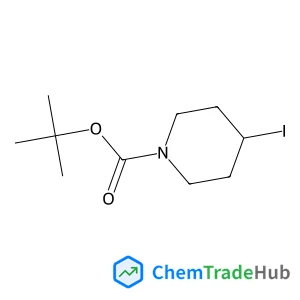
2-Methyl-2-propanyl 4-iodo-1-piperidinecarboxylate
CAS Number:
301673-14-3
Molecular Formula:
C10H18INO2
Recommended Suppliers






Disclaimer
This page provides academic journal information for reference and research purposes only. We are not affiliated with any journal publishers and do not handle publication submissions. For publication-related inquiries, please contact the respective journal publishers directly.
If you notice any inaccuracies in the information displayed, please contact us at support@chemtradehub.com. We will promptly review and address your concerns.