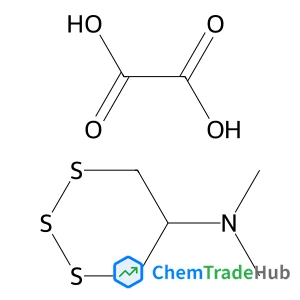
Oxalic acid compound with cyclohexylsulfamothioic O-acid (11)
CAS Number:
31895-22-4
Molecular Formula:
C7H13NO4S3
Mohammad S. Yalfani, Sandra Contreras, Francesc Medina, Jesus Sueiras
Hydrogen peroxide formation is achieved with remarkable productivity at ambient conditions (25 °C and atmospheric pressure) in aqueous medium using a heterogeneous catalytic system; formic acid is decomposed in the presence of a continuous flow of O2 over Pd/γ-Al2O3catalyst leading to the generation of hydrogen peroxide; the addition of a negligible amount of bromide ion improves the selectivity of the reaction.
Jinfan Wu, Tao Wang, Fen Xu, Lixian Sun, Yuan Gao, Hehui Wang, Guorong Zhang, Zhong Cao, Julan Zeng
DOI: 10.1039/D3SE01162C
Mohamed Ben Bechir, Faisal Alresheedi
DOI: 10.1039/D3CP04645A
Umair Shamraiz, Abdul Majeed, Bareera Raza, Noor ul Ain, Amin Badshah
DOI: 10.1039/D3SE00942D
Jing Xie, Dongni Wu, Yangfang Liao, Xiaolong Cao, Shiyou Zhou
DOI: 10.1039/D3CP04382G
Naixia Lv, Hongshun Ran, Jinrui Zhang, Jie Yin, Yuan Zhang, Hongping Li, Linhua Zhu
DOI: 10.1039/D3CP04963A
DOI: 10.1039/D3CP03903J
Hongyan Li, Jiang Xiang, Jing Xu, Wei Liu
DOI: 10.1039/D3CP03902A
Meng Xia, Xinyao Liu, Zhaorong Shang, Fuqiang Fan
DOI: 10.1039/D3CP03879C
When considering alternatives to 1-(4-Chlorophenyl)-N-hydroxymethanimine (CAS: 3...
This compound should be stored in a cool, dry place away from direct sunlight. I...
3-(4-Bromophenyl)-5-(2-fluorophenyl)-1,2,4-oxadiazole is synthesized through a m...
5-Chloro-2-(4-chlorophenyl)-4-methyl-6-[3-(1-piperidinyl)propoxy]pyrimidine (CAS...
2-Chloro-4-(difluoromethoxy)pyridine is used in the pharmaceutical industry for ...
3-Chloro-6-methylpyridazine (CAS: 1121-79-5) is classified under the Globally Ha...
Several alternatives can be used in the synthesis of Methyl 4,5-dimethyl-2-nitro...
Alternatives to (2E,2'E)-3,3'-(1,4-Phenylene)bisacrylaldehyde include other acry...
3-Amino-5-chloropyridin-2-ol hydrochloride is an organic compound with the CAS n...
When handling 6,7-Difluoro-2,3-dihydro-4H-chromen-4-one, it is essential to wear...

ChemComm publishes urgent research which is of outstanding significance and interest to experts in the field, while also appealing to the journal’s broad chemistry readership. Our communication format is ideally suited to short, urgent studies that are of such importance that they require accelerated publication. Our scope covers all topics in chemistry, and research at the interface of chemistry and other disciplines (such as materials science, nanoscience, physics, engineering and biology) where there is a significant novelty in the chemistry aspects. Major topic areas covered include: Analytical Chemistry Catalysis Chemical Biology and medicinal chemistry Computational Chemistry and Machine Learning Energy and sustainable chemistry Environmental Chemistry Green Chemistry Inorganic Chemistry Materials Chemistry Nanoscience Organic Chemistry Physical Chemistry Polymer Chemistry Supramolecular Chemistry