












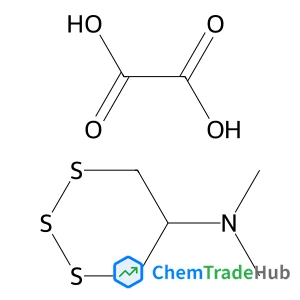
Oxalic acid compound with cyclohexylsulfamothioic O-acid (11)
CAS Number:
31895-22-4
Molecular Formula:
C7H13NO4S3
Jianguo Zeng, Keyu Shi, Yuying Zhang, Xuehui Sun, Baolong Zhang
The first noncovalent double hydrophilic block copolymer was constructed through inclusion complexation between β-cyclodextrin and the adamantyl group; it can further self-assemble into two distinctly different micelles in response to pH and temperature in dilute aqueous solution.
DOI: 10.1039/D3CP03903J
Raquel Yanes-Rodríguez, Rita Prosmiti
DOI: 10.1039/D3CP05410A
Meng Xia, Xinyao Liu, Zhaorong Shang, Fuqiang Fan
DOI: 10.1039/D3CP03879C
Licheng Liu, Deepak Pant
DOI: 10.1039/D3SE00876B
Vikki Anand Varma, Simmie Jaglan, Mohd Yasir Khan, Sujin B. Babu
DOI: 10.1039/D3CP03681B
Ziyu Liu, Baozeng Zhou, Xiaocha Wang, Wenbo Mi
DOI: 10.1039/D3CP05545K
Akira Yamaguchi, Tomoki Kujirai, Takeshi Fujita, Hideki Abe, Masahiro Miyauchi
DOI: 10.1039/D3SE01346D
When considering alternatives to 1-(4-Chlorophenyl)-N-hydroxymethanimine (CAS: 3...
This compound should be stored in a cool, dry place away from direct sunlight. I...
3-(4-Bromophenyl)-5-(2-fluorophenyl)-1,2,4-oxadiazole is synthesized through a m...
5-Chloro-2-(4-chlorophenyl)-4-methyl-6-[3-(1-piperidinyl)propoxy]pyrimidine (CAS...
2-Chloro-4-(difluoromethoxy)pyridine is used in the pharmaceutical industry for ...
3-Chloro-6-methylpyridazine (CAS: 1121-79-5) is classified under the Globally Ha...
Several alternatives can be used in the synthesis of Methyl 4,5-dimethyl-2-nitro...
Alternatives to (2E,2'E)-3,3'-(1,4-Phenylene)bisacrylaldehyde include other acry...
3-Amino-5-chloropyridin-2-ol hydrochloride is an organic compound with the CAS n...
When handling 6,7-Difluoro-2,3-dihydro-4H-chromen-4-one, it is essential to wear...

ChemComm publishes urgent research which is of outstanding significance and interest to experts in the field, while also appealing to the journal’s broad chemistry readership. Our communication format is ideally suited to short, urgent studies that are of such importance that they require accelerated publication. Our scope covers all topics in chemistry, and research at the interface of chemistry and other disciplines (such as materials science, nanoscience, physics, engineering and biology) where there is a significant novelty in the chemistry aspects. Major topic areas covered include: Analytical Chemistry Catalysis Chemical Biology and medicinal chemistry Computational Chemistry and Machine Learning Energy and sustainable chemistry Environmental Chemistry Green Chemistry Inorganic Chemistry Materials Chemistry Nanoscience Organic Chemistry Physical Chemistry Polymer Chemistry Supramolecular Chemistry
![10-(1-Azabicyclo[2.2.2]oct-3-ylmethyl)-10H-phenothiazine structure](https://static.chemtradehub.com/structs/292/29216-28-2-1d81.webp "10-(1-Azabicyclo[2.2.2]oct-3-ylmethyl)-10H-phenothiazine structure")





