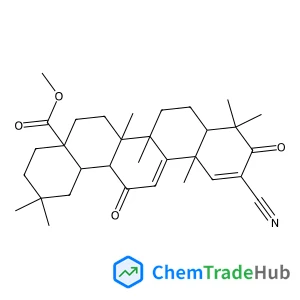
Methyl 2-cyano-3,12-dioxooleana-1,9(11)-dien-28-oate
CAS Number:
218600-53-4
Molecular Formula:
C32H43NO4
Tomoki Nishimura, Naoki Sumi, Yuta Koda, Yoshihiro Sasaki, Kazunari Akiyoshi
Polymer vesicles with molecular permeability offer significant potential to contribute to the understanding of biocatalytic processes in nano/micro compartments and therapeutic enzyme reactors. However, constructing such permeable vesicles remains challenging, as clear guidelines for the design of permeable membranes remain elusive. In the present study we focused on a hydrophobic polymer with hydrogen bond donor and acceptor moieties, i.e., a polymer that exhibits a lower-critical-solution-temperature (LCST)-like behavior, as a suitable component for the permeable bilayer membrane. We have developed a carbohydrate-based initiator system for the cationic ring opening polymerization of 2-oxazoline and synthesized molecular permeable polymer vesicles based on an amphiphilic block polymer composed of maltotriose and poly(n-propyl oxazoline) that exhibit LCST-like behavior. The resulting polymer vesicles are permeable to up to 1 kg mol−1 of FITC-PEG. These findings represent a major milestone toward the development of (i) intrinsically permeable polymer vesicles and (ii) functional polymer vesicles for a broad range of fundamental and biomedical applications.

Bioorganic & Medicinal Chemistry

Journal of Chemical Sciences

Polycyclic Aromatic Compounds

Main Group Chemistry

Journal of the Indian Institute of Science

Bioorganic & Medicinal Chemistry Letters

Biocatalysis and Biotransformation

Herald of the Russian Academy of Sciences

Atomization and Sprays

Topics in Catalysis
B. Geil
DOI: 10.1039/C3CP00139C
Ryusuke Futamura, Miguel Jorge, José R. B. Gomes
DOI: 10.1039/C3CP50193K
Dong Jun Kim, Sang Jin Kim, Dong Kyu Roh, Jong Hak Kim
DOI: 10.1039/C3CP44308F
Cristina Puzzarini
DOI: 10.1039/C3CP44301A
Purna P. Maharjan, Qiliang Chen, Lianjie Zhang, Olusegun Adebanjo, Nirmal Adhikari, Swaminathan Venkatesan, Prajwal Adhikary, Bjorn Vaagensmith, Qiquan Qiao
DOI: 10.1039/C3CP51070K
Deepansh Srivastava, R. Venkata SubbaRao, Ramesh Ramachandran
DOI: 10.1039/C3CP44296A
Xiao Lin, Zhi-Tao Wang, Igor Lyubinetsky, Bruce D. Kay, Zdenek Dohnálek
DOI: 10.1039/C3CP44040K
Qian Gou, Gang Feng, Luca Evangelisti, Alberto Lesarri, Emilio J. Cocinero, Walther Caminati
DOI: 10.1039/C3CP50306B
Christoph Kölbl, Beate Stempfle
DOI: 10.1039/C3CP44693J
Martin Thomas, Martin Brehm, Reinhold Fligg, Peter Vöhringer, Barbara Kirchner
DOI: 10.1039/C3CP44302G
When handling 4-(2-Furylmethyl)thiomorpholine 1,1-dioxide (CAS: 79206-94-3), it ...
When handling 4-Chloro-N-[2-(4-morpholinyl)ethyl]benzamide (CAS: 71320-77-9), it...
Waste containing this compound (CAS: 62921-74-8) should be handled according to ...
Waste containing (S)-Methyl 2-amino-3-cyclohexylpropanoate should be collected i...
This compound can be synthesized using a multi-step process involving the conjug...
There are several alternatives to (2E)-3-(3,4-Dichlorophenyl)acrylic acid in syn...
Ethyl 6-(2-nitrophenyl)imidazo[2,1-b][1,3]thiazole-3-carboxylate (CAS: 925437-84...
Waste containing 2-(1,3-Thiazol-2-yl)ethanamine (CAS: 18453-07-1) should be coll...
Methyl 5-iodo-2-methylbenzoate can be synthesized through the iodination of meth...
5-Chloro[1,2,4]triazolo[1,5-a]pyridine is commonly synthesized via the condensat...

Polymer Chemistry welcomes submissions in all areas of polymer science that have a strong focus on macromolecular chemistry. Manuscripts may cover a broad range of fields, yet no direct application focus is required.
![[4-Amino-2-(methylsulfanyl)-5-pyrimidinyl]methanol structure](https://static.chemtradehub.com/structs/588/588-36-3-fc73.webp "[4-Amino-2-(methylsulfanyl)-5-pyrimidinyl]methanol structure")