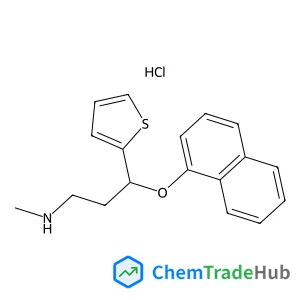
N-Methyl-3-(1-naphthyloxy)-3-(2-thienyl)-1-propanamine hydrochloride (1:1)
CAS Number:
1188266-11-6
Molecular Formula:
C18H20ClNOS
Qian Gou, Gang Feng, Luca Evangelisti, Alberto Lesarri, Emilio J. Cocinero, Walther Caminati
The rotational spectra of three isotopologues of the 1 : 1 complex between difluoromethane and formaldehyde have been observed and assigned using pulsed jet Fourier transform microwave spectroscopy. The formaldehyde lies in the FCF plane of difluoromethane, linked through a C–H⋯F and a bifurcated CH2⋯O weak hydrogen bonds. The rotational transitions are split into two component lines with a relative intensity ratio of 1 : 3, due to the internal rotation of the formaldehyde moiety along its symmetry axis. The barrier to this motion has been estimated by using a flexible model to be V2 = 180(10) cm−1.
Qihang Liu, Junjun Chen, Lang Zhang, Olim Ruzimuradov, Yichun Liu, Fengxian Li, Caiju Li, Mingjun Wang, Dong Fang, Jianhong Yi
DOI: 10.1039/D3RE00344B
Mingli Cao, Wei Yang
DOI: 10.1039/D3RE00399J
Yi-Xuan Yao, Hong-Wei Zhang, Chang-Bo Lu, Xue Wang, Shi-Dong Zhao, Hong-Yan Shang, Yuan-Yu Tian
DOI: 10.1039/D3RE00387F
Sanakousar F. M., Vidyasagar C. C., Shikandar D. B., Mounesh, Viswanatha C. C., Swapna S. Chigari
DOI: 10.1039/D3RE00408B
Mansur S. Miftakhov, Seda A. Torosyan, Fanuza A. Gimalova, Sergey L. Khursan, Zoya F. Nuriakhmetova, Elena V. Shchurik, Olga. A. Kraevaya
DOI: 10.1039/D3PY00893B
Luke Harvey, Jean-Michel Guigner, Laurent Bouteiller, Erwan Nicol, Olivier Colombani
DOI: 10.1039/D3PY00963G
Manfred Wagner, Christine Rosenauer, Jinhuo Dai, Priya Subramanian, Alasdair McKay, Jasper J. Michels, Tanja Junkers
DOI: 10.1039/D3PY01075A
Chunyang Bao, Jie Liu, Yanlong Yin, Zhirong Xin
DOI: 10.1039/D3PY01054F
N-(4-Methoxybenzyl)-2-pyridinamine (CAS: 52818-63-0) is increasingly being used ...
When handling Ethyl 4-(2-chlorophenyl)-1,3-thiazole-2-carboxylate, appropriate p...
Diethyldiselane (CAS: 628-39-7) is classified under the Globally Harmonized Syst...
The market for oxocopper (CAS: 12053-18-8) is primarily driven by its use in cat...
The market for 5-{[(2-Methyl-2-propanyl)oxy]carbonyl}-5-azaspiro[2.4]heptane-7-c...
2-(1-Pyrrolidinyl)-4-pyridinamine is a chemical compound with the CAS number 359...
2-(3-Pyridinyl)-1-azabicyclo[2.2.2]octane (CAS: 91556-75-1) is a crystalline sol...
(S)-Alpha-allyl-proline hydrochloride is usually synthesized via a Wittig reacti...
3-Methyl-1,2-oxazole-5-carboxylic acid (CAS: 4857-42-5) is an organic compound w...
Lys-SMCC-DM1 is synthesized via a multi-step process involving the coupling of S...

Physical Chemistry Chemical Physics (PCCP) is an international journal co-owned by 19 physical chemistry and physics societies from around the world. This journal publishes original, cutting-edge research in physical chemistry, chemical physics and biophysical chemistry. To be suitable for publication in PCCP, articles must include significant innovation and/or insight into physical chemistry; this is the most important criterion that reviewers and Editors will judge against when evaluating submissions. The journal has a broad scope and welcomes contributions spanning experiment, theory, computation and data science. Topical coverage includes spectroscopy, dynamics, kinetics, statistical mechanics, thermodynamics, electrochemistry, catalysis, surface science, quantum mechanics, quantum computing and machine learning. Interdisciplinary research areas such as polymers and soft matter, materials, nanoscience, energy, surfaces/interfaces, and biophysical chemistry are welcomed if they demonstrate significant innovation and/or insight into physical chemistry. Joined experimental/theoretical studies are particularly appreciated when complementary and based on up-to-date approaches.
![1-(1-Benzyl-1,2,3,6-tetrahydropyridin-4-yl)-1H-benzo[d]imidazol-2(3H)-one structure](https://static.chemtradehub.com/structs/603/60373-71-9-7dfb.webp "1-(1-Benzyl-1,2,3,6-tetrahydropyridin-4-yl)-1H-benzo[d]imidazol-2(3H)-one structure")