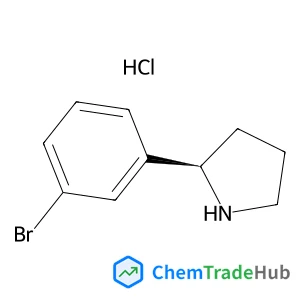
(2R)-2-(3-Bromophenyl)pyrrolidine hydrochloride (1:1)
CAS Number:
1391550-13-2
Molecular Formula:
C10H13BrClN
Sean A. Newmister, Stelamar Romminger, Jennifer J. Schmidt, Roberto G. S. Berlinck
Antimicrobial and anti-proliferative meleagrin and oxaline are roquefortine C-derived alkaloids produced by fungi of the genus Penicillium. Tandem O-methylations complete the biosynthesis of oxaline from glandicoline B through meleagrin. Currently, little is known about the role of these methylation patterns in the bioactivity profile of meleagrin and oxaline. To establish the structural and mechanistic basis of methylation in these pathways, crystal structures were determined for two late-stage methyltransferases in the oxaline and meleagrin gene clusters from Penicillium oxalicum and Penicillium chrysogenum. The homologous enzymes OxaG and RoqN were shown to catalyze penultimate hydroxylamine O-methylation to generate meleagrin in vitro. Crystal structures of these enzymes in the presence of methyl donor S-adenosylmethionine revealed an open active site, which lacks an apparent base indicating that catalysis is driven by proximity effects. OxaC was shown to methylate meleagrin to form oxaline in vitro, the terminal pathway product. Crystal structures of OxaC in a pseudo-Michaelis complex containing sinefungin and meleagrin, and in a product complex containing S-adenosyl-homocysteine and oxaline, reveal key active site residues with His313 serving as a base that is activated by Glu369. These data provide structural insights into the enzymatic methylation of these alkaloids that include a rare hydroxylamine oxygen acceptor, and can be used to guide future efforts towards selective derivatization and structural diversification and establishing the role of methylation in bioactivity.

Russian Journal of General Chemistry

Drug Discovery Today

Current Opinion in Solid State & Materials Science

Journal of Natural Medicines

Crystallography Reports

Chemistry Education Research and Practice

Russian Journal of Bioorganic Chemistry

Nature Medicine

Saudi Pharmaceutical Journal

Organic Process Research & Development
Yuki Tsukamoto, Jumpei Kida, Daisuke Aoki, Hideyuki Otsuka
DOI: 10.1039/D1PY00657F
Lei Zhang, Fangyuan Zhou, Zhenjiang Li, Bo Liu, Rui Yan, Jie Li, Yongzhu Hu, Chan Zhang, Zikun Luo, Kai Guo
DOI: 10.1039/D0PY00812E
Mengqian Huang, De Bai, Qin Chen, Changbo Zhao, Tianhua Ren, Caijuan Huang, Michael North, Haibo Xie
DOI: 10.1039/D0PY00291G
Hideto Tsuji, Kazumasa Iguchi, Kohji Tashiro, Yuki Arakawa
DOI: 10.1039/D0PY01115K
Wentao Peng, Yingying Cai, Luise Fanslau, Philipp Vana
DOI: 10.1039/D1PY01172C
Alexander Holm, Alexander Southan, Curtis W. Frank
DOI: 10.1039/D0PY00697A
Heli A. Brahmbhatt, Alexander Surtees, Cavan Tierney, Oluwabukunmi A. Ige, Elena V. Piletska, Thomas Swift
DOI: 10.1039/D0PY00921K
Priscila Quiñonez-Angulo, Robin A. Hutchinson, Ángel Licea-Claveríe, Enrique Saldívar-Guerra, Iván Zapata-González
DOI: 10.1039/D1PY00750E
N-(4-Methoxybenzyl)-2-pyridinamine (CAS: 52818-63-0) is increasingly being used ...
When handling Ethyl 4-(2-chlorophenyl)-1,3-thiazole-2-carboxylate, appropriate p...
Diethyldiselane (CAS: 628-39-7) is classified under the Globally Harmonized Syst...
The market for oxocopper (CAS: 12053-18-8) is primarily driven by its use in cat...
The market for 5-{[(2-Methyl-2-propanyl)oxy]carbonyl}-5-azaspiro[2.4]heptane-7-c...
2-(1-Pyrrolidinyl)-4-pyridinamine is a chemical compound with the CAS number 359...
2-(3-Pyridinyl)-1-azabicyclo[2.2.2]octane (CAS: 91556-75-1) is a crystalline sol...
(S)-Alpha-allyl-proline hydrochloride is usually synthesized via a Wittig reacti...
3-Methyl-1,2-oxazole-5-carboxylic acid (CAS: 4857-42-5) is an organic compound w...
Lys-SMCC-DM1 is synthesized via a multi-step process involving the coupling of S...

Organic & Biomolecular Chemistry (OBC) publishes original and high impact research and reviews in organic chemistry. We welcome research that shows new or significantly improved protocols or methodologies in total synthesis, synthetic methodology or physical and theoretical organic chemistry as well as research that shows a significant advance in the organic chemistry or molecular design aspects of chemical biology, catalysis, supramolecular and macromolecular chemistry, theoretical chemistry, mechanism-oriented physical organic chemistry, medicinal chemistry or natural products. Articles published in the journal should report new work which makes a highly-significant impact in the field. Routine and incremental work is generally not suitable for publication in the journal. More details about key areas of our scope are below. In all cases authors should include in their article clear rationale for why their research has been carried out.
![N-{15-[(2,5-Dioxo-1-pyrrolidinyl)oxy]-15-oxo-3,6,9,12-tetraoxapentadec-1-yl}-2-(2-propyn-1-yloxy)acetamide structure](https://static.chemtradehub.com/structs/210/2101206-92-0-2eb5.webp "N-{15-[(2,5-Dioxo-1-pyrrolidinyl)oxy]-15-oxo-3,6,9,12-tetraoxapentadec-1-yl}-2-(2-propyn-1-yloxy)acetamide structure")
![5'-Fluoro-[2,3'-biindolinylidene]-2',3-dione structure](https://static.chemtradehub.com/structs/251/251903-00-1-9cb1.webp "5'-Fluoro-[2,3'-biindolinylidene]-2',3-dione structure")