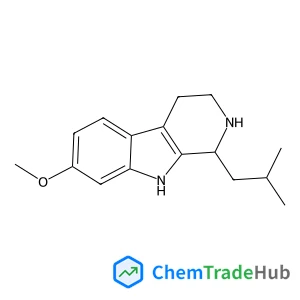
1-Isobutyl-7-methoxy-2,3,4,9-tetrahydro-1H-beta-carboline
CAS Number:
175975-76-5
Molecular Formula:
C16H22N2O
Mehdi A. Beniddir, Grégory Genta-Jouve, Thammarat Aree, Marylène Chollet-Krugler, Joël Boustie, Solenn Ferron, Aurélie Sauvager, Huu-Hung Nguyen, Kim-Phi-Phung Nguyen, Warinthorn Chavasiri, Pierre Le Pogam
New racemic dispiranic polyketides, tsavoenones A (1), B (2) and C (3), having a novel 1,7-dioxadispiro[4.0.4.4]tetradecane scaffold were isolated from the foliose lichen Parmotrema tsavoense. These compounds were structurally elucidated by extensive NMR analyses, comparison between experimental and theoretical 13C NMR data and X-ray crystallography. A putative biosynthetic scenario for the formation of 1–3 from parmosidone D, a meta-depsidone previously isolated from the same lichen material, was proposed. Tested for its cytotoxicity, 1 displayed a moderate activity against human myelogenous leukemia K562 cell line with an IC50 value of 66 μg mL−1.
Chen Zeng, Fanghao Hu, Rong Long, Wei Min
DOI: 10.1039/C8AN00910D
Guolan Tian, Lan Chen, Renxiao Liu, Guanglu Ge
DOI: 10.1039/C8AN01068D
S. A. Currivan, W. Q. Chen, R. Wilson, E. Sanz Rodriguez, N. Upadhyay, D. Connolly
DOI: 10.1039/C8AN01330F
Xiaoning Kai, Yiran Zhang, Youguang Zheng, Yunsheng Xue, Xiaoxing Yin, Jing Zhao
DOI: 10.1039/C8AN00765A
Mirela Sarbu, Željka Vukelić, David E. Clemmer
DOI: 10.1039/C8AN01118D
Do Hyun Kang, Keesung Kim, Younghwan Son, Pahn-Shick Chang, Ho-Sup Jung
DOI: 10.1039/C8AN01097H
Guobin Mao, Mingyuan Du, Xinxin Wang, Xinghu Ji, Zhike He
DOI: 10.1039/C8AN01640B
Jay G. Tarolli, Benjamin E. Naes, Lamar Butler, Keeyahna Foster, Caleb M. Gumbs, Andrea L. Howard, David Willingham
DOI: 10.1039/C7AN00175D
N-(4-Methoxybenzyl)-2-pyridinamine (CAS: 52818-63-0) is increasingly being used ...
When handling Ethyl 4-(2-chlorophenyl)-1,3-thiazole-2-carboxylate, appropriate p...
Diethyldiselane (CAS: 628-39-7) is classified under the Globally Harmonized Syst...
The market for oxocopper (CAS: 12053-18-8) is primarily driven by its use in cat...
The market for 5-{[(2-Methyl-2-propanyl)oxy]carbonyl}-5-azaspiro[2.4]heptane-7-c...
2-(1-Pyrrolidinyl)-4-pyridinamine is a chemical compound with the CAS number 359...
2-(3-Pyridinyl)-1-azabicyclo[2.2.2]octane (CAS: 91556-75-1) is a crystalline sol...
(S)-Alpha-allyl-proline hydrochloride is usually synthesized via a Wittig reacti...
3-Methyl-1,2-oxazole-5-carboxylic acid (CAS: 4857-42-5) is an organic compound w...
Lys-SMCC-DM1 is synthesized via a multi-step process involving the coupling of S...

Organic & Biomolecular Chemistry (OBC) publishes original and high impact research and reviews in organic chemistry. We welcome research that shows new or significantly improved protocols or methodologies in total synthesis, synthetic methodology or physical and theoretical organic chemistry as well as research that shows a significant advance in the organic chemistry or molecular design aspects of chemical biology, catalysis, supramolecular and macromolecular chemistry, theoretical chemistry, mechanism-oriented physical organic chemistry, medicinal chemistry or natural products. Articles published in the journal should report new work which makes a highly-significant impact in the field. Routine and incremental work is generally not suitable for publication in the journal. More details about key areas of our scope are below. In all cases authors should include in their article clear rationale for why their research has been carried out.
![1-(1-Benzyl-1,2,3,6-tetrahydropyridin-4-yl)-1H-benzo[d]imidazol-2(3H)-one structure](https://static.chemtradehub.com/structs/603/60373-71-9-7dfb.webp "1-(1-Benzyl-1,2,3,6-tetrahydropyridin-4-yl)-1H-benzo[d]imidazol-2(3H)-one structure")