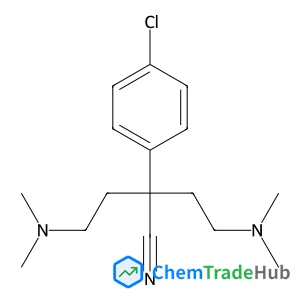
2-(4-Chlorophenyl)-4-(dimethylamino)-2-(2-(dimethylamino)ethyl)butanenitrile
CAS Number:
1246816-57-8
Molecular Formula:
C16H24ClN3
A graphical abstract is available for this content
Rhydian H. Beddoe, Helen F. Sneddon, Ross M. Denton
DOI: 10.1039/C8OB01929K
Xinying Zhang, Xuesen Fan
DOI: 10.1039/C8OB01846D
Zhongxuan Qiu, Rui Sun, Dawei Teng
DOI: 10.1039/C8OB02265H
Wei Yang, Jingyi Wang, He Wang, Lei Li, Yuekai Guan, Xianxiu Xu, Dayu Yu
DOI: 10.1039/C8OB01938J
Chang Gao, Xiaoting Gu, Xin Wang, Huikun Cao, Bin Lin, Youping Liu, Xin Di
DOI: 10.1039/C8OB02194E
Zhuo Wang, Tongyu Li, Siyang Xing, Bolin Zhu
DOI: 10.1039/C8OB01182F
Maojian Lu, Zhiji Liu, Jinwang Zhang, Yu Tian, Honggui Qin, Mingqiang Huang, Shirong Hu
DOI: 10.1039/C8OB01922C
Kun Liu, Xinye Shang, Yuyu Cheng, Xiaoyong Chang, Pengfei Li, Wenjun Li
DOI: 10.1039/C8OB02352B
Luisa Lempenauer, Aline Soupart, Elisabet Duñach, Gilles Lemière
DOI: 10.1039/C8OB01559G
C. Parthiban, Pavithra M., L. Vinod Kumar Reddy, Dwaipayan Sen, Melvin Samuel S., N. D. Pradeep Singh
DOI: 10.1039/C8OB01629A
This compound is mainly used as an intermediate in the synthesis of antipsychoti...
Waste containing 1-(D-Ribofuranosyl)-1,4-dihydro-3-pyridinecarboxamide (CAS: 191...
2-Methyl-2-propanyl 3-bromo-3-(hydroxymethyl)-1-azetidinecarboxylate (CAS: 20079...
N-(4-Chloro-2-pyridinyl)acetamide (CAS: 245056-66-0) is a chemical compound with...
5-Chloro-2-hydroxybenzoic acid, also known as 5-chlorosalicylic acid, is an arom...
When handling 1,1-Dichloro-1-fluoroethane (CAS: 1717-00-6), it is important to u...
Fmoc-(2S,3R)-3-phenylpyrrolidine-2-carboxylic acid is a white crystalline solid ...
4-Amino-5-bromo-2-pyridinecarboxylic acid is primarily used as a precursor in th...
Handling this compound should be done with personal protective equipment (PPE) i...
When handling 8-bromo-2,2-dimethyl-3,4-dihydro-2H-1,4-benzoxazin-3-one, use prop...

Physical Chemistry Chemical Physics (PCCP) is an international journal co-owned by 19 physical chemistry and physics societies from around the world. This journal publishes original, cutting-edge research in physical chemistry, chemical physics and biophysical chemistry. To be suitable for publication in PCCP, articles must include significant innovation and/or insight into physical chemistry; this is the most important criterion that reviewers and Editors will judge against when evaluating submissions. The journal has a broad scope and welcomes contributions spanning experiment, theory, computation and data science. Topical coverage includes spectroscopy, dynamics, kinetics, statistical mechanics, thermodynamics, electrochemistry, catalysis, surface science, quantum mechanics, quantum computing and machine learning. Interdisciplinary research areas such as polymers and soft matter, materials, nanoscience, energy, surfaces/interfaces, and biophysical chemistry are welcomed if they demonstrate significant innovation and/or insight into physical chemistry. Joined experimental/theoretical studies are particularly appreciated when complementary and based on up-to-date approaches.
![tert-Butyl N-[(2-chloropyridin-4-yl)methyl]carbamate structure](https://static.chemtradehub.com/structs/916/916210-27-0-9f95.webp "tert-Butyl N-[(2-chloropyridin-4-yl)methyl]carbamate structure")
![2,6-Di(thiophen-2-yl)dithieno[3,2-b:2',3'-d]thiophene structure](https://static.chemtradehub.com/structs/910/910788-24-8-5b70.webp "2,6-Di(thiophen-2-yl)dithieno[3,2-b:2',3'-d]thiophene structure")