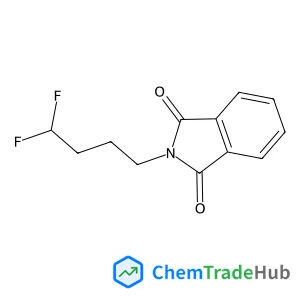
2-(4,4-Difluorobutyl)-1H-isoindole-1,3(2H)-dione
CAS Number:
1265341-14-7
Molecular Formula:
C12H11F2NO2
Rhydian H. Beddoe, Helen F. Sneddon, Ross M. Denton
The Mitsunobu reaction is widely regarded as the pre-eminent method for performing nucleophilic substitutions of alcohols with inversion of configuration. However, its applicability to large-scale synthesis is undermined by the fact that alcohol activation occurs at the expense of two stoichiometric reagents – a phosphine and an azodicarboxylate. The ideal Mitsunobu reaction would be sub-stoichiometric in the phosphine and azodicarboxylate species and employ innocuous terminal oxidants and reductants to achieve recycling. This Review article provides a summary and analysis of recent advances towards the development of such catalytic Mitsunobu reactions.

Nature Medicine

Journal of Saudi Chemical Society

Russian Chemical Bulletin

Journal of Natural Medicines

Chemistry Education Research and Practice

Russian Journal of General Chemistry

Acta Materialia

Russian Journal of Coordination Chemistry

Russian Journal of Organic Chemistry

Russian Journal of Applied Chemistry
DOI: 10.1039/D1PY01079D
Mengqian Huang, De Bai, Qin Chen, Changbo Zhao, Tianhua Ren, Caijuan Huang, Michael North, Haibo Xie
DOI: 10.1039/D0PY00291G
Aurélie Destephen
DOI: 10.1039/D1PY01046H
Ruixue Zhang, Xuwen Li, Hongwei Ma, Li Han, Chao Li, Songbo Zhang, Hongyuan Bai, Yang Li
DOI: 10.1039/D1PY01310F
Haosheng Pang, Yunjun Luo, Bing Zhang
DOI: 10.1039/D1PY00920F
Hideto Tsuji, Kazumasa Iguchi, Kohji Tashiro, Yuki Arakawa
DOI: 10.1039/D0PY01115K
Dimitrios Selianitis, Stergios Pispas
DOI: 10.1039/D1PY01320C
Nyoman D. Kurniawan
DOI: 10.1039/D1PY00602A
David K. Tran, Ahmed Z. Rashad, Donald J. Darensbourg
DOI: 10.1039/D1PY00784J
N-(4-Methoxybenzyl)-2-pyridinamine (CAS: 52818-63-0) is increasingly being used ...
When handling Ethyl 4-(2-chlorophenyl)-1,3-thiazole-2-carboxylate, appropriate p...
Diethyldiselane (CAS: 628-39-7) is classified under the Globally Harmonized Syst...
The market for oxocopper (CAS: 12053-18-8) is primarily driven by its use in cat...
The market for 5-{[(2-Methyl-2-propanyl)oxy]carbonyl}-5-azaspiro[2.4]heptane-7-c...
2-(1-Pyrrolidinyl)-4-pyridinamine is a chemical compound with the CAS number 359...
2-(3-Pyridinyl)-1-azabicyclo[2.2.2]octane (CAS: 91556-75-1) is a crystalline sol...
(S)-Alpha-allyl-proline hydrochloride is usually synthesized via a Wittig reacti...
3-Methyl-1,2-oxazole-5-carboxylic acid (CAS: 4857-42-5) is an organic compound w...
Lys-SMCC-DM1 is synthesized via a multi-step process involving the coupling of S...

Organic & Biomolecular Chemistry (OBC) publishes original and high impact research and reviews in organic chemistry. We welcome research that shows new or significantly improved protocols or methodologies in total synthesis, synthetic methodology or physical and theoretical organic chemistry as well as research that shows a significant advance in the organic chemistry or molecular design aspects of chemical biology, catalysis, supramolecular and macromolecular chemistry, theoretical chemistry, mechanism-oriented physical organic chemistry, medicinal chemistry or natural products. Articles published in the journal should report new work which makes a highly-significant impact in the field. Routine and incremental work is generally not suitable for publication in the journal. More details about key areas of our scope are below. In all cases authors should include in their article clear rationale for why their research has been carried out.
![N-{15-[(2,5-Dioxo-1-pyrrolidinyl)oxy]-15-oxo-3,6,9,12-tetraoxapentadec-1-yl}-2-(2-propyn-1-yloxy)acetamide structure](https://static.chemtradehub.com/structs/210/2101206-92-0-2eb5.webp "N-{15-[(2,5-Dioxo-1-pyrrolidinyl)oxy]-15-oxo-3,6,9,12-tetraoxapentadec-1-yl}-2-(2-propyn-1-yloxy)acetamide structure")
![1-{3-[4-Amino-3-(4-phenoxyphenyl)-1H-pyrazolo[3,4-d]pyrimidin-1-yl]-1-piperidinyl}-2,3-dihydroxy-1-propanone structure](https://static.chemtradehub.com/structs/122/1226872-27-0-e037.webp "1-{3-[4-Amino-3-(4-phenoxyphenyl)-1H-pyrazolo[3,4-d]pyrimidin-1-yl]-1-piperidinyl}-2,3-dihydroxy-1-propanone structure")