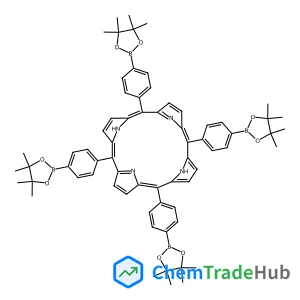
5,10,15,20-tetrakis(4-boronic acid pinacol ester phenyl) porphyrin
CAS Number:
1332748-00-1
Molecular Formula:
C68H74B4N4O8
Shin-Kung Wang, Hsun-Yun Chang, Yi-Hsuan Chu, Wei-Lun Kao, Chen-Yi Wu, Yi-Wei Lee, Yun-Wen You, Kuo-Jui Chu, Shu-Hang Hung
Gas cluster ion beam (GCIB) is a promising technique for preserving molecular structures during ion sputtering and successfully profiling biological and soft materials. However, although GCIB yields lower damage accumulation compared with C60+ and monoatomic ion beams, the inevitable alteration of the chemical structure can introduce artifacts into the resulting depth profile. To enhance the ionization yield and further mask damage, a low-energy O2+ (200–500 V) cosputter can be applied. While the energy per atom (E/n) of GCIB is known to be an important factor influencing the sputter process, the manner through which E/n affects the GCIB-O2+ cosputter process remains unclear. In this study, poly(ethylene terephthalate) (PET) was used as a model material to investigate the sputter process of 10–20 kV Ar1000–4000+ (E/n = 2.5–20 eV per atom) with and without O2+ cosputter at different energies and currents. Time-of-flight secondary ion mass spectrometry (ToF-SIMS) with Bi32+ as the primary ion was used to examine surfaces sputtered at different fluences. The sputter craters were also measured by alpha-step and atomic force microscopy in quantitative imaging mode. The SIMS results showed that the steady-state cannot be obtained with E/n values of less than 5 eV per atom due to damage accumulation using single GCIB sputtering. With a moderate E/n value of 5–15 eV per atom, the steady-state can be obtained, but the ∼50% decay in intensity indicated that damage cannot be masked completely despite the higher sputter yield. Furthermore, the surface Young's modulus decreased with increasing E/n, suggesting that depolymerization occurred. At an E/n value of 20 eV per atom, a failed profile was obtained with rapidly decreased sputter rate and secondary ion intensity due to the ion-induced crosslink. With O2+ cosputtering and a moderate E/n value, the oxidized species generated by O2+ enhanced the ionization yield, which led to a higher ion intensity at steady-state in general. Because higher kinetic energy or current density of O2+ led to a larger interaction volume and more structural damage that suppressed molecular ion intensity, the enhancement from O2+ was most apparent with low-energy–high-current (200 V, 80 μA cm−2) or high-energy–low-current (500 V, 5 μA cm−2) O2+ cosputtering with 0.5 μA cm−2 GCIBs. In these cases, little or no intensity drop was observed at the steady-state.
Yan-Lin Li, Kun Cui, Zheng-Yang Gu, Hu He
DOI: 10.1039/D3QO01281F
Sushil Sharma, Sanchita Sengupta
DOI: 10.1039/D3QO01542D
Panpan Lei, Bingran Chen, Tonghui Zhang, Qinlin Chen, Liangming Xuan, Haifeng Wang, Qiongjiao Yan, Wei Wang, Jie Zeng
DOI: 10.1039/D3QO01551C
Yuan Chen, Rui-jun Peng, Xue-jing Zhang, Ming Yan
DOI: 10.1039/D3QO01607B
Xiaoxiang Zhang, Chenrui Liu, Yingying Zhang, Fang Shen, Wanxing Wei, Zhuan Zhang, Taoyuan Liang
DOI: 10.1039/D3QO01457F
Jin-Jun Ren, Fan Wang, Dan-Ping Chen, Lu Deng, Chong-Yun Shao, Shi-Kai Wang
DOI: 10.1039/D3CP04758J
Shu-Qin Qin, Wei Xu, Qi-Qi Wang, Run-Yi Chen, De-Zhi Yang, Yang Lu
DOI: 10.1039/D3QO01649H
Liqun Yang, Wenkui Lu, Xiaoyu Wu, Yan Lu, Xiaomin Xie, Zhaoguo Zhang
DOI: 10.1039/D3QO01725G
Hao-Cong Li, Guan-Nan Li, Hao-Sen Wang, Xiao-Lan Chen, Bing Yu
DOI: 10.1039/D3QO01575K
Matthew Pennachio, Zheng Wei, Robert G. Clevenger, Kathleen V. Kilway, Alexandra Tsybizova, Renana Gershoni-Poranne, Marina A. Petrukhina
DOI: 10.1039/D3QO01282D
N-(4-Methoxybenzyl)-2-pyridinamine (CAS: 52818-63-0) is increasingly being used ...
When handling Ethyl 4-(2-chlorophenyl)-1,3-thiazole-2-carboxylate, appropriate p...
Diethyldiselane (CAS: 628-39-7) is classified under the Globally Harmonized Syst...
The market for oxocopper (CAS: 12053-18-8) is primarily driven by its use in cat...
The market for 5-{[(2-Methyl-2-propanyl)oxy]carbonyl}-5-azaspiro[2.4]heptane-7-c...
2-(1-Pyrrolidinyl)-4-pyridinamine is a chemical compound with the CAS number 359...
2-(3-Pyridinyl)-1-azabicyclo[2.2.2]octane (CAS: 91556-75-1) is a crystalline sol...
(S)-Alpha-allyl-proline hydrochloride is usually synthesized via a Wittig reacti...
3-Methyl-1,2-oxazole-5-carboxylic acid (CAS: 4857-42-5) is an organic compound w...
Lys-SMCC-DM1 is synthesized via a multi-step process involving the coupling of S...

Analyst publishes analytical and bioanalytical research that reports premier fundamental discoveries and inventions, and the applications of those discoveries, unconfined by traditional discipline barriers.
![2-[(5Z,8Z,11Z,14Z)-5,8,11,14-Icosatetraen-1-yloxy]-1,3-propanediol structure](https://static.chemtradehub.com/structs/222/222723-55-9-0348.webp "2-[(5Z,8Z,11Z,14Z)-5,8,11,14-Icosatetraen-1-yloxy]-1,3-propanediol structure")
![[3-(2,6-Dichlorophenyl)-5-isopropyl-1,2-oxazol-4-yl]methanol structure](https://static.chemtradehub.com/structs/278/278597-30-1-5c79.webp "[3-(2,6-Dichlorophenyl)-5-isopropyl-1,2-oxazol-4-yl]methanol structure")
![(4aR,5S,6R,8aS)-5-[2-(3-Furyl)ethyl]-8a-(hydroxymethyl)-5,6-dimethyl-3,4,4a,5,6,7,8,8a-octahydro-1-naphthalenecarboxylic acid structure](https://static.chemtradehub.com/structs/184/18411-75-1-d4cd.webp "(4aR,5S,6R,8aS)-5-[2-(3-Furyl)ethyl]-8a-(hydroxymethyl)-5,6-dimethyl-3,4,4a,5,6,7,8,8a-octahydro-1-naphthalenecarboxylic acid structure")