












Repercussions of multi-electron uptake by a twistacene: a reduction-induced double dehydrogenative annulation
Literature Information
Publication Date
2023-09-22
DOI
10.1039/D3QO01282D
Impact Factor
5.281
Authors
Matthew Pennachio, Zheng Wei, Robert G. Clevenger, Kathleen V. Kilway, Alexandra Tsybizova, Renana Gershoni-Poranne, Marina A. Petrukhina
View Original
Abstract
Chemical reduction of highly-twisted 9,10,11,20,21,22-hexaphenyltetrabenzo[a,c,l,n]pentacene (C74H46, 1) was investigated using Li and Cs metals as the reducing agents. The Cs-induced reduction of 1 in the presence of 18-crown-6 ether enabled the isolation of a solvent-separated ion pair (SSIP) with a “naked” monoanion. Upon reduction with Li metal, a double reductive dehydrogenative annulation of 1 was observed to afford a new C74H422− dianion. The latter was shown to undergo a further reduction to C74H424− without additional core transformation. All products were characterized by single-crystal X-ray diffraction and spectroscopic methods. Subsequent in-depth theoretical analysis of one vs. two and four electron uptake by 1 provided insights into how the changes of geometry, aromaticity and charge facilitated the core transformation of twistacene observed upon two-fold reduction. These experimental and theoretical results pave the way to understanding of the reduction-induced core transformations of highly twisted and strained π-systems.
Recommended Journals
Related Literature
Dual-responsive probe and DNA interstrand crosslink precursor target the unique redox status of cancer cells
Dehao Yu, Luo Wang, Jingao Li, Xuanwei Zeng, Yuanyuan Jia, Junyu Tian, Anahit Campbell, Huabing Sun, Heli Fan
2023-11-07
Communication
DOI: 10.1039/D3CC05175G
Introduction of TiO2 enhancing the catalytic performance of Ti(SO4)2/SiO2 for dimethyl ether oxidation
Xiujuan Gao, Faen Song, Xiaoxing Wang, Junfeng Zhang, Yizhuo Han, Qingde Zhang
2023-11-10
Communication
DOI: 10.1039/D3CC04819E
Development of 18F-Labeled hydrophilic trans-cyclooctene as a bioorthogonal tool for PET probe construction
Muyun Xu, Xinrui Ma, Jessica E. Pigga, He Zhang, Shuli Wang, Weiling Zhao, Huaifu Deng, Anna M. Wu, Rihe Liu, Zhanhong Wu, Joseph M. Fox, Zibo Li
2023-10-17
Communication
DOI: 10.1039/D3CC04212J
Towards high-performance nonlinear optical materials through embedding a D–A system into β-ketoenamine-linked COFs
Mingyan Li, Jiahui Chu, Debo Ding, Tingting Li, Endian Su, Yinglin Song, Yun-Fang Yang, Yuanbin She, Jianhong Jia
2023-11-09
Communication
DOI: 10.1039/D3CC04845D
Optimizing milling and sintering parameters for mild synthesis of highly conductive Li5.5PS4.5Cl1.5 solid electrolyte
2023-11-09
Communication
DOI: 10.1039/D3CC05099H
Mesoporous alloy chiral nanoparticles with high production yield and strong optical activities
Yicong Ma, Lin Yang, Yu Chen, Xiaopeng Bai, Geping Qu, Tao Yao, Xiangchen Hu, Jianfang Wang, Zongxiang Xu, Yi Yu, Zhifeng Huang
2023-11-10
Communication
DOI: 10.1039/D3CC04354A
Hierarchical 2D honeycomb-like network from barium-seamed nanocapsules
Kanishka Sikligar, Steven P. Kelley, Gary A. Baker, Jerry L. Atwood
2023-10-20
Communication
DOI: 10.1039/D3CC03374K
Synthesis of medium-sized heterocycles from oxetanes based on an allylic amination/ring-opening strategy
Jixing Li, Ming Fang, Maoyan Liao, Hongling Xie, Xiu-Qin Dong, Jianwei Sun, Hai Huang
2023-11-15
Communication
DOI: 10.1039/D3CC04355J
Phenylalanine-based fibrillar systems
Soumen Kuila, Sukantha Dey, Akash Shrivastava, Jayanta Nanda
2023-11-06
Feature Article
DOI: 10.1039/D3CC04138G
2D superlattices via interfacial self-assembly of polymer-grafted Au nanoparticles
Liangzhu Jiang, Xi Mao, Changxu Liu, Xiaodan Guo, Renhua Deng, Jintao Zhu
2023-11-07
Feature Article
DOI: 10.1039/D3CC04587K
You might also like
Compound Q&A
What is the market or research trend for N-(4-Methoxybenzyl)-2-pyridinamine (CAS: 52818-63-0)?
N-(4-Methoxybenzyl)-2-pyridinamine (CAS: 52818-63-0) is increasingly being used ...
52818-63-0N-(4-Methoxybenzyl)-...
Compound Q&A
What precautions should be taken when handling Ethyl 4-(2-chlorophenyl)-1,3-thiazole-2-carboxylate (CAS: 1050507-06-6)?
When handling Ethyl 4-(2-chlorophenyl)-1,3-thiazole-2-carboxylate, appropriate p...
1050507-06-6Ethyl 4-(2-chlorophe...
Compound Q&A
What regulatory guidelines apply to diethyldiselane (CAS: 628-39-7)?
Diethyldiselane (CAS: 628-39-7) is classified under the Globally Harmonized Syst...
628-39-7Diethyldiselane
Compound Q&A
What is the market or research trend for oxocopper (CAS: 12053-18-8)?
The market for oxocopper (CAS: 12053-18-8) is primarily driven by its use in cat...
12053-18-8oxocopper; oxo-(oxoc...
Compound Q&A
What is the market or research trend for 5-{[(2-Methyl-2-propanyl)oxy]carbonyl}-5-azaspiro[2.4]heptane-7-carboxylic acid?
The market for 5-{[(2-Methyl-2-propanyl)oxy]carbonyl}-5-azaspiro[2.4]heptane-7-c...
1268519-54-55-{[(2-Methyl-2-prop...
Compound Q&A
What is 2-(1-Pyrrolidinyl)-4-pyridinamine (CAS: 35981-63-6)?
2-(1-Pyrrolidinyl)-4-pyridinamine is a chemical compound with the CAS number 359...
35981-63-62-(1-Pyrrolidinyl)-4...
Compound Q&A
What are the physical and chemical properties of 2-(3-Pyridinyl)-1-azabicyclo[2.2.2]octane (CAS: 91556-75-1)?
2-(3-Pyridinyl)-1-azabicyclo[2.2.2]octane (CAS: 91556-75-1) is a crystalline sol...
91556-75-12-(3-Pyridinyl)-1-az...
Compound Q&A
How is (S)-Alpha-allyl-proline hydrochloride (CAS: 129704-91-2) typically synthesized?
(S)-Alpha-allyl-proline hydrochloride is usually synthesized via a Wittig reacti...
129704-91-2(S)-Alpha-allyl-prol...
Compound Q&A
What is 3-Methyl-1,2-oxazole-5-carboxylic acid (CAS: 4857-42-5)?
3-Methyl-1,2-oxazole-5-carboxylic acid (CAS: 4857-42-5) is an organic compound w...
4857-42-53-Methyl-1,2-oxazole...
Compound Q&A
How is Lys-SMCC-DM1 (CAS: 1281816-04-3) typically synthesized?
Lys-SMCC-DM1 is synthesized via a multi-step process involving the coupling of S...
1281816-04-3Lys-SMCC-DM1
Source Journal
Organic Chemistry Frontiers

CiteScore:
7.8
Self-citation Rate:
8.7%
Articles per Year:
724
Organic Chemistry Frontiers publishes high-quality research from across organic chemistry. Emphases are placed on studies that make significant contributions to the field of organic chemistry by reporting either new or significantly improved protocols or methodologies. Topics include, but are not limited to the following: Organic synthesis Development of synthetic methodologies Catalysis Natural products Functional organic materials Supramolecular and macromolecular chemistry Physical and computational organic chemistry
Recommended Compounds
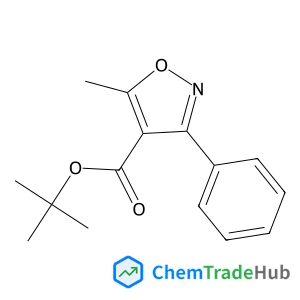
2-Methyl-2-propanyl 5-methyl-3-phenyl-1,2-oxazole-4-carboxylate
CAS Number:
211429-79-7
Molecular Formula:
C15H17NO3
Recommended Suppliers





Disclaimer
This page provides academic journal information for reference and research purposes only. We are not affiliated with any journal publishers and do not handle publication submissions. For publication-related inquiries, please contact the respective journal publishers directly.
If you notice any inaccuracies in the information displayed, please contact us at support@chemtradehub.com. We will promptly review and address your concerns.