












On-line coupling between capillary electrophoresis and microscale thermophoresis (CE–MST); the proof-of-concept
Literature Information
Publication Date
2018-09-07
DOI
10.1039/C8AN01191E
Impact Factor
4.616
Authors
Paweł M. Nowak, Michał Woźniakiewicz
View Original
Abstract
We demonstrate that microscale thermophoresis can be easily coupled with capillary electrophoresis in an on-line flow system (CE–MST), offering new potential possibilities. It takes advantage of sample separation and miniaturization prior to thermo-optical/MST analysis. No instrument modification is required. The future perspective is discussed.
Related Literature
Effects of intramolecular hydrogen bonding on the excited state dynamics of phenol chromophores
Yi Lin Yang, Yu-Chieh Ho, Yuri A. Dyakov, Wen-Hsin Hsu, Yi-Lun Sun, Wan-Chen Tsai, Wei-Ping Hu
2013-03-15
Paper
DOI: 10.1039/C3CP44674C
Benchmark quantum-chemical calculations on a complete set of rotameric families of the DNA sugar–phosphate backbone and their comparison with modern density functional theory
Arnošt Mládek, Miroslav Krepl, Michal Otyepka, Pavel Banáš, Marie Zgarbová, Petr Jurečka
2013-03-18
Paper
DOI: 10.1039/C3CP44383C
A statistical approach for analyzing the development of 1H multiple-quantum coherence in solids
Yuuki Mogami, Yasuto Noda, Hiroto Ishikawa, K. Takegoshi
2013-04-12
Paper
DOI: 10.1039/C3CP43778G
High permeability and salt rejection reverse osmosis by a zeolite nano-membrane
Yilun Liu
2013-02-12
Paper
DOI: 10.1039/C3CP43854F
Chelating ionic liquids for reversible zinc electrochemistry
Mega Kar, Bjorn Winther-Jensen, Maria Forsyth, Douglas R. MacFarlane
2013-03-22
Paper
DOI: 10.1039/C3CP51102B
Rotational spectroscopy meets theory
Cristina Puzzarini
2013-02-19
Perspective
DOI: 10.1039/C3CP44301A
Thermodynamics of oligomer formation: implications for secondary organic aerosol formation and reactivity
Joseph W. DePalma, Andrew J. Horan, Wiley A. Hall IV, Murray V. Johnston
2013-03-22
Paper
DOI: 10.1039/C3CP44586K
Stability and physical properties of a tri-ring based porous g-C4N3 sheet
Xiaowei Li, Shunhong Zhang, Qian Wang
2013-04-04
Paper
DOI: 10.1039/C3CP44660C
Microscopic effects of the bonding configuration of nitrogen-doped graphene on its reactivity toward hydrogen peroxide reduction reaction
Ping Wu, Pan Du, Hui Zhang, Chenxin Cai
2013-03-15
Paper
DOI: 10.1039/C3CP50900A
You might also like
Compound Q&A
What is the market or research trend for N-(4-Methoxybenzyl)-2-pyridinamine (CAS: 52818-63-0)?
N-(4-Methoxybenzyl)-2-pyridinamine (CAS: 52818-63-0) is increasingly being used ...
52818-63-0N-(4-Methoxybenzyl)-...
Compound Q&A
What precautions should be taken when handling Ethyl 4-(2-chlorophenyl)-1,3-thiazole-2-carboxylate (CAS: 1050507-06-6)?
When handling Ethyl 4-(2-chlorophenyl)-1,3-thiazole-2-carboxylate, appropriate p...
1050507-06-6Ethyl 4-(2-chlorophe...
Compound Q&A
What regulatory guidelines apply to diethyldiselane (CAS: 628-39-7)?
Diethyldiselane (CAS: 628-39-7) is classified under the Globally Harmonized Syst...
628-39-7Diethyldiselane
Compound Q&A
What is the market or research trend for oxocopper (CAS: 12053-18-8)?
The market for oxocopper (CAS: 12053-18-8) is primarily driven by its use in cat...
12053-18-8oxocopper; oxo-(oxoc...
Compound Q&A
What is the market or research trend for 5-{[(2-Methyl-2-propanyl)oxy]carbonyl}-5-azaspiro[2.4]heptane-7-carboxylic acid?
The market for 5-{[(2-Methyl-2-propanyl)oxy]carbonyl}-5-azaspiro[2.4]heptane-7-c...
1268519-54-55-{[(2-Methyl-2-prop...
Compound Q&A
What is 2-(1-Pyrrolidinyl)-4-pyridinamine (CAS: 35981-63-6)?
2-(1-Pyrrolidinyl)-4-pyridinamine is a chemical compound with the CAS number 359...
35981-63-62-(1-Pyrrolidinyl)-4...
Compound Q&A
What are the physical and chemical properties of 2-(3-Pyridinyl)-1-azabicyclo[2.2.2]octane (CAS: 91556-75-1)?
2-(3-Pyridinyl)-1-azabicyclo[2.2.2]octane (CAS: 91556-75-1) is a crystalline sol...
91556-75-12-(3-Pyridinyl)-1-az...
Compound Q&A
How is (S)-Alpha-allyl-proline hydrochloride (CAS: 129704-91-2) typically synthesized?
(S)-Alpha-allyl-proline hydrochloride is usually synthesized via a Wittig reacti...
129704-91-2(S)-Alpha-allyl-prol...
Compound Q&A
What is 3-Methyl-1,2-oxazole-5-carboxylic acid (CAS: 4857-42-5)?
3-Methyl-1,2-oxazole-5-carboxylic acid (CAS: 4857-42-5) is an organic compound w...
4857-42-53-Methyl-1,2-oxazole...
Compound Q&A
How is Lys-SMCC-DM1 (CAS: 1281816-04-3) typically synthesized?
Lys-SMCC-DM1 is synthesized via a multi-step process involving the coupling of S...
1281816-04-3Lys-SMCC-DM1
Source Journal
Analyst

CiteScore:
7.8
Self-citation Rate:
5.6%
Articles per Year:
653
Analyst publishes analytical and bioanalytical research that reports premier fundamental discoveries and inventions, and the applications of those discoveries, unconfined by traditional discipline barriers.
Recommended Compounds
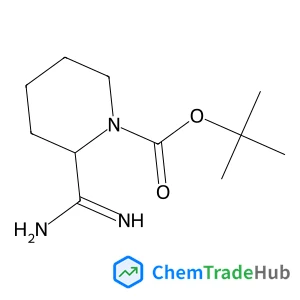
2-Methyl-2-propanyl 2-carbamimidoyl-1-piperidinecarboxylate
CAS Number:
1258640-98-0
Molecular Formula:
C11H21N3O2
![(2R,6S)-6-[(Benzyloxy)methyl]-4-{[(2-methyl-2-propanyl)oxy]carbonyl}-2-morpholinecarboxylic acid structure](https://static.chemtradehub.com/structs/109/1093085-91-6-3382.webp "(2R,6S)-6-[(Benzyloxy)methyl]-4-{[(2-methyl-2-propanyl)oxy]carbonyl}-2-morpholinecarboxylic acid structure")
(2R,6S)-6-[(Benzyloxy)methyl]-4-{[(2-methyl-2-propanyl)oxy]carbonyl}-2-morpholinecarboxylic acid
CAS Number:
1093085-91-6
Molecular Formula:
C18H25NO6
![N-{[(2-Methyl-2-propanyl)oxy]carbonyl}-L-methionylglycine structure](https://static.chemtradehub.com/structs/234/23446-03-9-e1e5.webp "N-{[(2-Methyl-2-propanyl)oxy]carbonyl}-L-methionylglycine structure")
N-{[(2-Methyl-2-propanyl)oxy]carbonyl}-L-methionylglycine
CAS Number:
23446-03-9
Molecular Formula:
C12H22N2O5S
Recommended Suppliers







Disclaimer
This page provides academic journal information for reference and research purposes only. We are not affiliated with any journal publishers and do not handle publication submissions. For publication-related inquiries, please contact the respective journal publishers directly.
If you notice any inaccuracies in the information displayed, please contact us at support@chemtradehub.com. We will promptly review and address your concerns.