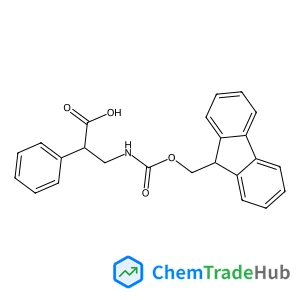
(S)-3-((((9H-Fluoren-9-yl)methoxy)carbonyl)amino)-2-phenylpropanoic acid
CAS Number:
1217663-60-9
Molecular Formula:
C24H21NO4
Ya Ding, Hao Li, Yunge Meng, Te Zhang, Jiawen Li, Qiu-Yun Chen
A metal-free protocol through visible light mediated oxidative cleavage of CC bonds to directly construct CN bonds has been developed for the conversion of alkenes to hydrazones under mild conditions. The reaction involves a diazetidine intermediate that is generated by [2 + 2] annulation of alkenes with diazenes generated in situ by single-electron oxidation of arylhydrazines. The key features of this reaction include a broad substrate scope and readily available reagents.
Huafeng Chen, Weijing Pan, Kuo-Wei Huang, Xuequan Zhang, Dirong Gong
DOI: 10.1039/C7PY00252A
Marco Albuszis, Peter J. Roth, Werner Pauer, Hans-Ulrich Moritz
DOI: 10.1039/C4PY00709C
Jérémy Brassinne, Charles-André Fustin, Jean-François Gohy
DOI: 10.1039/C6PY02143C
Ana Cenacchi Perreira, Samuel Pearson, Franck D'Agosto, Muriel Lansalot, Elodie Bourgeat-Lami
DOI: 10.1039/C6PY01742H
Shuang Li, Xianyu Deng, Lei Feng, Xincheng Miao, Kuangyi Tang, Qianqian Li, Zhen Li
DOI: 10.1039/C6PY01733A
Hongjun Yang, Zhongrui Wang, Yulei Zheng, Wenyan Huang, Xiaoqiang Xue, Bibiao Jiang
DOI: 10.1039/C7PY00174F
Hyeonuk Yeo, Nam-Ho You, Se Gyu Jang, Seokhoon Ahn, Kwang-Un Jeong, Seung Hee Lee, Munju Goh
DOI: 10.1039/C7PY00243B
Senbin Chen, Marie-Hélène Alves, Maud Save, Laurent Billon
DOI: 10.1039/C4PY00390J
Chun Feng, Guolin Lu, Gang Sun, Xunwei Liu, Xiaoyu Huang
DOI: 10.1039/C4PY00772G
Selvam Subramaniyan, Taeshik Earmme, Nishit M. Murari, Samson A. Jenekhe
DOI: 10.1039/C4PY00566J
When considering alternatives to 1-(4-Chlorophenyl)-N-hydroxymethanimine (CAS: 3...
This compound should be stored in a cool, dry place away from direct sunlight. I...
3-(4-Bromophenyl)-5-(2-fluorophenyl)-1,2,4-oxadiazole is synthesized through a m...
5-Chloro-2-(4-chlorophenyl)-4-methyl-6-[3-(1-piperidinyl)propoxy]pyrimidine (CAS...
2-Chloro-4-(difluoromethoxy)pyridine is used in the pharmaceutical industry for ...
3-Chloro-6-methylpyridazine (CAS: 1121-79-5) is classified under the Globally Ha...
Several alternatives can be used in the synthesis of Methyl 4,5-dimethyl-2-nitro...
Alternatives to (2E,2'E)-3,3'-(1,4-Phenylene)bisacrylaldehyde include other acry...
3-Amino-5-chloropyridin-2-ol hydrochloride is an organic compound with the CAS n...
When handling 6,7-Difluoro-2,3-dihydro-4H-chromen-4-one, it is essential to wear...

Organic Chemistry Frontiers publishes high-quality research from across organic chemistry. Emphases are placed on studies that make significant contributions to the field of organic chemistry by reporting either new or significantly improved protocols or methodologies. Topics include, but are not limited to the following: Organic synthesis Development of synthetic methodologies Catalysis Natural products Functional organic materials Supramolecular and macromolecular chemistry Physical and computational organic chemistry