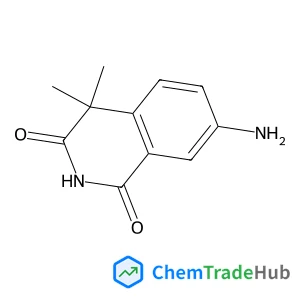
1,3(2H,4H)-Isoquinolinedione, 7-amino-4,4-dimethyl-
CAS Number:
14576-22-8
Molecular Formula:
C11H12N2O2
Marco Albuszis, Peter J. Roth, Werner Pauer, Hans-Ulrich Moritz
A series of uniform, macroporous poly(styrene-co-divinylbenzene) microspheres with diameters ranging from 6.6 ± 0.6 to 8.6 ± 0.2 μm was prepared in a multistep procedure involving precipitation polymerization synthesis of polystyrene seed particles, swelling of seed particles with plasticiser and porogen, and polymerization of styrene–divinylbenzene (S–DVB) inside the seed particles. Particles prepared with varying DVB feed ratios had comparable diameters (as evidenced by scanning electron microscopy) with specific surface areas increasing with DVB content from 11 to 467 m2 g−1 (measured by nitrogen adsorption). Residual double bonds were converted into azide functionality (through HBr addition and bromo-azide substitution) or alkyne functionality (Br2 addition followed by double elimination) which allowed for CuAAC-click chemistry conjugation with reagents carrying the respective complimentary alkyne or azide functional groups including the fluorescent dye derivatives 7-nitro-4-(prop-2-ynylamino)benzofuran (NBD-alkyne) and Rhodamine B hexylazide synthesised for this purpose. Efficiency of chemical transformations was determined using a combination of CHN and IC elemental analyses, solid state NMR spectroscopy, FT-IR spectroscopy, Raman spectroscopy, and confocal scanning fluorescence microscopy. Although the respective second steps in each modification route (substitution and elimination) suffered from lower yields (∼35%), porous particles with azide loadings of up to 0.71 mmol g−1 and alkyne loadings of up to 0.78 mmol g−1 were prepared. Confocal laser scanning microscopy on Rhodamine B-labelled microspheres indicated functionalization throughout the particles featuring a core–shell structure with higher functionalization in the outer layer of particles. Results are expected to contribute to the development of advanced, well-defined, macroporous particles with high, chemically accessible surface areas.
Akimitsu Narita, Hai I. Wang
DOI: 10.1039/D0CP00298D
Gifty Sara Rolly, Guy Yardeni, Ronen Bar-Ziv, Tomer Zidki
DOI: 10.1039/C9CP06820A
Francesco Delodovici, Daniel S. Choi, Mohamed Al Fahim, Larry A. Burchfield, Nicola Manini
DOI: 10.1039/C9CP03978C
Bohak Yoon, Haley M. Stowe
DOI: 10.1039/C9CP04518J
Tan Phat Dao, M. Idrees, Huynh V. Phuc, Nguyen N. Hieu, Nguyen T. T. Binh, Hoi B. Dinh, B. Amin, Chuong V. Nguyen
DOI: 10.1039/C9CP07009E
Ji-Yu Feng, Matthias M. Minjauw, Ranjith K. Ramachandran, Michiel Van Daele, Hilde Poelman, Timo Sajavaara, Jolien Dendooven, Christophe Detavernier
DOI: 10.1039/D0CP00786B
Luís F. da Silva, Ariadne C. Catto, Waldir Avansi, Jr, Alexandre Mesquita, Lauro J. Q. Maia, Osmando F. Lopes, Máximo Siu Li, Mário L. Moreira, Elson Longo, Juan Andrés, Valmor R. Mastelaro
DOI: 10.1039/C9CP02893E
Mitra Maddah, Mina Maddah, Kiana Peyvandi
DOI: 10.1039/C9CP03833G
Baihui Lin, Hongxing Zhang
DOI: 10.1039/D0CP00763C
4-Nitrophenyl phosphate disodium salt hexahydrate is primarily used as a substra...
2-(Trifluoromethyl)-1,3-oxazole-4-carboxylic Acid (CAS: 1060816-01-4) is widely ...
2-Fluoro-4-biphenylcarboxylic acid should be stored in a cool, dry place at room...
Prednisolone-21-Carboxylic Acid is primarily used in the pharmaceutical industry...
4-(Hydrazinomethyl)-1,2,3-benzenetriol (CAS: 3614-72-0) should be stored in a co...
4-Amino-1-methyl-1H-pyrazole-5-carboxylic acid hydrochloride (CAS: 92534-70-8) i...
Dehydropachymic acid (CAS: 77012-31-8) is regulated by various agencies. It fall...
The market and research trends for 6-[(2,2-Dimethylpropanoyl)amino]nicotinic aci...
1,10-Phenanthroline-2,9-dicarbaldehyde should be stored in a cool, dry place awa...
5-Carbamoyl-11-oxo-10,11-dihydro-5H-dibenzo[b,f]azepin-10-yl acetate can be synt...

Polymer Chemistry welcomes submissions in all areas of polymer science that have a strong focus on macromolecular chemistry. Manuscripts may cover a broad range of fields, yet no direct application focus is required.