












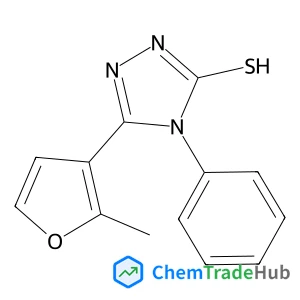
5-(2-Methyl-3-furyl)-4-phenyl-2,4-dihydro-3H-1,2,4-triazole-3-thione
CAS Number:
346464-59-3
Molecular Formula:
C13H11N3OS
Chunsheng Xiao, Chaoliang He, Gao Li, Xuesi Chen
In the present work, a horseradish peroxidase (HRP)-catalyzed hydrogel based on a double-end tyramine conjugated linear poly(ethylene glycol) (TA-PEG-TA) polymer is developed. The TA-PEG-TA is designed to act as not only a substrate of HRP, but also a macromonomer. We find that, the linear structure is sufficient to form robust hydrogels, and therefore it greatly simplifies the polymer architecture applicable to HRP-catalyzed hydrogels, which are always based on graft or branched polymers. The gelation time and strength of the TA-PEG-TA hydrogels can be well tuned by varying the concentrations of the polymer and HRP as well as the molar ratios of H2O2 to TA groups. The gelation mechanism is clarified by exploring the HRP-catalyzed reaction of a single-end tyramine conjugated poly(ethylene glycol) monomethyl ether (mPEG-TA). The multiple active hydrogen atoms (in the hydroxyl group and the o-position) of phenol moieties can be oxidized by H2O2via HRP catalysis, which should be responsible for the generation of mPEG-TA oligomers and the gelation of TA-PEG-TA. This study provides a new strategy for the design of injectable enzymatically crosslinked hydrogels.
John D. Holbrey, W. Matthew Reichert, Mark Nieuwenhuyzen, Oonagh Sheppard, Robin D. Rogers
DOI: 10.1039/B212726A
Dharma Rao Vutukuri, Kulandaivelu Sivanandan, S. Thayumanavan
DOI: 10.1039/B212206P
George W. Gokel
DOI: 10.1039/B305483G
Robin B. Bedford, Michael E. Blake, Craig P. Butts, Debbie Holder
DOI: 10.1039/B211329E
Greta Varchi, Christiane Kofink, David M. Lindsay, Alfredo Ricci, Paul Knochel
DOI: 10.1039/B211115B
Nadège Pantoustier, Sébastien Moins, Michaël Wautier, Philippe Degée, Philippe Dubois
DOI: 10.1039/B208703K
Jacqueline Collin, Jean-Claude Daran, Emmanuelle Schulz, Alexander Trifonov
DOI: 10.1039/B310954B
Hidetoshi Kishuku, Mitsuru Shindo, Kozo Shishido
DOI: 10.1039/B211227B
Shigekazu Ito, Hongze Liang, Masaaki Yoshifuji
DOI: 10.1039/B211230B
Angel Mendoza, Juan Aguilar, Manuel G. Basallote, Laura Gil, Juan C. Hernández, M. Angeles Máñez, Enrique García-España, Lena Ruiz-Ramírez, Conxa Soriano, Begoña Verdejo
DOI: 10.1039/B309721H
When handling lithium chloride hydrate (1:1:1) (CAS: 16712-20-2), it is importan...
4-(4H-1,2,4-Triazol-4-yl)piperidine is generally considered safe for use in phar...
Waste containing 1,3-Thiazole-2-carboxamide (CAS: 16733-85-0) should be collecte...
5-(Difluoromethyl)-2-fluorobenzonitrile (CAS: 934175-58-3) is subject to regulat...
Methyl 3-acetamido-2-thiophenecarboxylate can be synthesized by the reaction of ...
4-Isoquinolinecarbonitrile is a chemical compound with the CAS number 34846-65-6...
Store Methyl 1H-1,2,3-triazole-4-carboxylate (CAS: 877309-59-6) in a cool, dry p...
6-Bromo[1,3]thiazolo[5,4-b]pyridin-2-amine (CAS: 1160791-13-8) is subject to the...
(2S,3S)-2-Ammonio-3-(3,4-dihydroxyphenyl)-3-hydroxypropanoate (CAS: 23651-95-8) ...
7-Bromo-3-methyl-3,4-dihydroquinazolin-4-one is a solid with a crystalline form....

Polymer Chemistry welcomes submissions in all areas of polymer science that have a strong focus on macromolecular chemistry. Manuscripts may cover a broad range of fields, yet no direct application focus is required.
![1-[4-(4-Methyl-1H-imidazol-1-yl)phenyl]ethanone structure](https://static.chemtradehub.com/structs/142/142161-53-3-7f55.webp "1-[4-(4-Methyl-1H-imidazol-1-yl)phenyl]ethanone structure")
![6,6-Dimethylbicyclo[3.1.1]hept-2-ene-2-carbaldehyde structure](https://static.chemtradehub.com/structs/564/564-94-3-e746.webp "6,6-Dimethylbicyclo[3.1.1]hept-2-ene-2-carbaldehyde structure")



