












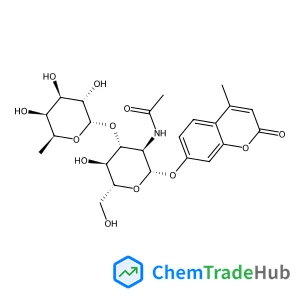
4-Methyl-2-oxo-2H-chromen-7-yl 2-acetamido-2-deoxy-3-O-(6-deoxy-alpha-L-galactopyranosyl)-beta-D-glucopyranoside
CAS Number:
383160-12-1
Molecular Formula:
C24H31NO12
Robin B. Bedford, Michael E. Blake, Craig P. Butts, Debbie Holder
Palladium acetate in a mixture of TBAB and water can be used as an effective catalyst for the Suzuki coupling of deactivated aryl chloride substrates.
Guoqiang Ding
DOI: 10.1039/D1RE00208B
Prachiti R. Bedadur, Arun Torris
DOI: 10.1039/D1RE00076D
Matthijs de Geus, Inge van der Meulen, Bart Goderis, Kristof van Hecke, Marko Dorschu, Harm van der Werff, Cor E. Koning
DOI: 10.1039/B9PY00360F
Kai Cheng, Shiyao Lu, Kai Wang, Guangsheng Luo
DOI: 10.1039/D1RE00434D
Bhanwar Kumar Malviya, Genji Sukumar
DOI: 10.1039/D1RE00260K
Hien T. T. Duong, T. L. Uyen Nguyen, Martina H. Stenzel
DOI: 10.1039/B9PY00210C
Abolfazl Heydari, Mahdieh Darroudi
DOI: 10.1039/D1RE00089F
Mathurin Grogna, Rudi Cloots, André Luxen, Christine Jérôme, Catherine Passirani, Nolwenn Lautram, Jean-F. Desreux, Christophe Detrembleur
DOI: 10.1039/C0PY00117A
Jungang Yi, Xianghui Wu, Huadong Wu, Jia Guo
DOI: 10.1039/D1RE90046C
When handling lithium chloride hydrate (1:1:1) (CAS: 16712-20-2), it is importan...
4-(4H-1,2,4-Triazol-4-yl)piperidine is generally considered safe for use in phar...
Waste containing 1,3-Thiazole-2-carboxamide (CAS: 16733-85-0) should be collecte...
5-(Difluoromethyl)-2-fluorobenzonitrile (CAS: 934175-58-3) is subject to regulat...
Methyl 3-acetamido-2-thiophenecarboxylate can be synthesized by the reaction of ...
4-Isoquinolinecarbonitrile is a chemical compound with the CAS number 34846-65-6...
Store Methyl 1H-1,2,3-triazole-4-carboxylate (CAS: 877309-59-6) in a cool, dry p...
6-Bromo[1,3]thiazolo[5,4-b]pyridin-2-amine (CAS: 1160791-13-8) is subject to the...
(2S,3S)-2-Ammonio-3-(3,4-dihydroxyphenyl)-3-hydroxypropanoate (CAS: 23651-95-8) ...
7-Bromo-3-methyl-3,4-dihydroquinazolin-4-one is a solid with a crystalline form....

ChemComm publishes urgent research which is of outstanding significance and interest to experts in the field, while also appealing to the journal’s broad chemistry readership. Our communication format is ideally suited to short, urgent studies that are of such importance that they require accelerated publication. Our scope covers all topics in chemistry, and research at the interface of chemistry and other disciplines (such as materials science, nanoscience, physics, engineering and biology) where there is a significant novelty in the chemistry aspects. Major topic areas covered include: Analytical Chemistry Catalysis Chemical Biology and medicinal chemistry Computational Chemistry and Machine Learning Energy and sustainable chemistry Environmental Chemistry Green Chemistry Inorganic Chemistry Materials Chemistry Nanoscience Organic Chemistry Physical Chemistry Polymer Chemistry Supramolecular Chemistry
![Benzeneacetic acid, 2-bromo-α-[[(1,1-dimethylethoxy)carbonyl]amino]-, (αS)- structure](https://static.chemtradehub.com/structs/122/1228547-87-2-f296.webp "Benzeneacetic acid, 2-bromo-α-[[(1,1-dimethylethoxy)carbonyl]amino]-, (αS)- structure")



