












Conformational isomerism in cyclic peptoids and its specification
Literature Information
Publication Date
2017-11-16
DOI
10.1039/C7OB02643A
Impact Factor
3.876
Authors
A. D'Amato, R. Schettini, G. Della Sala, C. Costabile, C. Tedesco, I. Izzo, F. De Riccardis
View Original
Abstract
Most of the structural studies made on the secondary structure of peptoids describe their geometric attributes in terms of the classic Ramachandran plot (based on the local analysis of ω, ψ, χ, φ dihedral angles). However, little intuitive understanding is available from internal coordinates when stereochemistry is involved. In this contribution we list all the conformationally stable cyclic peptoids reported up to the year 2017 and propose a simple method to define their geometric arrangement in terms of planar chirality. Evidence of conformational isomerism (due to the long average time of single bond rotation) and conformational chirality (induced by the absence of roto-reflection axes) in this promising class of synthetic macrocycles is provided by NMR spectroscopy (using Pirkle's alcohol as chiral solvating agent) and careful evaluation of X-ray crystallographic studies. The full understanding of the oligomeric macrocycles’ structural properties and the clear framing of their conformational isomerism in a proper conceptual scheme is fundamental for future application of peptoids in asymmetric synthesis, chiral recognition and supramolecular chemistry.
Related Literature
Controlled proteinassembly on a switchable surface
Ying Liu, Li Mu, Baohong Liu, Song Zhang, Pengyuan Yang, Jilie Kong
2004-04-14
Communication
DOI: 10.1039/B400776J
Programmed single step self-assembly of a [2 × 2] grid architecture built on metallic centers of different coordination geometries
Anne Petitjean, Nathalie Kyritsakas, Jean-Marie Lehn
2004-04-23
Communication
DOI: 10.1039/B402854F
Synthesis and properties of rhenium tricarbonyl complex bearing N-fused tetraphenylporphyrin ligand
Motoki Toganoh, Tomoya Ishizuka
2004-09-20
Communication
DOI: 10.1039/B406234E
Novel aggregation of [Ni(thiolato)2(amine)2]-type square planes assisted by silver(i) ions
Takumi Konno, Masafumi Usami, Masakazu Hirotsu, Takashi Yoshimura, Tatsuya Kawamoto
2004-09-01
Communication
DOI: 10.1039/B404512B
Y-shaped two-photon absorbing molecules with an imidazole–thiazole core
Ke Feng, Leonardo De Boni, Lino Misoguti, C. R. Mendonça, Michael Meador, Fu-Lian Hsu, Xiu R. Bu
2004-04-21
Communication
DOI: 10.1039/B402019G
Phenylthiolate as a σ- and π- donor ligand: synthesis of a 3-D organometallic coordination polymer [K2Fe(SPh)4]n
Xiao-Yan Yu, Lin-Hong Weng
2004-05-24
Communication
DOI: 10.1039/B404443F
A new (63)·(69.81) non-interpenetrated paramagnetic network with helical nanochannels based on a tricarboxylic perchlorotriphenylmethyl radical
Daniel Maspoch, Daniel Ruiz-Molina, Klaus Wurst, Concepció Rovira, Jaume Veciana
2004-04-22
Communication
DOI: 10.1039/B315147F
First cation radical salt of a tetrathiafulvalene–based phosphine metal complex
Narcis Avarvari, Marc Fourmigué
2004-05-05
Communication
DOI: 10.1039/B403168G
Construction of building-blocks for polyether synthesis using sequential catalytic ring-closing enyne and cross metathesis
J. Stephen Clark, Frédéric Elustondo, Marc C. Kimber
2004-09-24
Communication
DOI: 10.1039/B409067E
High-efficiency and minimum-waste continuous kinetic resolution of racemic alcohols by using lipase in supercritical carbon dioxide
Tomoko Matsuda, Kazunori Watanabe, Tadao Harada, Kaoru Nakamura, Yoshitaka Arita, Yukihiro Misumi, Shinichiro Ichikawa, Takao Ikariya
2004-08-26
Communication
DOI: 10.1039/B406882C
You might also like
Compound Q&A
What precautions should be taken when handling 2-Chloro-1,2-bis(4-methylphenyl)ethanone (CAS: 71193-32-3)?
When handling 2-Chloro-1,2-bis(4-methylphenyl)ethanone (CAS: 71193-32-3), it is ...
71193-32-32-Chloro-1,2-bis(4-m...
Compound Q&A
What industries use 4-Ethoxy-3-(5-methyl-4-oxo-7-propyl-1,4-dihydroimidazo[5,1-f][1,2,4]triazin-2-yl)benzenesulfonyl chloride (CAS: 224789-26-8)?
4-Ethoxy-3-(5-methyl-4-oxo-7-propyl-1,4-dihydroimidazo[5,1-f][1,2,4]triazin-2-yl...
224789-26-84-Ethoxy-3-(5-methyl...
Compound Q&A
How should Methyl 3-Oxo-4-Androsten-17-Carboxylate (CAS: 2681-55-2) be stored?
Methyl 3-Oxo-4-Androsten-17-Carboxylate (CAS: 2681-55-2) should be stored in a c...
2681-55-2Methyl 3-Oxo-4-Andro...
Compound Q&A
What are the main uses of (R)-3-Amino-4-(3-hexylphenylamino)-4-oxobutylphosphonic acid (CAS: 909725-61-7)?
(R)-3-Amino-4-(3-hexylphenylamino)-4-oxobutylphosphonic acid is primarily used i...
909725-61-7(R)-3-Amino-4-(3-hex...
Compound Q&A
What regulatory guidelines apply to 2-Methyl-2-propanyl 3-amino-3-carbamoyl-1-azetidinecarboxylate (CAS: 1254120-14-3)?
2-Methyl-2-propanyl 3-amino-3-carbamoyl-1-azetidinecarboxylate (CAS: 1254120-14-...
1254120-14-32-Methyl-2-propanyl ...
Compound Q&A
Are there alternatives to (E)-4-(tert-Butoxy)-4-oxobut-2-enoic acid (CAS: 135355-96-3) in synthesis?
There are alternative reagents that can be used in synthesis instead of (E)-4-(t...
135355-96-3(E)-4-(tert-Butoxy)-...
Compound Q&A
What are the physical and chemical properties of [2-(3-Chlorophenyl)-1,3-thiazol-4-yl]methanol (CAS: 121202-20-8)?
[2-(3-Chlorophenyl)-1,3-thiazol-4-yl]methanol (CAS: 121202-20-8) is a crystallin...
121202-20-8[2-(3-Chlorophenyl)-...
Compound Q&A
What is the market or research trend for Methyl (2S)-[(4S)-2,2-dimethyl-1,3-dioxolan-4-yl]{[(4-methylphenyl)sulfonyl]oxy}acetate (CAS: 166249-17-8)?
The market and research trends for Methyl (2S)-[(4S)-2,2-dimethyl-1,3-dioxolan-4...
166249-17-8Methyl (2S)-[(4S)-2,...
Compound Q&A
What is the market or research trend for 1-Bromo-2-isocyanatoethane (CAS: 42865-19-0)?
The market for 1-Bromo-2-isocyanatoethane (CAS: 42865-19-0) is driven by its use...
42865-19-01-Bromo-2-isocyanato...
Compound Q&A
What are the main uses of 4-Nitro-D-phenylalanine hydrochloride (CAS: 147065-06-3)?
4-Nitro-D-phenylalanine hydrochloride (CAS: 147065-06-3) is primarily used in re...
147065-06-34-Nitro-D-phenylalan...
Source Journal
Organic & Biomolecular Chemistry

CiteScore:
3.4
Self-citation Rate:
10.3%
Articles per Year:
1041
Organic & Biomolecular Chemistry (OBC) publishes original and high impact research and reviews in organic chemistry. We welcome research that shows new or significantly improved protocols or methodologies in total synthesis, synthetic methodology or physical and theoretical organic chemistry as well as research that shows a significant advance in the organic chemistry or molecular design aspects of chemical biology, catalysis, supramolecular and macromolecular chemistry, theoretical chemistry, mechanism-oriented physical organic chemistry, medicinal chemistry or natural products. Articles published in the journal should report new work which makes a highly-significant impact in the field. Routine and incremental work is generally not suitable for publication in the journal. More details about key areas of our scope are below. In all cases authors should include in their article clear rationale for why their research has been carried out.
Recommended Compounds
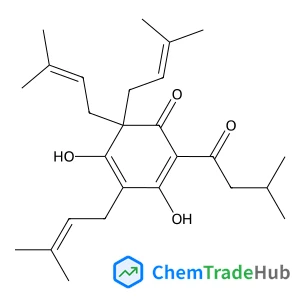
3,5-Dihydroxy-4-(3-methylbutanoyl)-2,6,6-tris(3-methyl-2-buten-1-yl)-2,4-cyclohexadien-1-one
CAS Number:
468-28-0
Molecular Formula:
C26H38O4

Recommended Suppliers




Disclaimer
This page provides academic journal information for reference and research purposes only. We are not affiliated with any journal publishers and do not handle publication submissions. For publication-related inquiries, please contact the respective journal publishers directly.
If you notice any inaccuracies in the information displayed, please contact us at support@chemtradehub.com. We will promptly review and address your concerns.