













Spatial requirement for PAMO for transformation of non-native linear substrates
Literature Information
Publication Date
2018-01-03
DOI
10.1039/C7CP07172H
Impact Factor
3.676
Authors
Miguel de Abreu, Lyndsey J. Ferguson, Derek J. Quinn, Meilan Huang
View Original
Abstract
Phenylacetone monooxygenase is the most stable and thermo-tolerant member of the Baeyer–Villiger monooxygenases family, and therefore it is an ideal candidate for the synthesis of industrially relevant ester or lactone compounds. However, its limited substrate scope has largely limited its industrial applications. Linear substrates are interesting from an industrial point of view, it is thus necessary to identify the essential spatial requirement for achieving high conversions for non-native linear substrates. Here using molecular dynamics simulations, we compared the conversion of a non-native linear substrate 2-octanone and the native substrate phenylacetone, catalyzed by the WT enzyme and a quadruple variant P253F/G254A/R258M/L443F that exhibits significantly improved activity towards 2-octanone. We uncovered that a remarkable movement of L289 is crucial for a reshaping of the active site of the quadruple variant so as to prevent the aliphatic substrate from moving away from the C4a-peroxyflavin, thus enabling it to keep a catalytically relevant pose during the oxygenation process. By performing steady-state kinetic analysis of two single-mutation variants at position 258, we further validated that the L289 reposition is attributed to the combined effect of quadruple mutations. In order to further explore the substrate scope of PAMO we also studied the binding of cyclopentanone and 2-phenylcyclohexanone, which are the typical substrates of CPMO in group I and CHMO in group III, respectively. Our study provides fundamental atomic-level insights in rational engineering of PAMO for wide applications in industrial biocatalysis, in particular, in the biotransformation of long-chain aliphatic oils into potential biodiesels.
Related Literature
Novel N,O-Cu(OAc)2 complex catalysed diastereo- and enantioselective 1,4-addition of glycine derivatives to alkylidene malonates
Ming Wang, Yu-Hua Shi, Jun-Fei Luo, Wenting Du, Xiao-Xin Shi, Wei-Ping Deng
2011-02-04
Paper
DOI: 10.1039/C0CY00001A
An organogel formed from a cyclic β-aminoalcohol
Chuanqing Kang, Zheng Bian, Yabing He, Fushe Han, Xuepeng Qiu, Lianxun Gao
2011-08-24
Communication
DOI: 10.1039/C1CC13179F
Pentametallic lanthanide-alkoxide square-based pyramids: high energy barrier for thermal relaxation in a holmium single molecule magnet‡
Robin J. Blagg, Floriana Tuna, Eric J. L. McInnes, Richard E. P. Winpenny
2011-09-01
Communication
DOI: 10.1039/C1CC14186D
Optically pure bulky (hetero)arylalkyl carbinols via kinetic resolution
Bin Hu, Meng Meng, Weimin Mo, Xinquan Hu, Wei-Ping Deng
2011-09-05
Communication
DOI: 10.1039/C1CC14591F
Efficient coating of polystyrene microspheres with graphene nanosheets
Yunxing Li, Zhaoqun Wang, Liang Yang, Hao Gu
2011-08-24
Communication
DOI: 10.1039/C1CC14614A
Rhodium-catalyzed asymmetric phenylation of N-phosphinoylarylimines with triphenylborane‡
Xinyu Hao, Qian Chen, Masami Kuriyama, Ken-ichi Yamada, Yasutomo Yamamoto, Kiyoshi Tomioka
2011-02-04
Communication
DOI: 10.1039/C0CY00083C
Reduction of organic azides to amines using reusable Fe3O4nanoparticles in aqueous medium
Subham Surana, Ajay Chauhan, Bibudha Parasar
2012-12-19
Communication
DOI: 10.1039/C2CY20776A
A gram scale synthesis of a multi-13C-labelled anthocyanin, [6,8,10,3′,5′-13C5]cyanidin-3-glucoside, for use in oral tracer studies in humans
Qingzhi Zhang, Nigel P. Botting, Colin Kay
2011-09-05
Communication
DOI: 10.1039/C1CC14323A
Gold(i)-catalyzed synthesis of furans and pyrrolesviaalkyne hydration
Pierrick Nun, Stéphanie Dupuy, Albert Poater, Luigi Cavallo, Steven P. Nolan
2011-01-31
Communication
DOI: 10.1039/C0CY00055H
Direct C–H bond arylations and alkenylations with phenol-derived fluorine-free electrophiles
Sergei I. Kozhushkov, Harish Kumar Potukuchi, Lutz Ackermann
2012-10-24
Minireview
DOI: 10.1039/C2CY20505J
You might also like
Compound Q&A
What industries use (1R,3S)-1,3-Cyclopentanediol (CAS: 16326-97-9)?
(1R,3S)-1,3-Cyclopentanediol finds applications in various industries. In the ph...
16326-97-9(1R,3S)-1,3-Cyclopen...
Compound Q&A
What precautions should be taken when handling N'-[4-(Dimethylamino)phenyl]-N,N-dimethyl-1,4-benzenediamine (CAS: 637-31-0)?
When handling N'-[4-(Dimethylamino)phenyl]-N,N-dimethyl-1,4-benzenediamine, it i...
637-31-0N'-[4-(Dimethylamino...
Compound Q&A
Are there alternatives to 5-(2,4-Difluorophenyl)-2-methoxypyrimidine (CAS: 1352318-16-1) in synthesis?
There are several alternatives to 5-(2,4-Difluorophenyl)-2-methoxypyrimidine in ...
1352318-16-15-(2,4-Difluoropheny...
Compound Q&A
What regulatory guidelines apply to 1-(3-Methoxyphenoxy)propan-2-ol (CAS: 382141-68-6)?
1-(3-Methoxyphenoxy)propan-2-ol (CAS: 382141-68-6) must comply with the Globally...
382141-68-61-(3-Methoxyphenoxy)...
Compound Q&A
Is Tetrodotoxin Citrate (CAS: 18660-81-6) safe?
Tetrodotoxin Citrate is extremely dangerous and should be handled with extreme c...
18660-81-6Tetrodotoxin Citrate
Compound Q&A
What are the main uses of 2-Methyl-2-propanyl [(1R,3S)-3-hydroxycyclopentyl]carbamate (CAS: 225641-84-9)?
2-Methyl-2-propanyl [(1R,3S)-3-hydroxycyclopentyl]carbamate (CAS: 225641-84-9) i...
225641-84-92-Methyl-2-propanyl ...
Compound Q&A
How should waste containing 4-(2-Hydroxyhexafluoroisopropyl)Benzoic Acid (CAS: 16261-80-6) be handled?
Waste containing 4-(2-Hydroxyhexafluoroisopropyl)Benzoic Acid (CAS: 16261-80-6) ...
16261-80-64-(2-Hydroxyhexafluo...
Compound Q&A
How is 2-Methyl-2-proanyl {(2S)-1-[(benzyloxy)amino]-3-hydroxy-3-methyl-1-oxo-2-butanyl}carbamate (CAS: 102507-19-7) typically synthesized?
2-Methyl-2-proanyl {(2S)-1-[(benzyloxy)amino]-3-hydroxy-3-methyl-1-oxo-2-butanyl...
102507-19-72-Methyl-2-propanyl ...
Compound Q&A
What is Benzeneethanamine, α-ethyl-, hydrochloride (1:1) (CAS: 20735-15-3)?
Benzeneethanamine, α-ethyl-, hydrochloride (1:1) is an organic compound with the...
20735-15-3Benzeneethanamine, α...
Compound Q&A
Are there alternatives to 3-{(E)-[4-(Dimethylamino)phenyl]diazenyl}benzoic acid (CAS: 20691-84-3) in synthesis?
In the synthesis of compounds similar to 3-{(E)-[4-(Dimethylamino)phenyl]diazeny...
20691-84-33-{(E)-[4-(Dimethyla...
Source Journal
Physical Chemistry Chemical Physics

CiteScore:
5.5
Self-citation Rate:
10.3%
Articles per Year:
3036
Physical Chemistry Chemical Physics (PCCP) is an international journal co-owned by 19 physical chemistry and physics societies from around the world. This journal publishes original, cutting-edge research in physical chemistry, chemical physics and biophysical chemistry. To be suitable for publication in PCCP, articles must include significant innovation and/or insight into physical chemistry; this is the most important criterion that reviewers and Editors will judge against when evaluating submissions. The journal has a broad scope and welcomes contributions spanning experiment, theory, computation and data science. Topical coverage includes spectroscopy, dynamics, kinetics, statistical mechanics, thermodynamics, electrochemistry, catalysis, surface science, quantum mechanics, quantum computing and machine learning. Interdisciplinary research areas such as polymers and soft matter, materials, nanoscience, energy, surfaces/interfaces, and biophysical chemistry are welcomed if they demonstrate significant innovation and/or insight into physical chemistry. Joined experimental/theoretical studies are particularly appreciated when complementary and based on up-to-date approaches.
Recommended Compounds
![N-[(5,6-Dichloro-1H-benzimidazol-2-yl)methyl]-9-(1-methyl-1H-pyrazol-4-yl)-2-(4-morpholinyl)-9H-purin-6-amine structure](https://static.chemtradehub.com/structs/238/2387704-62-1-25f4.webp "N-[(5,6-Dichloro-1H-benzimidazol-2-yl)methyl]-9-(1-methyl-1H-pyrazol-4-yl)-2-(4-morpholinyl)-9H-purin-6-amine structure")
N-[(5,6-Dichloro-1H-benzimidazol-2-yl)methyl]-9-(1-methyl-1H-pyrazol-4-yl)-2-(4-morpholinyl)-9H-purin-6-amine
CAS Number:
2387704-62-1
Molecular Formula:
C21H20Cl2N10O
![N,N'-1,2-Ethanediylbis[2-(vinylsulfonyl)acetamide] structure](https://static.chemtradehub.com/structs/667/66710-66-5-b556.webp "N,N'-1,2-Ethanediylbis[2-(vinylsulfonyl)acetamide] structure")
N,N'-1,2-Ethanediylbis[2-(vinylsulfonyl)acetamide]
CAS Number:
66710-66-5
Molecular Formula:
C10H16N2O6S2

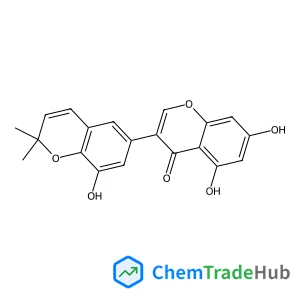
5,7,8'-Trihydroxy-2',2'-dimethyl-2'H,4H-3,6'-bichromen-4-one
CAS Number:
129280-33-7
Molecular Formula:
C20H16O6
Recommended Suppliers



Disclaimer
This page provides academic journal information for reference and research purposes only. We are not affiliated with any journal publishers and do not handle publication submissions. For publication-related inquiries, please contact the respective journal publishers directly.
If you notice any inaccuracies in the information displayed, please contact us at support@chemtradehub.com. We will promptly review and address your concerns.