












Theoretical perspectives on the structure, electronic, and optical properties of titanosilicates Li2M4[(TiO)Si4O12] (M = K+, Rb+)
Literature Information
Publication Date
2017-05-17
DOI
10.1039/C7CP01946G
Impact Factor
3.676
Authors
Zuju Ma, Rongjian Sa, Yongfan Zhang, Kechen Wu
View Original
Abstract
It is still a challenge to design and synthesize high performance broader ultraviolet non-linear optical (NLO) materials. Two new transition-metal silicates have recently attracted a lot of attention due to their strong phase-matched second harmonic generation (SHG) responses (about 4.5 times higher than KDP). However, the electronic and optical properties underlying the high performance of these materials and consequently, the possibility of designing more efficient silicates for NLO applications are not presently clear. In this study, the geometrical structure and bonding character, electronic structure and optical properties of Li2M4[(TiO)Si4O12] (M = K+, Rb+) crystals have been systematically determined based on the density functional theory. Satisfactory agreement between the experimental and theoretical results indicates that the method and conditions used herein are favorable. A detailed analysis of the precise electronic structure and dipole moments of the two compounds suggests that it is the strong covalent character between Ti(Si) and O and the same orientation alignment of the dipole moment vector of the constituent asymmetric [TiO5]6− square pyramid anion units that result in the large SHG responses for the two compounds. In addition, the unavailable linear and non-linear optical experimental parameters, including dielectric function, optical absorption and birefringence, and all the components of the SHG coefficients are reported for the first time. This investigation unravels the structure–property relationships of titanosilicates and may be significant in terms of providing an efficient strategy towards designing more potential and competitive NLO materials.
Recommended Journals
Related Literature
Gold-catalyzed C5-alkylation of indolines and sequential oxidative aromatization: access to C5-functionalized indoles
Wenzheng Zhang, Guangyang Xu, Lin Qiu, Jiangtao Sun
2018-05-02
Communication
DOI: 10.1039/C8OB00826D
Design of chiral ferrocenylphosphine-spiro phosphonamidite ligands for ruthenium-catalyzed highly enantioselective coupling of 1,2-diols with amines
Xiao Yi, Yirui Chen, An Huang, Dingguo Song, Jiaying He, Fei Ling, Weihui Zhong
2021-11-03
Research Article
DOI: 10.1039/D1QO01443A
Recent advances in catalytic enantioselective direct C–H bond functionalization of electron-deficient N-containing heteroarenes
Xiao-Lan Liu, Luo-Bin Jiang, Mu-Peng Luo, Zhi Ren, Shou-Guo Wang
2021-09-22
Review Article
DOI: 10.1039/D1QO01223A
Intramolecular iron-catalyzed transannulation of furans with O-acetyl oximes: synthesis of functionalized pyrroles
Anton S. Makarov, Alexander A. Fadeev, Maxim G. Uchuskin
2021-10-05
Research Article
DOI: 10.1039/D1QO01281A
Synthesis of N-indolated amino acids or peptides from 2-alkynylanilines via a dearomatization process
Weilian Qiu, Weiyi Wang, Yin Liu, Renhua Fan
2021-10-07
Research Article
DOI: 10.1039/D1QO01257F
Synthesis and biochemical evaluation of two novel N-hydroxyalkylated cyclosporin A analogs
Viktoria Kahlert, Oliver Ohlenschläger, Jelena Melesina, Christian Lücke
2018-05-24
Paper
DOI: 10.1039/C8OB00980E
High pressure-assisted low-loading asymmetric organocatalytic conjugate addition of nitroalkanes to chalcones‡
Agnieszka Cholewiak, Kamil Adamczyk, Michał Kopyt, Adrian Kasztelan, Piotr Kwiatkowski
2018-05-22
Paper
DOI: 10.1039/C8OB00561C
Palladium-catalysed stereoselective [3 + 2] annulation of vinylethylene carbonates and tryptanthrin-based ketones
Qing-Zhu Li, Jun-Long Li, Bin Zhang, Zhen Dai, Ke Xie, Rong Zeng, Liang Zou, Xiang Zhang
2021-11-22
Research Article
DOI: 10.1039/D1QO01543E
Mild and efficient synthesis of indoles and isoquinolones via a nickel-catalyzed Larock-type heteroannulation reaction
Wei-Zhi Weng, Jian Xie, Bo Zhang
2018-05-04
Paper
DOI: 10.1039/C8OB00795K
You might also like
Compound Q&A
What industries use (1R,3S)-1,3-Cyclopentanediol (CAS: 16326-97-9)?
(1R,3S)-1,3-Cyclopentanediol finds applications in various industries. In the ph...
16326-97-9(1R,3S)-1,3-Cyclopen...
Compound Q&A
What precautions should be taken when handling N'-[4-(Dimethylamino)phenyl]-N,N-dimethyl-1,4-benzenediamine (CAS: 637-31-0)?
When handling N'-[4-(Dimethylamino)phenyl]-N,N-dimethyl-1,4-benzenediamine, it i...
637-31-0N'-[4-(Dimethylamino...
Compound Q&A
Are there alternatives to 5-(2,4-Difluorophenyl)-2-methoxypyrimidine (CAS: 1352318-16-1) in synthesis?
There are several alternatives to 5-(2,4-Difluorophenyl)-2-methoxypyrimidine in ...
1352318-16-15-(2,4-Difluoropheny...
Compound Q&A
What regulatory guidelines apply to 1-(3-Methoxyphenoxy)propan-2-ol (CAS: 382141-68-6)?
1-(3-Methoxyphenoxy)propan-2-ol (CAS: 382141-68-6) must comply with the Globally...
382141-68-61-(3-Methoxyphenoxy)...
Compound Q&A
Is Tetrodotoxin Citrate (CAS: 18660-81-6) safe?
Tetrodotoxin Citrate is extremely dangerous and should be handled with extreme c...
18660-81-6Tetrodotoxin Citrate
Compound Q&A
What are the main uses of 2-Methyl-2-propanyl [(1R,3S)-3-hydroxycyclopentyl]carbamate (CAS: 225641-84-9)?
2-Methyl-2-propanyl [(1R,3S)-3-hydroxycyclopentyl]carbamate (CAS: 225641-84-9) i...
225641-84-92-Methyl-2-propanyl ...
Compound Q&A
How should waste containing 4-(2-Hydroxyhexafluoroisopropyl)Benzoic Acid (CAS: 16261-80-6) be handled?
Waste containing 4-(2-Hydroxyhexafluoroisopropyl)Benzoic Acid (CAS: 16261-80-6) ...
16261-80-64-(2-Hydroxyhexafluo...
Compound Q&A
How is 2-Methyl-2-proanyl {(2S)-1-[(benzyloxy)amino]-3-hydroxy-3-methyl-1-oxo-2-butanyl}carbamate (CAS: 102507-19-7) typically synthesized?
2-Methyl-2-proanyl {(2S)-1-[(benzyloxy)amino]-3-hydroxy-3-methyl-1-oxo-2-butanyl...
102507-19-72-Methyl-2-propanyl ...
Compound Q&A
What is Benzeneethanamine, α-ethyl-, hydrochloride (1:1) (CAS: 20735-15-3)?
Benzeneethanamine, α-ethyl-, hydrochloride (1:1) is an organic compound with the...
20735-15-3Benzeneethanamine, α...
Compound Q&A
Are there alternatives to 3-{(E)-[4-(Dimethylamino)phenyl]diazenyl}benzoic acid (CAS: 20691-84-3) in synthesis?
In the synthesis of compounds similar to 3-{(E)-[4-(Dimethylamino)phenyl]diazeny...
20691-84-33-{(E)-[4-(Dimethyla...
Source Journal
Physical Chemistry Chemical Physics

CiteScore:
5.5
Self-citation Rate:
10.3%
Articles per Year:
3036
Physical Chemistry Chemical Physics (PCCP) is an international journal co-owned by 19 physical chemistry and physics societies from around the world. This journal publishes original, cutting-edge research in physical chemistry, chemical physics and biophysical chemistry. To be suitable for publication in PCCP, articles must include significant innovation and/or insight into physical chemistry; this is the most important criterion that reviewers and Editors will judge against when evaluating submissions. The journal has a broad scope and welcomes contributions spanning experiment, theory, computation and data science. Topical coverage includes spectroscopy, dynamics, kinetics, statistical mechanics, thermodynamics, electrochemistry, catalysis, surface science, quantum mechanics, quantum computing and machine learning. Interdisciplinary research areas such as polymers and soft matter, materials, nanoscience, energy, surfaces/interfaces, and biophysical chemistry are welcomed if they demonstrate significant innovation and/or insight into physical chemistry. Joined experimental/theoretical studies are particularly appreciated when complementary and based on up-to-date approaches.
Recommended Compounds
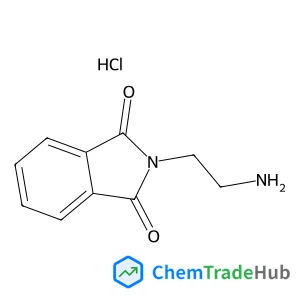
2-(2-Aminoethyl)-1H-isoindole-1,3(2H)-dione hydrochloride (1:1)
CAS Number:
30250-67-0
Molecular Formula:
C10H11ClN2O2
Recommended Suppliers




Disclaimer
This page provides academic journal information for reference and research purposes only. We are not affiliated with any journal publishers and do not handle publication submissions. For publication-related inquiries, please contact the respective journal publishers directly.
If you notice any inaccuracies in the information displayed, please contact us at support@chemtradehub.com. We will promptly review and address your concerns.