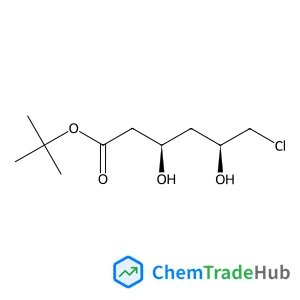
2-Methyl-2-propanyl (3R,5S)-6-chloro-3,5-dihydroxyhexanoate
CAS Number:
154026-93-4
Molecular Formula:
C10H19ClO4
Wenzheng Zhang, Guangyang Xu, Lin Qiu, Jiangtao Sun
A novel protocol for the synthesis of C5-alkylated indole derivatives via a gold-catalyzed reaction of indolines with diazo compounds and subsequent oxidative aromatization has been developed. C–H bond functionalization selectively occurs at the C5-position of indolines without a directing group. The experimental operation is simple and the whole process can be manipulated in one-pot.

Herald of the Russian Academy of Sciences

Main Group Chemistry

Topics in Catalysis

Biocatalysis and Biotransformation

Critical Reviews in Solid State and Materials Sciences

Chinese Journal of Chemistry

Bioorganic & Medicinal Chemistry

Journal of Asian Natural Products Research

NDT & E International

Journal of the Indian Institute of Science
Yuanqi Wu, Bing Xu, Bing Liu, Zhan-Ming Zhang, Yu Liu
DOI: 10.1039/C8OB02922A
Shuang Sun, Padma Akkapeddi, Nuria Martínez-Sáez, Vukosava M. Torres, Carlos Cordeiro, Omar Boutureira
DOI: 10.1039/C8OB02877J
Jonathan Barrios-Rivera, Yingjian Xu, Martin Wills
DOI: 10.1039/C8OB02889C
Si-Zhe Li, Armelle Vigouroux, Mohammed Ahmar, Abbas El Sahili, Laurent Soulère, Laïla Sago, David Cornu, Solange Moréra, Yves Queneau
DOI: 10.1039/C8OB03086C
Fei Meng, Qin Fang, Weidong Yuan, Ning Xu, Shujun Cao, Jianlin Chun, Jie Li, Honglin Zhang, Yingguang Zhu
DOI: 10.1039/D0QO00282H
Joshua McErlean, Jessica A. Smith, Tom Hasell, Michael V. Perkins
DOI: 10.1039/C8OB02130A
Blake S. N. Huchenski, Alexander W. H. Speed
DOI: 10.1039/C8OB02330A
(1R,3S)-1,3-Cyclopentanediol finds applications in various industries. In the ph...
When handling N'-[4-(Dimethylamino)phenyl]-N,N-dimethyl-1,4-benzenediamine, it i...
There are several alternatives to 5-(2,4-Difluorophenyl)-2-methoxypyrimidine in ...
1-(3-Methoxyphenoxy)propan-2-ol (CAS: 382141-68-6) must comply with the Globally...
Tetrodotoxin Citrate is extremely dangerous and should be handled with extreme c...
2-Methyl-2-propanyl [(1R,3S)-3-hydroxycyclopentyl]carbamate (CAS: 225641-84-9) i...
Waste containing 4-(2-Hydroxyhexafluoroisopropyl)Benzoic Acid (CAS: 16261-80-6) ...
2-Methyl-2-proanyl {(2S)-1-[(benzyloxy)amino]-3-hydroxy-3-methyl-1-oxo-2-butanyl...
Benzeneethanamine, α-ethyl-, hydrochloride (1:1) is an organic compound with the...
In the synthesis of compounds similar to 3-{(E)-[4-(Dimethylamino)phenyl]diazeny...

Organic & Biomolecular Chemistry (OBC) publishes original and high impact research and reviews in organic chemistry. We welcome research that shows new or significantly improved protocols or methodologies in total synthesis, synthetic methodology or physical and theoretical organic chemistry as well as research that shows a significant advance in the organic chemistry or molecular design aspects of chemical biology, catalysis, supramolecular and macromolecular chemistry, theoretical chemistry, mechanism-oriented physical organic chemistry, medicinal chemistry or natural products. Articles published in the journal should report new work which makes a highly-significant impact in the field. Routine and incremental work is generally not suitable for publication in the journal. More details about key areas of our scope are below. In all cases authors should include in their article clear rationale for why their research has been carried out.
![N-[(9H-Fluoren-9-ylmethoxy)carbonyl]-beta-phenyl-L-phenylalanine structure](https://static.chemtradehub.com/structs/201/201484-50-6-c2fc.webp "N-[(9H-Fluoren-9-ylmethoxy)carbonyl]-beta-phenyl-L-phenylalanine structure")