












Mild and efficient synthesis of indoles and isoquinolones via a nickel-catalyzed Larock-type heteroannulation reaction
Literature Information
Publication Date
2018-05-04
DOI
10.1039/C8OB00795K
Impact Factor
3.876
Authors
Wei-Zhi Weng, Jian Xie, Bo Zhang
View Original
Abstract
A simple and efficient approach for the preparation of substituted indoles and isoquinolones via a nickel-catalyzed Larock-type heteroannulation reaction is reported. This transformation employed air-stable and inexpensive Ni(dppp)Cl2 as a precatalyst and Et3N as a mild base. Moreover, the reaction occurs efficiently under mild conditions, and a wide range of substituted indoles and isoquinolones bearing various functional groups are obtained in moderate to excellent yields.
Recommended Journals
Related Literature
Bio-based polycarbonates: progress and prospects
Mi Feng, Ming Jiang
2023-11-14
Tutorial Review
DOI: 10.1039/D3SU00248A
Simultaneous production of proteases and antioxidant biopeptides by solid-state fermentation
Luciane Maria Colla, Christian Oliveira Reinehr, Paola Gouvêa Manfredini, Vítor Augusto Farina Cavanhi, Jorge Alberto Vieira Costa
2023-08-29
Paper
DOI: 10.1039/D3FB00077J
Eco-design of the remembrance poppy: a life cycle assessment study
Andrea Paulillo, Martina Pucciarelli, Phil Prior, Paola Lettieri
2023-11-28
Paper
DOI: 10.1039/D3SU00279A
Development of strong and high-barrier food packaging films from cyclic-anhydride modified bacterial cellulose
Zhuolun Jiang, Ka Man Cheung, To Ngai
2023-10-23
Paper
DOI: 10.1039/D3SU00219E
Elucidating multiple reaction pathways for the degradation of antibiotics in water by a self-active single-atom zinc catalyst on biochar
Jieming Yuan, Yunkyoung Han, Krishnamoorthy Sathiyan, Virender K. Sharma, Abdol Hadi Mokarizadeh, Mesfin Tsige, Jiechao Jiang, Xingmao Ma
2023-10-17
Paper
DOI: 10.1039/D3SU00265A
Exploring the potential of mosambi peel and sago powder in developing edible spoons
Bareera Siddiqui, Alisha Ahmad, Owais Yousuf, Kaiser Younis
2023-09-27
Paper
DOI: 10.1039/D3FB00111C
Storage stability assessment of guava fruit (Psidium guajava L.) cv. ‘Gola’ in response to different packaging materials
Ali Asad Yousaf, Kashif Sarfraz Abbasi, Muhammad Suhail Ibrahim, Asma Sohail, Mamoona Faiz, Mehwish Khadim
2023-11-28
Paper
DOI: 10.1039/D3FB00113J
Towards sustainable synthesis: a life cycle assessment of polymer of intrinsic microporosity (PIM-1) by green mechanosynthesis
Ching Yoong Loh, Rui Huang, Roy Bell, Ming Xie
2023-10-26
Paper
DOI: 10.1039/D3SU00340J
Extraction of cellulose from restaurant food waste
Matthew T. Garnett, Harrish Kumar Senthil Kumar, Bryan S. Beckingham, Symone L. M. Alexander
2023-11-25
Paper
DOI: 10.1039/D3SU00192J
You might also like
Compound Q&A
What industries use (1R,3S)-1,3-Cyclopentanediol (CAS: 16326-97-9)?
(1R,3S)-1,3-Cyclopentanediol finds applications in various industries. In the ph...
16326-97-9(1R,3S)-1,3-Cyclopen...
Compound Q&A
What precautions should be taken when handling N'-[4-(Dimethylamino)phenyl]-N,N-dimethyl-1,4-benzenediamine (CAS: 637-31-0)?
When handling N'-[4-(Dimethylamino)phenyl]-N,N-dimethyl-1,4-benzenediamine, it i...
637-31-0N'-[4-(Dimethylamino...
Compound Q&A
Are there alternatives to 5-(2,4-Difluorophenyl)-2-methoxypyrimidine (CAS: 1352318-16-1) in synthesis?
There are several alternatives to 5-(2,4-Difluorophenyl)-2-methoxypyrimidine in ...
1352318-16-15-(2,4-Difluoropheny...
Compound Q&A
What regulatory guidelines apply to 1-(3-Methoxyphenoxy)propan-2-ol (CAS: 382141-68-6)?
1-(3-Methoxyphenoxy)propan-2-ol (CAS: 382141-68-6) must comply with the Globally...
382141-68-61-(3-Methoxyphenoxy)...
Compound Q&A
Is Tetrodotoxin Citrate (CAS: 18660-81-6) safe?
Tetrodotoxin Citrate is extremely dangerous and should be handled with extreme c...
18660-81-6Tetrodotoxin Citrate
Compound Q&A
What are the main uses of 2-Methyl-2-propanyl [(1R,3S)-3-hydroxycyclopentyl]carbamate (CAS: 225641-84-9)?
2-Methyl-2-propanyl [(1R,3S)-3-hydroxycyclopentyl]carbamate (CAS: 225641-84-9) i...
225641-84-92-Methyl-2-propanyl ...
Compound Q&A
How should waste containing 4-(2-Hydroxyhexafluoroisopropyl)Benzoic Acid (CAS: 16261-80-6) be handled?
Waste containing 4-(2-Hydroxyhexafluoroisopropyl)Benzoic Acid (CAS: 16261-80-6) ...
16261-80-64-(2-Hydroxyhexafluo...
Compound Q&A
How is 2-Methyl-2-proanyl {(2S)-1-[(benzyloxy)amino]-3-hydroxy-3-methyl-1-oxo-2-butanyl}carbamate (CAS: 102507-19-7) typically synthesized?
2-Methyl-2-proanyl {(2S)-1-[(benzyloxy)amino]-3-hydroxy-3-methyl-1-oxo-2-butanyl...
102507-19-72-Methyl-2-propanyl ...
Compound Q&A
What is Benzeneethanamine, α-ethyl-, hydrochloride (1:1) (CAS: 20735-15-3)?
Benzeneethanamine, α-ethyl-, hydrochloride (1:1) is an organic compound with the...
20735-15-3Benzeneethanamine, α...
Compound Q&A
Are there alternatives to 3-{(E)-[4-(Dimethylamino)phenyl]diazenyl}benzoic acid (CAS: 20691-84-3) in synthesis?
In the synthesis of compounds similar to 3-{(E)-[4-(Dimethylamino)phenyl]diazeny...
20691-84-33-{(E)-[4-(Dimethyla...
Source Journal
Organic & Biomolecular Chemistry

CiteScore:
3.4
Self-citation Rate:
10.3%
Articles per Year:
1041
Organic & Biomolecular Chemistry (OBC) publishes original and high impact research and reviews in organic chemistry. We welcome research that shows new or significantly improved protocols or methodologies in total synthesis, synthetic methodology or physical and theoretical organic chemistry as well as research that shows a significant advance in the organic chemistry or molecular design aspects of chemical biology, catalysis, supramolecular and macromolecular chemistry, theoretical chemistry, mechanism-oriented physical organic chemistry, medicinal chemistry or natural products. Articles published in the journal should report new work which makes a highly-significant impact in the field. Routine and incremental work is generally not suitable for publication in the journal. More details about key areas of our scope are below. In all cases authors should include in their article clear rationale for why their research has been carried out.
Recommended Compounds
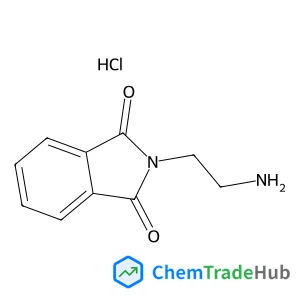
2-(2-Aminoethyl)-1H-isoindole-1,3(2H)-dione hydrochloride (1:1)
CAS Number:
30250-67-0
Molecular Formula:
C10H11ClN2O2
Recommended Suppliers






Disclaimer
This page provides academic journal information for reference and research purposes only. We are not affiliated with any journal publishers and do not handle publication submissions. For publication-related inquiries, please contact the respective journal publishers directly.
If you notice any inaccuracies in the information displayed, please contact us at support@chemtradehub.com. We will promptly review and address your concerns.