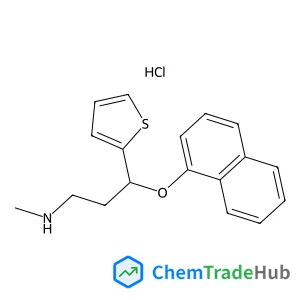
N-Methyl-3-(1-naphthyloxy)-3-(2-thienyl)-1-propanamine hydrochloride (1:1)
CAS Number:
1188266-11-6
Molecular Formula:
C18H20ClNOS
K. Krishnamoorthy, Rajesh S. Gokhale, Aliasgar Q. Contractor, Anil Kumar
We report on the design and development of a novel label-free DNA sensor based on conducting poly(3,4-ethylenedioxythiophene) for the direct detection and quantification of target ssDNA.
Yongli Huang, Zengsheng Ma, Yichun Zhou, Weitao Zheng, Ji Zhou, Chang Q. Sun
DOI: 10.1039/C4CP02516D
N. Eltouny
DOI: 10.1039/C4CP02379J
Qiang Zhang, Yanghua Deng, Zhonghua Hu, Yafei Liu, Mingming Yao, Peipei Liu
DOI: 10.1039/C4CP02928C
O. V. Magdysyuk, F. Adams, H.-P. Liermann, I. Spanopoulos, P. N. Trikalitis, M. Hirscher, R. E. Morris, M. J. Duncan, L. J. McCormick, R. E. Dinnebier
DOI: 10.1039/C4CP03298E
Anne Neumeister, Jurij Jakobi, Christoph Rehbock, Janine Moysig, Stephan Barcikowski
DOI: 10.1039/C4CP03316G
Swati Vartak, Anatoly Golovnev, Ata Roudgar, Michael Eikerling
DOI: 10.1039/C4CP02937B
Micael Silva, Angelo Miguel Figueiredo, Eurico J. Cabrita
DOI: 10.1039/C4CP03534H
J. C. J. Camp, J. McGregor, I. M. Watson, R. A. Cox, M. Kalberer, A. D. Ward, F. D. Pope
DOI: 10.1039/C4CP00994K
Marina Frank, Sebastian Funke, Hainer Wackerbarth, Guido H. Clever
DOI: 10.1039/C4CP02188F
N-(4-Methoxybenzyl)-2-pyridinamine (CAS: 52818-63-0) is increasingly being used ...
When handling Ethyl 4-(2-chlorophenyl)-1,3-thiazole-2-carboxylate, appropriate p...
Diethyldiselane (CAS: 628-39-7) is classified under the Globally Harmonized Syst...
The market for oxocopper (CAS: 12053-18-8) is primarily driven by its use in cat...
The market for 5-{[(2-Methyl-2-propanyl)oxy]carbonyl}-5-azaspiro[2.4]heptane-7-c...
2-(1-Pyrrolidinyl)-4-pyridinamine is a chemical compound with the CAS number 359...
2-(3-Pyridinyl)-1-azabicyclo[2.2.2]octane (CAS: 91556-75-1) is a crystalline sol...
(S)-Alpha-allyl-proline hydrochloride is usually synthesized via a Wittig reacti...
3-Methyl-1,2-oxazole-5-carboxylic acid (CAS: 4857-42-5) is an organic compound w...
Lys-SMCC-DM1 is synthesized via a multi-step process involving the coupling of S...

ChemComm publishes urgent research which is of outstanding significance and interest to experts in the field, while also appealing to the journal’s broad chemistry readership. Our communication format is ideally suited to short, urgent studies that are of such importance that they require accelerated publication. Our scope covers all topics in chemistry, and research at the interface of chemistry and other disciplines (such as materials science, nanoscience, physics, engineering and biology) where there is a significant novelty in the chemistry aspects. Major topic areas covered include: Analytical Chemistry Catalysis Chemical Biology and medicinal chemistry Computational Chemistry and Machine Learning Energy and sustainable chemistry Environmental Chemistry Green Chemistry Inorganic Chemistry Materials Chemistry Nanoscience Organic Chemistry Physical Chemistry Polymer Chemistry Supramolecular Chemistry