


Influence of orientation mismatch on charge transport across grain boundaries in tri-isopropylsilylethynyl (TIPS) pentacene thin films
Literature Information
Publication Date
2017-02-17
DOI
10.1039/C6CP06436A
Impact Factor
3.676
Authors
Florian Steiner, Carl Poelking, Dorota Niedzialek, Denis Andrienko, Jenny Nelson
View Original
Abstract
We present a multi-scale model for charge transport across grain boundaries in molecular electronic materials that incorporates packing disorder, electrostatic and polarisation effects. We choose quasi two-dimensional films of tri-isopropylsilylethynyl pentacene (TIPS-P) as a model system representative of technologically relevant crystalline organic semiconductors. We use atomistic molecular dynamics, with a force-field specific for TIPS-P, to generate and equilibrate polycrystalline two-dimensional thin films. The energy landscape is obtained by calculating contributions from electrostatic interactions and polarization. The variation in these contributions leads to energetic barriers between grains. Subsequently, charge transport is simulated using a kinetic Monte-Carlo algorithm. Two-grain systems with varied mutual orientation are studied. We find relatively little effect of long grain boundaries due to the presence of low impedance pathways. However, effects could be more pronounced for systems with limited inter-grain contact areas. Furthermore, we present a lattice model to generalize the model for small molecular systems. In the general case, depending on molecular architecture and packing, grain boundaries can result in interfacial energy barriers, traps or a combination of both with qualitatively different effects on charge transport.
Recommended Journals

Journal of the Indian Institute of Science

Heteroatom Chemistry

Topics in Catalysis

Polycyclic Aromatic Compounds

Colloid Journal

Journal of Asian Natural Products Research

Journal of Chemical Sciences

Bioorganic & Medicinal Chemistry Letters

Main Group Chemistry

Critical Reviews in Solid State and Materials Sciences
Related Literature
Phosphate ions improve the performance of BiFeO3 piezoelectric photoelectrochemical water splitting
Jinzhe Li, Jianguo Zhou
2023-12-02
Paper
DOI: 10.1039/D3NJ02733C
Eco-friendly, in-water, and catalyst-free assembly of acylethenylpyrroloimidazoindoles from 3H-indoles and acylpyrrolylacetylenes
Ludmila A. Oparina, Kseniya V. Belyaeva, Nikita A. Kolyvanov, Igor A. Ushakov, Denis N. Tomilin, Lyubov N. Sobenina, Anton V. Kuzmin, Boris A. Trofimov
2023-11-17
Paper
DOI: 10.1039/D3NJ05049A
2023 Journal of Materials Chemistry Lectureship winner: Dr Jovana Milić, University of Fribourg, Switzerland
2023-11-14
Editorial
DOI: 10.1039/D3TB90200E
Novel solar-light-driven Z-scheme BiOCl@WS2 nanocomposite photocatalysts for the photocatalytic removal of organic pollutants
Chang-Mou Wu, Kebena Gebeyehu Motora, Pankaj Koinkar, Akihiro Furube
2023-11-06
Paper
DOI: 10.1039/D3NJ04410F
A novel CT-responsive hydrogel for the construction of an organ simulation phantom for the repeatability and stability study of radiomic features
Zhenyu Shu, Xiaoli Zheng, Sailong Wei, Meng Ma, Huiwen He, Yanqin Shi, Xiangyang Gong, Si Chen, Xu Wang
2023-11-07
Paper
DOI: 10.1039/D3TB01706K
A fuel-initiated DNA molecular machine for microRNA detection in serum via poly-adenine-mediated spherical nucleic acids
Xiaoqing Yi, Zhiwei Shang, Xianliang Nong, Fan Xia
2023-11-01
Paper
DOI: 10.1039/D3TB02361C
Exploring the magnetic, electric and magnetodielectric properties of (1 − x)Ba0.9Ni0.1Ti0.9Mn0.1O3–xCo0.9Mn0.1Fe1.9V0.1O4 multiferroic composites
Showket Ahmad Bhat, Mohd Ikram
2023-12-15
Paper
DOI: 10.1039/D3NJ05096C
Injectable spontaneously formed asymmetric adhesive hydrogel with controllable removal for wound healing
Lei Liang, Xi Li, Zhouying Tan, Min Liu, Yuwei Qiu, Qingyu Yu, Chaojie Yu, Mengmeng Yao, Bingyan Guo, Pengcheng Che, Hong Zhang
2023-10-26
Paper
DOI: 10.1039/D3TB02014B
On the mechanochemical synthesis of C-scorpionates with an oxime moiety and their application in the copper-catalyzed azide–alkyne cycloaddition (CuAAC) reaction
Carla Gomes, Mariana Costa, Susana M. M. Lopes, Bernardo Albuquerque Nogueira, José A. Paixão, Teresa M. V. D. Pinho e Melo, Luísa M. D. R. S. Martins, Marta Pineiro
2023-12-15
Paper
DOI: 10.1039/D3NJ05017C
You might also like
Compound Q&A
Is 6-(3-Fluorophenyl)picolinic acid (CAS: 887982-40-3) safe?
6-(3-Fluorophenyl)picolinic acid is generally considered safe for laboratory use...
887982-40-36-(3-Fluorophenyl)pi...
Compound Q&A
What industries use (3R)-3-Pyrrolidinol (CAS: 2799-21-5)?
(3R)-3-Pyrrolidinol is used in the pharmaceutical industry as a precursor for dr...
2799-21-5(3R)-3-Pyrrolidinol
Compound Q&A
What precautions should be taken when handling (4R,5R)-4,5-Diethoxycarbonyl-2,2-dimethyldioxolane (CAS: 59779-75-8)?
When handling (4R,5R)-4,5-Diethoxycarbonyl-2,2-dimethyldioxolane (CAS: 59779-75-...
59779-75-8(4R,5R)-4,5-Diethoxy...
Compound Q&A
How is 1-(6-Chloroimidazo[1,2-b]pyridazin-3-yl)ethanone (CAS: 90734-71-7) typically synthesized?
1-(6-Chloroimidazo[1,2-b]pyridazin-3-yl)ethanone is often synthesized via a mult...
90734-71-71-(6-Chloroimidazo[1...
Compound Q&A
What is the market or research trend for N-Ethyl-3,4-dimethylbenzylamine (CAS: 39180-83-1)?
The market for N-Ethyl-3,4-dimethylbenzylamine (CAS: 39180-83-1) remains steady,...
39180-83-1N-Ethyl-3,4-dimethyl...
Compound Q&A
What is Tert-butyl 3-(pyrrolidin-1-yl)azetidine-1-carboxylate (CAS: 1019008-21-9)?
Tert-butyl 3-(pyrrolidin-1-yl)azetidine-1-carboxylate is a chemical compound wit...
1019008-21-9Tert-butyl 3-(pyrrol...
Compound Q&A
What regulatory guidelines apply to 1-Bromo-3-chloro-2,4-dimethoxybenzene (CAS: 1228956-93-1)?
1-Bromo-3-chloro-2,4-dimethoxybenzene (CAS: 1228956-93-1) falls under the classi...
1228956-93-11-Bromo-3-chloro-2,4...
Compound Q&A
Is 8-Bromo-2-methyl-3,4-dihydroisoquinolin-1(2H)-one (CAS: 1368622-07-4) safe?
The safety of 8-Bromo-2-methyl-3,4-dihydroisoquinolin-1(2H)-one (CAS: 1368622-07...
1368622-07-48-Bromo-2-methyl-3,4...
Compound Q&A
Is Benzyl [(3S)-2,6-dioxo-3-piperidinyl]carbamate (CAS: 22785-43-9) safe?
Benzyl [(3S)-2,6-dioxo-3-piperidinyl]carbamate is generally safe when handled wi...
22785-43-9Benzyl [(3S)-2,6-dio...
Compound Q&A
How should 1-{[4-(4,4,5,5-Tetramethyl-1,3,2-dioxaborolan-2-yl)phenyl]sulfonyl}pyrrolidine (CAS: 928657-21-0) be stored?
1-{[4-(4,4,5,5-Tetramethyl-1,3,2-dioxaborolan-2-yl)phenyl]sulfonyl}pyrrolidine s...
928657-21-01-{[4-(4,4,5,5-Tetra...
Source Journal
Physical Chemistry Chemical Physics

CiteScore:
5.5
Self-citation Rate:
10.3%
Articles per Year:
3036
Physical Chemistry Chemical Physics (PCCP) is an international journal co-owned by 19 physical chemistry and physics societies from around the world. This journal publishes original, cutting-edge research in physical chemistry, chemical physics and biophysical chemistry. To be suitable for publication in PCCP, articles must include significant innovation and/or insight into physical chemistry; this is the most important criterion that reviewers and Editors will judge against when evaluating submissions. The journal has a broad scope and welcomes contributions spanning experiment, theory, computation and data science. Topical coverage includes spectroscopy, dynamics, kinetics, statistical mechanics, thermodynamics, electrochemistry, catalysis, surface science, quantum mechanics, quantum computing and machine learning. Interdisciplinary research areas such as polymers and soft matter, materials, nanoscience, energy, surfaces/interfaces, and biophysical chemistry are welcomed if they demonstrate significant innovation and/or insight into physical chemistry. Joined experimental/theoretical studies are particularly appreciated when complementary and based on up-to-date approaches.
Recommended Compounds
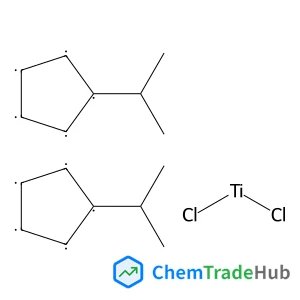
BIS(I-PROPYLCYCLOPENTADIENYL)TITANIUM DICHLORIDE
CAS Number:
12130-65-3
Molecular Formula:
C16H22Cl2Ti
Recommended Suppliers








Disclaimer
This page provides academic journal information for reference and research purposes only. We are not affiliated with any journal publishers and do not handle publication submissions. For publication-related inquiries, please contact the respective journal publishers directly.
If you notice any inaccuracies in the information displayed, please contact us at support@chemtradehub.com. We will promptly review and address your concerns.