












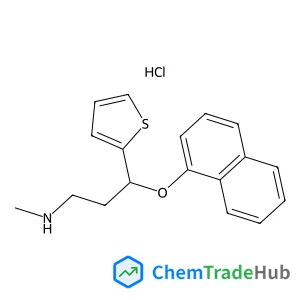
N-Methyl-3-(1-naphthyloxy)-3-(2-thienyl)-1-propanamine hydrochloride (1:1)
CAS Number:
1188266-11-6
Molecular Formula:
C18H20ClNOS
Wei Wang, Wei Li, Kai Zhang
Correction for ‘Redox-responsive, reversibly fluorescent nanoparticles from sustainable cellulose derivatives’ by Wei Wang et al., J. Mater. Chem. A, 2014, 2, 13675–13681.
Varinder K. Aggarwal, Jeffery Richardson
DOI: 10.1039/B304625G
Fei Gao, Su-Yuan Xie, Rong-Bin Huang, Lan-Sun Zheng
DOI: 10.1039/B306921B
Jason A. Halfen, Victor G. Young, Jr.
DOI: 10.1039/B311520H
Olivier J. Dautel, Jean-Pierre Lère-Porte, Joël J. E. Moreau, Michel Wong Chi Man
DOI: 10.1039/B308703D
Xinjun Wang, Yi Xie, Qixun Guo
DOI: 10.1039/B308264D
Lin-Ping Zhang, Thomas C. W. Mak
DOI: 10.1039/B307604K
Yan Zhao, Bryce Sadtler, Min Lin, Gregory H. Hockerman, Alexander Wei
DOI: 10.1039/B317061F
Lu Jiang, Robert C. Hughes, Darryl Y. Sasaki
DOI: 10.1039/B316657K
Yitong Li, Chi Ming Yang
DOI: 10.1039/B310543A
L. Pu, Y. Shi, J. M. Zhu, X. M. Bao, R. Zhang, Y. D. Zheng
DOI: 10.1039/B315810A
N-(4-Methoxybenzyl)-2-pyridinamine (CAS: 52818-63-0) is increasingly being used ...
When handling Ethyl 4-(2-chlorophenyl)-1,3-thiazole-2-carboxylate, appropriate p...
Diethyldiselane (CAS: 628-39-7) is classified under the Globally Harmonized Syst...
The market for oxocopper (CAS: 12053-18-8) is primarily driven by its use in cat...
The market for 5-{[(2-Methyl-2-propanyl)oxy]carbonyl}-5-azaspiro[2.4]heptane-7-c...
2-(1-Pyrrolidinyl)-4-pyridinamine is a chemical compound with the CAS number 359...
2-(3-Pyridinyl)-1-azabicyclo[2.2.2]octane (CAS: 91556-75-1) is a crystalline sol...
(S)-Alpha-allyl-proline hydrochloride is usually synthesized via a Wittig reacti...
3-Methyl-1,2-oxazole-5-carboxylic acid (CAS: 4857-42-5) is an organic compound w...
Lys-SMCC-DM1 is synthesized via a multi-step process involving the coupling of S...

Journal of Materials Chemistry A, B & C cover high quality studies across all fields of materials chemistry. The journals focus on those theoretical or experimental studies that report new understanding, applications, properties and synthesis of materials. The journals have a strong history of publishing quality reports of interest to interdisciplinary communities and providing an efficient and rigorous service through peer review and publication. The journals are led by an international team of Editors-in-Chief and Associate Editors who are all active researchers in their fields. Journal of Materials Chemistry A, B & C are separated by the intended application of the material studied. Broadly, applications in energy and sustainability are of interest to Journal of Materials Chemistry A, applications in biology and medicine are of interest to Journal of Materials Chemistry B, and applications in optical, magnetic and electronic devices are of interest to Journal of Materials Chemistry C. More than one Journal of Materials Chemistry journal may be suitable for certain fields and researchers are encouraged to submit their paper to the journal that they feel best fits for their particular article. Example topic areas within the scope of Journal of Materials Chemistry A are listed below. This list is neither exhaustive nor exclusive. Artificial photosynthesis Batteries Carbon dioxide conversion Catalysis Fuel cells Gas capture/separation/storage Green/sustainable materials Hydrogen generation Hydrogen storage Photocatalysis Photovoltaics Self-cleaning materials Self-healing materials Sensors Supercapacitors Thermoelectrics Water splitting Water treatment
![1,10-bis(3,5-dimethylphenyl)-12-hydroxy-4,5,6,7-tetrahydroiindeno[7,1-de:1',7'-fg][1,3,2]dioxaphosphocine 12-oxide structure](https://static.chemtradehub.com/structs/141/1412439-82-7-b9a9.webp "1,10-bis(3,5-dimethylphenyl)-12-hydroxy-4,5,6,7-tetrahydroiindeno[7,1-de:1',7'-fg][1,3,2]dioxaphosphocine 12-oxide structure")
![1-oxaspiro[4.4]nonan-6-one structure](https://static.chemtradehub.com/structs/134/134179-01-4-e051.webp "1-oxaspiro[4.4]nonan-6-one structure")






