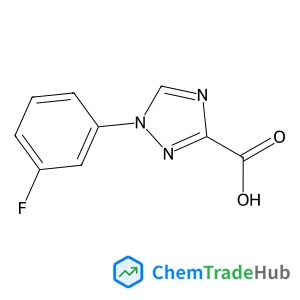
1-(3-Fluorophenyl)-1H-1,2,4-triazole-3-carboxylic acid
CAS Number:
1292369-51-7
Molecular Formula:
C9H6FN3O2
Feng Yu, Pinhong Chen, Guosheng Liu
A Pd-catalyzed intermolecular asymmetric hydroamination of styrenes was developed to give various chiral benzyl amides exclusively, in which the oxidation-stable pyridine-oxazoline was used as the chiral ligand to provide moderate to good enantioselectivities.
Yangang Wu, Wenbo Cai, Lulu Yu, Junbiao Chang, Chuanjun Song
DOI: 10.1039/D3QO01454A
Ming Bai, Yu-Fei Xi, Si-Hui Mi, Pei-Yuan Yang, Li-Li Lou, Tian-Ming Lv, Xin Zhang, Guo-Dong Yao, Bin Lin, Shao-Jiang Song
DOI: 10.1039/D3QO01769A
José Francisco Rizo, Jesús F. Arteaga, Ludovic Favereau, Abel Ros, Uwe Pischel
DOI: 10.1039/D3QO01762A
Jianjun Wang, Huiying Hong, Daguo Hu, Jieling Liu, Wei Liu, Yian Shi
DOI: 10.1039/D3QO01472J
Kanak Kanti Das, Somenath Mahato, Debraj Ghorai, Sutapa Dey, Santanu Panda
DOI: 10.1039/D3QO01838E
Jeong Min Bak, Moonyeong Song, Inji Shin, Hee Nam Lim
DOI: 10.1039/D3OB01603J
Meng Liu, Xinke Ouyang, Chenglong Xuan
DOI: 10.1039/D3QO01929B
Adrián Luguera Ruiz, Elena Mariani, Stefano Protti, Maurizio Fagnoni
DOI: 10.1039/D3QO01856C
Jia Wu, Xiangyun Xu, Chongwen Duan, Shan Chen, Dan Wang, Likui Fang, Weiyang Tang, Fusheng Li
DOI: 10.1039/D3QO01522J
Qiwen Huang, Yanze Li, Cun Yang, Wendan Wu, Jingjie Hai, Xinyao Li
DOI: 10.1039/D3QO01877F
2-Methylbenzene-1,4-diamine dihydrochloride (CAS: 615-45-2) should be stored in ...
(1S,4S)-2,5-Diazabicyclo[2.2.1]heptane dihydrobromide is generally considered sa...
(6-Chloropyridazin-3-YL)methanamine finds applications in the pharmaceutical ind...
2-Fluoro-3-methylphenol is primarily used in the synthesis of pharmaceuticals, p...
When handling 3-Methoxy-4-nitrobenzonitrile, it is important to wear appropriate...
When handling 1,3-Oxazolo[4,5-b]pyridine-2(3H)-thione (CAS: 211949-57-4), it is ...
4-Ethynylbenzamide (CAS: 90347-86-7) falls under various regulatory guidelines i...
3-(2-Ethylphenyl)-2-thioxo-4-imidazolidinone is primarily used as an intermediat...
(2-Fluoro-6-methoxyphenyl)acetic acid, also known as 4-fluoro-3-methoxybenzoic a...
Market trends for 2-[4-(Hydroxymethyl)phenoxy]ethanol (CAS: 102196-18-9) indicat...

Organic Chemistry Frontiers publishes high-quality research from across organic chemistry. Emphases are placed on studies that make significant contributions to the field of organic chemistry by reporting either new or significantly improved protocols or methodologies. Topics include, but are not limited to the following: Organic synthesis Development of synthetic methodologies Catalysis Natural products Functional organic materials Supramolecular and macromolecular chemistry Physical and computational organic chemistry