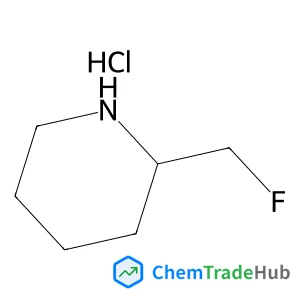
(2S)-2-(Fluoromethyl)piperidine hydrochloride (1:1)
CAS Number:
886216-73-5
Molecular Formula:
C6H13ClFN
Ming Bai, Yu-Fei Xi, Si-Hui Mi, Pei-Yuan Yang, Li-Li Lou, Tian-Ming Lv, Xin Zhang, Guo-Dong Yao, Bin Lin, Shao-Jiang Song
Isatin-based spiro indolenine alkaloids are derived from mixed biosynthetic origins, and the C-2 and C-3 carbonyl groups of isatin could be spirocyclic, thus achieving a variable chemical diversity. Four novel alkaloids (1a/1b, 2, and 3), featuring an unusual isatin-based spiro indolenine system, were obtained from the leaves of Isatis indigotica Fortune. Compounds 1a/1b were a pair of enantiomers characterized by an unprecedented 6/5/6/5/6 N,O-heterocyclic scaffold with a unique spiro[4.5] core. Compound 2 was the first 6/5/6/5/5/6 hexacyclic skeleton fused with an unexpected dispiro[4.4.0.4] system of an isatin-based alkaloid. Their structures were elucidated by 1D and 2D NMR and HRESIMS techniques as well as density functional theory (DFT) calculations and computer-assisted structure elucidation (CASE). The possible biosynthetic pathways for compounds 1a/1b–3 are proposed. In addition, all alkaloids were evaluated for their anti-neuroinflammatory and acetylcholinesterase inhibitory effects.

Nature Medicine

New Journal of Chemistry

Russian Journal of Bioorganic Chemistry

Drug Discovery Today

Russian Journal of Applied Chemistry

Current Opinion in Solid State & Materials Science

Russian Journal of Coordination Chemistry

Journal of Saudi Chemical Society

Acta Materialia

Russian Journal of Organic Chemistry
Athi N. Naganathan
DOI: 10.1039/C1CP20964G
Yuhui Lu, Craig Lent
DOI: 10.1039/C1CP21332F
Dongsheng Fu, Yufeng Liu, Guoming Liu, Yunlan Su, Dujin Wang
DOI: 10.1039/C1CP21281H
Carlos Randino, Marcin Ziółek, Ricard Gelabert, Juan Angel Organero, Michal Gil, Miquel Moreno, José M. Lluch, Abderrazzak Douhal
DOI: 10.1039/C1CP21039D
V. Brites, K. Franzreb, J. N. Harvey, S. G. Sayres, M. W. Ross, D. E. Blumling, A. W. Castleman, Jr., M. Hochlaf
DOI: 10.1039/C1CP21566C
Yoshinobu Akinaga, Jaewoon Jung, Seiichiro Ten-no
DOI: 10.1039/C1CP21001G
Stefan Zahn, Katharina Wendler, Luigi Delle Site, Barbara Kirchner
DOI: 10.1039/C1CP20288J
P. Schmitteckert
DOI: 10.1039/C1CP21247H
Paulo R. Silva, Lucas L. R. Vono, Breno P. Espósito, Maurício S. Baptista, Liane M. Rossi
DOI: 10.1039/C1CP21525F
2-Methylbenzene-1,4-diamine dihydrochloride (CAS: 615-45-2) should be stored in ...
(1S,4S)-2,5-Diazabicyclo[2.2.1]heptane dihydrobromide is generally considered sa...
(6-Chloropyridazin-3-YL)methanamine finds applications in the pharmaceutical ind...
2-Fluoro-3-methylphenol is primarily used in the synthesis of pharmaceuticals, p...
When handling 3-Methoxy-4-nitrobenzonitrile, it is important to wear appropriate...
When handling 1,3-Oxazolo[4,5-b]pyridine-2(3H)-thione (CAS: 211949-57-4), it is ...
4-Ethynylbenzamide (CAS: 90347-86-7) falls under various regulatory guidelines i...
3-(2-Ethylphenyl)-2-thioxo-4-imidazolidinone is primarily used as an intermediat...
(2-Fluoro-6-methoxyphenyl)acetic acid, also known as 4-fluoro-3-methoxybenzoic a...
Market trends for 2-[4-(Hydroxymethyl)phenoxy]ethanol (CAS: 102196-18-9) indicat...

Organic Chemistry Frontiers publishes high-quality research from across organic chemistry. Emphases are placed on studies that make significant contributions to the field of organic chemistry by reporting either new or significantly improved protocols or methodologies. Topics include, but are not limited to the following: Organic synthesis Development of synthetic methodologies Catalysis Natural products Functional organic materials Supramolecular and macromolecular chemistry Physical and computational organic chemistry