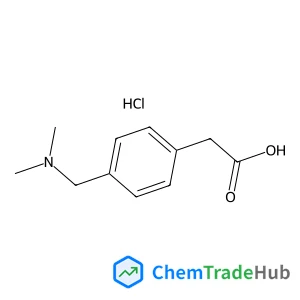
4-(Dimethylaminomethyl)phenylacetic acid hydrochloride
CAS Number:
99985-52-1
Molecular Formula:
C11H16ClNO2
Qiwen Huang, Yanze Li, Cun Yang, Wendan Wu, Jingjie Hai, Xinyao Li
We herein report a chiral phosphoric acid-catalyzed Paal–Knorr reaction of N-amino(aza)quinolinones and 1,4-diketones for constructing N–N axially chiral pyrrolyl(aza)quinolinones with ‘6–5’-membered rings. The protocol proceeds smoothly under mild conditions, exhibiting excellent functional group compatibility and delivering a diverse set of pyrrolyl(aza)quinolinones in excellent yields with high atroposelectivities. Moreover, this strategy is applicable for the atroposelective synthesis of N–N axially chiral pyrrolyl-dihydroquinolinone/pyridinone and shows broad further synthetic transformations. Additionally, density functional theory studies unveiled that the key to control axially chiral N–N atropisomers is based on the second dehydroxylation process as the rate-determining step, not the first cyclization step. Therefore, this work not only offers a new family member of N–N atropisomers but also reveals the origin of the atroposelectivity.
I. A. K. Young, C. Murray, C. M. Blaum, R. A. Cox, R. L. Jones, F. D. Pope
DOI: 10.1039/C1CP21337G
M. Isabel Burguete, Eduardo García-Verdugo, Santiago V. Luis, Julián A. Restrepo
DOI: 10.1039/C1CP20970A
N. Renaud, M. Hliwa, C. Joachim
DOI: 10.1039/C1CP21221D
Abu Md Asaduzzaman, Georg Schreckenbach
DOI: 10.1039/C1CP21168D
Weiwei Zhou, Tao Chen, Kim Seng Tan, Xingtao Jia, Zhiqiang Luo, Chunxiao Cong, Huanping Yang, Chang Ming Li
DOI: 10.1039/C1CP21917K
Athi N. Naganathan
DOI: 10.1039/C1CP20964G
Qing-Jiang Pan, Yuan-Ru Guo, Li Li, Samuel O. Odoh, Hong-Gang Fu, Hong-Xing Zhang
DOI: 10.1039/C1CP00030F
Che-Hung Kuo, Chi-Ping Liu, Szu-Hsian Lee, Hsun-Yun Chang, Wei-Chun Lin, Yun-Wen You, Hua-Yang Liao
DOI: 10.1039/C1CP20590K
Andreia Mota, Jason P. Hallett, Maxim L. Kuznetsov, Isabel Correia
DOI: 10.1039/C1CP20800D
Juan Pablo Catalán
DOI: 10.1039/C1CP21380F
2-Methylbenzene-1,4-diamine dihydrochloride (CAS: 615-45-2) should be stored in ...
(1S,4S)-2,5-Diazabicyclo[2.2.1]heptane dihydrobromide is generally considered sa...
(6-Chloropyridazin-3-YL)methanamine finds applications in the pharmaceutical ind...
2-Fluoro-3-methylphenol is primarily used in the synthesis of pharmaceuticals, p...
When handling 3-Methoxy-4-nitrobenzonitrile, it is important to wear appropriate...
When handling 1,3-Oxazolo[4,5-b]pyridine-2(3H)-thione (CAS: 211949-57-4), it is ...
4-Ethynylbenzamide (CAS: 90347-86-7) falls under various regulatory guidelines i...
3-(2-Ethylphenyl)-2-thioxo-4-imidazolidinone is primarily used as an intermediat...
(2-Fluoro-6-methoxyphenyl)acetic acid, also known as 4-fluoro-3-methoxybenzoic a...
Market trends for 2-[4-(Hydroxymethyl)phenoxy]ethanol (CAS: 102196-18-9) indicat...

Organic Chemistry Frontiers publishes high-quality research from across organic chemistry. Emphases are placed on studies that make significant contributions to the field of organic chemistry by reporting either new or significantly improved protocols or methodologies. Topics include, but are not limited to the following: Organic synthesis Development of synthetic methodologies Catalysis Natural products Functional organic materials Supramolecular and macromolecular chemistry Physical and computational organic chemistry
![2-Methylbenzo[h]quinoline structure](https://static.chemtradehub.com/structs/605/605-88-9-ac43.webp "2-Methylbenzo[h]quinoline structure")