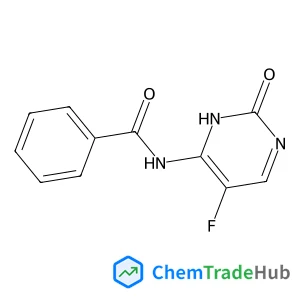
N-(5-Fluoro-2-oxo-2,3-dihydro-4-pyrimidinyl)benzamide
CAS Number:
10357-07-0
Molecular Formula:
C11H8FN3O2
José Francisco Rizo, Jesús F. Arteaga, Ludovic Favereau, Abel Ros, Uwe Pischel
A series of six azaborahelicenes with varying electron-donor substitution at the 4-position of the aryl residue (i.e., naphthyl) or with variable π-extension of the aryl residue (thianthrenyl, anthryl, pyrenyl) was prepared with an efficient and flexible synthetic protocol. These different types of functionalization afforded notably pronounced intramolecular charge-transfer (ICT) character for the dyes with the strongest electron donor substitution (NMe2) or easiest to oxidize aryl residues, as evidenced by photophysical investigations. These effects also impact the corresponding chiroptical properties of the separated M- and P-enantiomers, which notably display circularly polarized luminescence (CPL) with dissymmetry factors in the order of magnitude of 10−4 to 10−3. Theoretical calculations confirm the optical spectroscopy data and are in agreement with the proposed involvement of ICT processes.
Christine Cézard, Frédéric Aubry, Florence Djedaïni-Pilard, François-Yves Dupradeau
DOI: 10.1039/C1CP20854C
Yufang Liu, Kai Jiang, Deheng Shi, Jinfeng Sun
DOI: 10.1039/C1CP20729F
ChiYung Yam, Lingyi Meng, GuanHua Chen, Quan Chen, Ngai Wong
DOI: 10.1039/C1CP20766K
Johan Scheers, Jagath Pitawala, Frederic Thebault, Jae-Kwang Kim, Jou-Hyeon Ahn, Aleksandar Matic, Per Jacobsson
DOI: 10.1039/C1CP21062A
Tomoya Uruga, Hajime Tanida, Yasuko Terada, Yasuhiro Iwasawa, Shin-ichi Ohkoshi
DOI: 10.1039/C1CP20895K
T. Gál, P. Geerlings, F. De Proft, M. Torrent-Sucarrat
DOI: 10.1039/C1CP21213C
Arindam Chakraborty, Santanab Giri, Soma Duley, Anakuthil Anoop, Patrick Bultinck, Pratim K. Chattaraj
DOI: 10.1039/C1CP21430F
Andrea Sabatié-Gogova, Eric Renault, Gilles Montavon, Nicolas Galland
DOI: 10.1039/C1CP20512A
2-Methylbenzene-1,4-diamine dihydrochloride (CAS: 615-45-2) should be stored in ...
(1S,4S)-2,5-Diazabicyclo[2.2.1]heptane dihydrobromide is generally considered sa...
(6-Chloropyridazin-3-YL)methanamine finds applications in the pharmaceutical ind...
2-Fluoro-3-methylphenol is primarily used in the synthesis of pharmaceuticals, p...
When handling 3-Methoxy-4-nitrobenzonitrile, it is important to wear appropriate...
When handling 1,3-Oxazolo[4,5-b]pyridine-2(3H)-thione (CAS: 211949-57-4), it is ...
4-Ethynylbenzamide (CAS: 90347-86-7) falls under various regulatory guidelines i...
3-(2-Ethylphenyl)-2-thioxo-4-imidazolidinone is primarily used as an intermediat...
(2-Fluoro-6-methoxyphenyl)acetic acid, also known as 4-fluoro-3-methoxybenzoic a...
Market trends for 2-[4-(Hydroxymethyl)phenoxy]ethanol (CAS: 102196-18-9) indicat...

Organic Chemistry Frontiers publishes high-quality research from across organic chemistry. Emphases are placed on studies that make significant contributions to the field of organic chemistry by reporting either new or significantly improved protocols or methodologies. Topics include, but are not limited to the following: Organic synthesis Development of synthetic methodologies Catalysis Natural products Functional organic materials Supramolecular and macromolecular chemistry Physical and computational organic chemistry
![4-[(2-{2-[2-(2-Aminoethoxy)ethoxy]ethoxy}ethyl)amino]-2-(2,6-dioxo-3-piperidinyl)-1H-isoindole-1,3(2H)-dione structure](https://static.chemtradehub.com/structs/209/2093416-31-8-3162.webp "4-[(2-{2-[2-(2-Aminoethoxy)ethoxy]ethoxy}ethyl)amino]-2-(2,6-dioxo-3-piperidinyl)-1H-isoindole-1,3(2H)-dione structure")