












An EPR study of ampullosporin A, a medium-length peptaibiotic, in bicelles and vesicles
Literature Information
Publication Date
2015-11-19
DOI
10.1039/C5CP04136H
Impact Factor
3.676
Authors
Annalisa Dalzini, Fernando Formaggio, Claudio Toniolo, Marina Gobbo, Anna Lisa Maniero
View Original
Abstract
Ampullosporin A is a medium-length (14-amino acid long) hydrophobic peptide of the peptaibol family. In this work, electron paramagnetic resonance and circular dichroism spectroscopies were applied to study the interaction of synthetic ampullosporin A and three spin-labeled analogs with small unilamellar vesicles and bicelles. Zwitterionic vesicles were used to investigate the conformation and the penetration depth of the peptide at room temperature. Bicelles were employed in combination with EPR spectroscopy to study the order, dynamics, orientation, aggregation and the 3D-structure of the peptide at near physiological temperature. In the membrane, the peptide adopts a helical structure that changes in nature depending on the thickness of the membrane-mimetic system, from mostly α-helical in vesicles to a more elongated helix in bicelles, suggesting an increase in the 310-helical content. The orientation assumed by the peptide also shows a dependence on the membrane-mimetic system: in bicelles, ampullosporin A has a transmembrane orientation at a peptide-to-lipid (P : L) ratio of 1 : 100 and higher, while in vesicles it undergoes a transition from a parallel to a transmembrane orientation as a function of the P : L ratio. In bicelles, the peptide was found to be monomeric at a P : L ratio of 1 : 25 and lower. Overall, the comparison of the results obtained in the two membrane-mimetic systems showed that ampullosporin A has a rather flexible structure that readily adapts to the bilayer thickness.
Related Literature
The first synthetic studies on pestalotiopsin A. A stereocontrolled approach to the functionalised bicyclic core
Derek Johnston, Emmanuel Couché, David J. Edmonds, Kenneth W. Muir, David J. Procter
2002-12-13
Paper
DOI: 10.1039/B209066J
Synthesis and application of a new chiral monodentate spiro phosphoramidite ligand based on hexamethyl-1,1′-spirobiindane backbone in asymmetric hydroamination/arylation of alkenes
Huanyu Shan, Rihuang Pan, Xufeng Lin
2018-08-16
Communication
DOI: 10.1039/C8OB01785A
l-Dopa and dopamine conjugated naphthalenediimides modulate amyloid β toxicity
Madhu Ramesh, Pandeeswar Makam, Chandrashekhar Voshavar, Harshavardhan Khare, Kolla Rajasekhar, Suryanarayanarao Ramakumar, Thimmaiah Govindaraju
2018-09-28
Paper
DOI: 10.1039/C8OB01691G
Preparation and characterization of pyrene modified uridine derivatives as potential electron donors in RNA
Jennifer Frommer, Beatrice Karg, Klaus Weisz, Sabine Müller
2018-09-27
Paper
DOI: 10.1039/C8OB02246A
Synthesis of CID-cleavable protein crosslinking agents containing quaternary amines for structural mass spectrometry
Susan E. Hagen, Kun Liu, Yafei Jin, Lolita Piersimoni, Hollis D. Showalter
2018-03-07
Communication
DOI: 10.1039/C8OB00329G
Synthesis of difluoromethylated enynes by the reaction of α-(trifluoromethyl)styrenes with terminal alkynes
Mingsheng Wu, Xianghu Zhao, Yisen Liu, Song Cao
2018-09-11
Paper
DOI: 10.1039/C8OB02117A
Dirhodium(ii)/P(t-Bu)3 catalyzed tandem reaction of α,β-unsaturated aldehydes with arylboronic acids
Ziling Ma, Yuanhua Wang
2018-09-20
Paper
DOI: 10.1039/C8OB01997E
Catalytic asymmetric Tamura cycloaddition of homophthalic anhydrides with 2-arylidene-1,3-diones
Han Xu, Feng Sha, Qiong Li, Xin-Yan Wu
2018-09-19
Paper
DOI: 10.1039/C8OB01970C
Preferential precipitation of C70 over C60 with p-halohomooxacalix[3]arenes
Naoki Komatsu
2002-11-27
Paper
DOI: 10.1039/B208107E
Formal reductive addition of acetonitrile to aldehydes and ketones‡
Karim Muratov, Ekaterina Kuchuk, Sreekumar Vellalath, Oleg I. Afanasyev, Alexei P. Moskovets, Gleb Denisov, Denis Chusov
2018-09-28
Paper
DOI: 10.1039/C8OB01992D
You might also like
Compound Q&A
Is 6-(3-Fluorophenyl)picolinic acid (CAS: 887982-40-3) safe?
6-(3-Fluorophenyl)picolinic acid is generally considered safe for laboratory use...
887982-40-36-(3-Fluorophenyl)pi...
Compound Q&A
What industries use (3R)-3-Pyrrolidinol (CAS: 2799-21-5)?
(3R)-3-Pyrrolidinol is used in the pharmaceutical industry as a precursor for dr...
2799-21-5(3R)-3-Pyrrolidinol
Compound Q&A
What precautions should be taken when handling (4R,5R)-4,5-Diethoxycarbonyl-2,2-dimethyldioxolane (CAS: 59779-75-8)?
When handling (4R,5R)-4,5-Diethoxycarbonyl-2,2-dimethyldioxolane (CAS: 59779-75-...
59779-75-8(4R,5R)-4,5-Diethoxy...
Compound Q&A
How is 1-(6-Chloroimidazo[1,2-b]pyridazin-3-yl)ethanone (CAS: 90734-71-7) typically synthesized?
1-(6-Chloroimidazo[1,2-b]pyridazin-3-yl)ethanone is often synthesized via a mult...
90734-71-71-(6-Chloroimidazo[1...
Compound Q&A
What is the market or research trend for N-Ethyl-3,4-dimethylbenzylamine (CAS: 39180-83-1)?
The market for N-Ethyl-3,4-dimethylbenzylamine (CAS: 39180-83-1) remains steady,...
39180-83-1N-Ethyl-3,4-dimethyl...
Compound Q&A
What is Tert-butyl 3-(pyrrolidin-1-yl)azetidine-1-carboxylate (CAS: 1019008-21-9)?
Tert-butyl 3-(pyrrolidin-1-yl)azetidine-1-carboxylate is a chemical compound wit...
1019008-21-9Tert-butyl 3-(pyrrol...
Compound Q&A
What regulatory guidelines apply to 1-Bromo-3-chloro-2,4-dimethoxybenzene (CAS: 1228956-93-1)?
1-Bromo-3-chloro-2,4-dimethoxybenzene (CAS: 1228956-93-1) falls under the classi...
1228956-93-11-Bromo-3-chloro-2,4...
Compound Q&A
Is 8-Bromo-2-methyl-3,4-dihydroisoquinolin-1(2H)-one (CAS: 1368622-07-4) safe?
The safety of 8-Bromo-2-methyl-3,4-dihydroisoquinolin-1(2H)-one (CAS: 1368622-07...
1368622-07-48-Bromo-2-methyl-3,4...
Compound Q&A
Is Benzyl [(3S)-2,6-dioxo-3-piperidinyl]carbamate (CAS: 22785-43-9) safe?
Benzyl [(3S)-2,6-dioxo-3-piperidinyl]carbamate is generally safe when handled wi...
22785-43-9Benzyl [(3S)-2,6-dio...
Compound Q&A
How should 1-{[4-(4,4,5,5-Tetramethyl-1,3,2-dioxaborolan-2-yl)phenyl]sulfonyl}pyrrolidine (CAS: 928657-21-0) be stored?
1-{[4-(4,4,5,5-Tetramethyl-1,3,2-dioxaborolan-2-yl)phenyl]sulfonyl}pyrrolidine s...
928657-21-01-{[4-(4,4,5,5-Tetra...
Source Journal
Physical Chemistry Chemical Physics

CiteScore:
5.5
Self-citation Rate:
10.3%
Articles per Year:
3036
Physical Chemistry Chemical Physics (PCCP) is an international journal co-owned by 19 physical chemistry and physics societies from around the world. This journal publishes original, cutting-edge research in physical chemistry, chemical physics and biophysical chemistry. To be suitable for publication in PCCP, articles must include significant innovation and/or insight into physical chemistry; this is the most important criterion that reviewers and Editors will judge against when evaluating submissions. The journal has a broad scope and welcomes contributions spanning experiment, theory, computation and data science. Topical coverage includes spectroscopy, dynamics, kinetics, statistical mechanics, thermodynamics, electrochemistry, catalysis, surface science, quantum mechanics, quantum computing and machine learning. Interdisciplinary research areas such as polymers and soft matter, materials, nanoscience, energy, surfaces/interfaces, and biophysical chemistry are welcomed if they demonstrate significant innovation and/or insight into physical chemistry. Joined experimental/theoretical studies are particularly appreciated when complementary and based on up-to-date approaches.
Recommended Compounds
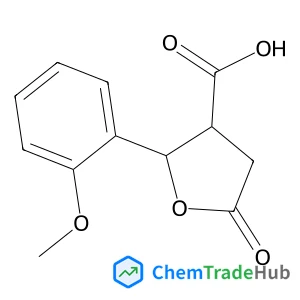
trans-2-(2-Methoxyphenyl)-5-oxotetrahydrofuran-3-carboxylic acid
CAS Number:
99226-02-5
Molecular Formula:
C12H12O5
![(2E)-4-[(1R,2S,8R,19S,21R)-14-Hydroxy-11-isopropenyl-8,23,23-trimethyl-5-(3-methyl-2-buten-1-yl)-16,20-dioxo-3,7,22-trioxaheptacyclo[17.4.1.1~8,12~.0~2,17~.0~2,21~.0~4,15~.0~6,13~]pentacosa-4(15),5,13
,17-tetraen-21-yl]-2-methyl-2-butenoic acid structure](https://static.chemtradehub.com/structs/173/173867-04-4-d2d3.webp "(2E)-4-[(1R,2S,8R,19S,21R)-14-Hydroxy-11-isopropenyl-8,23,23-trimethyl-5-(3-methyl-2-buten-1-yl)-16,20-dioxo-3,7,22-trioxaheptacyclo[17.4.1.1~8,12~.0~2,17~.0~2,21~.0~4,15~.0~6,13~]pentacosa-4(15),5,13
,17-tetraen-21-yl]-2-methyl-2-butenoic acid structure")

![2-[({[(2-Methyl-2-propanyl)oxy]carbonyl}amino)methyl]isonicotinic acid structure](https://static.chemtradehub.com/structs/473/473924-63-9-973b.webp "2-[({[(2-Methyl-2-propanyl)oxy]carbonyl}amino)methyl]isonicotinic acid structure")
2-[({[(2-Methyl-2-propanyl)oxy]carbonyl}amino)methyl]isonicotinic acid
CAS Number:
473924-63-9
Molecular Formula:
C12H16N2O4
Recommended Suppliers




Disclaimer
This page provides academic journal information for reference and research purposes only. We are not affiliated with any journal publishers and do not handle publication submissions. For publication-related inquiries, please contact the respective journal publishers directly.
If you notice any inaccuracies in the information displayed, please contact us at support@chemtradehub.com. We will promptly review and address your concerns.