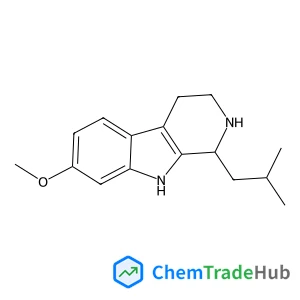
1-Isobutyl-7-methoxy-2,3,4,9-tetrahydro-1H-beta-carboline
CAS Number:
175975-76-5
Molecular Formula:
C16H22N2O
Madhu Ramesh, Pandeeswar Makam, Chandrashekhar Voshavar, Harshavardhan Khare, Kolla Rajasekhar, Suryanarayanarao Ramakumar, Thimmaiah Govindaraju
The process of protein misfolding and aggregation to form neurotoxic species is strongly implicated in most of the neurodegenerative disorders. In particular, amyloid beta (Aβ) misfolding and aggregation is central to pathophysiological processes of Alzheimer's disease. The development of aggregation modulators has enormous implications in the discovery of effective therapeutic agents for Alzheimer's disease. Herein, we report the design and synthesis of a series of natural amino acid, L-dopa and dopamine appended derivatives of naphthalenediimide (NDI) to identify efficient aggregation modulators. Furthermore, the molecular docking studies revealed the possible binding sites and binding mode of NDI-conjugates to Aβ aggregates. Among the designed NDI-conjugates, L-dopa and dopamine derivatives (NLD and NDP, respectively) showed excellent aggregation modulation efficiency (inhibition and dissolution), as shown by the thioflavin T (ThT) binding assays, dot blot analysis and in cellulo studies. The docking results from in silico studies are in good agreement with the experimental data. In addition to their significant modulation efficiency towards Aβ aggregation, NLD and NDP possess antioxidant activity conducive to the development of disease-modifying therapeutic agents for the treatment of Alzheimer's disease.
Pravin S. Shirude, Liming Ying, Shankar Balasubramanian
DOI: 10.1039/B801465E
Kazuyuki Nobusawa, Atsushi Ikeda, Yasunori Tanaka, Mineo Hashizume, Jun-ichi Kikuchi, Michihiro Shirakawa, Tatsuya Kitahara, Norifumi Fujita, Seiji Shinkai
DOI: 10.1039/B715960A
Yasuo Norikane, Ryuzi Katoh, Nobuyuki Tamaoki
DOI: 10.1039/B718813G
Jeffrey B.-H. Tok, Nicholas O. Fischer
DOI: 10.1039/B717936G
Jihoon Lee, Mi-hyun Kim, Sang-sup Jew, Hyeung-geun Park, Byeong-Seon Jeong
DOI: 10.1039/B800130H
Shinji Matsumoto, Satoshi Yamaguchi, Atsuhiko Wada, Toshihiro Matsui, Masato Ikeda
DOI: 10.1039/B719004B
Jun-ichi Ito, Satoshi Ujiie, Hisao Nishiyama
DOI: 10.1039/B800387D
Lu Zhang, Wesley A. Whitfield, Lei Zhu
DOI: 10.1039/B719644J
Chuan-Feng Chen, Zhi-Tang Huang
DOI: 10.1039/B800258D
N-(4-Methoxybenzyl)-2-pyridinamine (CAS: 52818-63-0) is increasingly being used ...
When handling Ethyl 4-(2-chlorophenyl)-1,3-thiazole-2-carboxylate, appropriate p...
Diethyldiselane (CAS: 628-39-7) is classified under the Globally Harmonized Syst...
The market for oxocopper (CAS: 12053-18-8) is primarily driven by its use in cat...
The market for 5-{[(2-Methyl-2-propanyl)oxy]carbonyl}-5-azaspiro[2.4]heptane-7-c...
2-(1-Pyrrolidinyl)-4-pyridinamine is a chemical compound with the CAS number 359...
2-(3-Pyridinyl)-1-azabicyclo[2.2.2]octane (CAS: 91556-75-1) is a crystalline sol...
(S)-Alpha-allyl-proline hydrochloride is usually synthesized via a Wittig reacti...
3-Methyl-1,2-oxazole-5-carboxylic acid (CAS: 4857-42-5) is an organic compound w...
Lys-SMCC-DM1 is synthesized via a multi-step process involving the coupling of S...

Organic & Biomolecular Chemistry (OBC) publishes original and high impact research and reviews in organic chemistry. We welcome research that shows new or significantly improved protocols or methodologies in total synthesis, synthetic methodology or physical and theoretical organic chemistry as well as research that shows a significant advance in the organic chemistry or molecular design aspects of chemical biology, catalysis, supramolecular and macromolecular chemistry, theoretical chemistry, mechanism-oriented physical organic chemistry, medicinal chemistry or natural products. Articles published in the journal should report new work which makes a highly-significant impact in the field. Routine and incremental work is generally not suitable for publication in the journal. More details about key areas of our scope are below. In all cases authors should include in their article clear rationale for why their research has been carried out.
![(2R,6S)-6-[(Benzyloxy)methyl]-4-{[(2-methyl-2-propanyl)oxy]carbonyl}-2-morpholinecarboxylic acid structure](https://static.chemtradehub.com/structs/109/1093085-91-6-3382.webp "(2R,6S)-6-[(Benzyloxy)methyl]-4-{[(2-methyl-2-propanyl)oxy]carbonyl}-2-morpholinecarboxylic acid structure")