












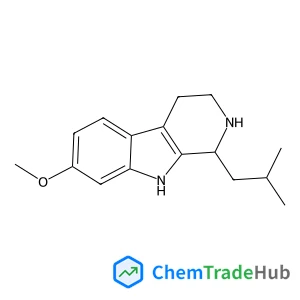
1-Isobutyl-7-methoxy-2,3,4,9-tetrahydro-1H-beta-carboline
CAS Number:
175975-76-5
Molecular Formula:
C16H22N2O
Mingsheng Wu, Xianghu Zhao, Yisen Liu, Song Cao
A novel and efficient method for the synthesis of difluoromethylated enynes by the reaction of α-(trifluoromethyl)styrenes with terminal alkynes with the assistance of NaOtBu was described. The mechanism of the reaction might involve the SN2′ reaction of α-(trifluoromethyl)styrenes and a subsequent 1,3-H shift. Isomerization (E → Z) of 1-difluoromethyl-1,3-enynes in the presence of ZrCl4 was also developed.
You-Rim Yoon, Yong-beom Lim, Eunji Lee, Myongsoo Lee
DOI: 10.1039/B719868J
Suobo Zhang, Zhaohui Su
DOI: 10.1039/B801784K
Moloy Banerjee, Vijay S. Vyas, Sergey V. Lindeman, Rajendra Rathore
DOI: 10.1039/B800168E
Johann Elbaz, Bella Shlyahovsky, Itamar Willner
DOI: 10.1039/B716774A
Lu Zhang, Wesley A. Whitfield, Lei Zhu
DOI: 10.1039/B719644J
Nicholas P. Power, John E. Warren, Jerry L. Atwood
DOI: 10.1039/B719769A
Nicolas Bouquin, Vladimir L. Malinovskii, Robert Häner
DOI: 10.1039/B802193G
Alejandro Díaz-Moscoso, Patricia Balbuena, Marta Gómez-García, Carmen Ortiz Mellet, Juan M. Benito, Loïc Le Gourriérec, Christophe Di Giorgio, Pierre Vierling, Antonino Mazzaglia, Norberto Micali, Jacques Defaye, José M. García Fernández
DOI: 10.1039/B718672J
Fiorella L. Callari, Salvatore Sortino
DOI: 10.1039/B800132D
N-(4-Methoxybenzyl)-2-pyridinamine (CAS: 52818-63-0) is increasingly being used ...
When handling Ethyl 4-(2-chlorophenyl)-1,3-thiazole-2-carboxylate, appropriate p...
Diethyldiselane (CAS: 628-39-7) is classified under the Globally Harmonized Syst...
The market for oxocopper (CAS: 12053-18-8) is primarily driven by its use in cat...
The market for 5-{[(2-Methyl-2-propanyl)oxy]carbonyl}-5-azaspiro[2.4]heptane-7-c...
2-(1-Pyrrolidinyl)-4-pyridinamine is a chemical compound with the CAS number 359...
2-(3-Pyridinyl)-1-azabicyclo[2.2.2]octane (CAS: 91556-75-1) is a crystalline sol...
(S)-Alpha-allyl-proline hydrochloride is usually synthesized via a Wittig reacti...
3-Methyl-1,2-oxazole-5-carboxylic acid (CAS: 4857-42-5) is an organic compound w...
Lys-SMCC-DM1 is synthesized via a multi-step process involving the coupling of S...

Organic & Biomolecular Chemistry (OBC) publishes original and high impact research and reviews in organic chemistry. We welcome research that shows new or significantly improved protocols or methodologies in total synthesis, synthetic methodology or physical and theoretical organic chemistry as well as research that shows a significant advance in the organic chemistry or molecular design aspects of chemical biology, catalysis, supramolecular and macromolecular chemistry, theoretical chemistry, mechanism-oriented physical organic chemistry, medicinal chemistry or natural products. Articles published in the journal should report new work which makes a highly-significant impact in the field. Routine and incremental work is generally not suitable for publication in the journal. More details about key areas of our scope are below. In all cases authors should include in their article clear rationale for why their research has been carried out.
![N-{[(2-Methyl-2-propanyl)oxy]carbonyl}-L-methionylglycine structure](https://static.chemtradehub.com/structs/234/23446-03-9-e1e5.webp "N-{[(2-Methyl-2-propanyl)oxy]carbonyl}-L-methionylglycine structure")
![1-(1-Benzyl-1,2,3,6-tetrahydropyridin-4-yl)-1H-benzo[d]imidazol-2(3H)-one structure](https://static.chemtradehub.com/structs/603/60373-71-9-7dfb.webp "1-(1-Benzyl-1,2,3,6-tetrahydropyridin-4-yl)-1H-benzo[d]imidazol-2(3H)-one structure")





