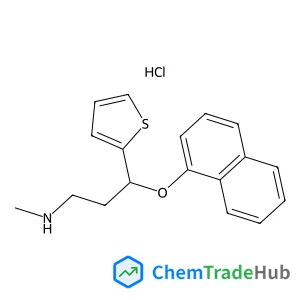
N-Methyl-3-(1-naphthyloxy)-3-(2-thienyl)-1-propanamine hydrochloride (1:1)
CAS Number:
1188266-11-6
Molecular Formula:
C18H20ClNOS
Naoki Komatsu
Preferential precipitation of C70 from a toluene solution of C60 and C70 was accomplished with p-trihalohomooxacalix[3]arenes (13·X·X·X) prepared by the reductive coupling of diformylphenols. Heavy halogens, Br and/or I, are essential at the para position of 13·X·X·X for obtaining good yields and selectivities. C70 with up to 92% purity was obtained after the preferential precipitation.
Jye-Shane Yang, Jyu-Lun Yan
DOI: 10.1039/B713428M
Ruth I. J. Amos, Brendon S. Gourlay, Brian F. Yates
DOI: 10.1039/B719570B
Patrick Eisenberger, Iris Kieltsch, Nicolas Armanino, Antonio Togni
DOI: 10.1039/B801424H
Takaaki Tsuruoka, Rena Takahashi, Toshihiro Nakamura, Minoru Fujii, Kensuke Akamatsu, Hidemi Nawafune
DOI: 10.1039/B717732A
Preston A. Chase, Titel Jurca, Douglas W. Stephan
DOI: 10.1039/B718598G
Olivier Thillaye du Boullay, Colin Bonduelle, Blanca Martin-Vaca, Didier Bourissou
DOI: 10.1039/B800852C
Yoshihiko Yamamoto, Naohiro Kirai, Yu Harada
DOI: 10.1039/B802231C
Andrés de la Escosura, Martijn Verwegen, Friso D. Sikkema, Marta Comellas-Aragonès, Andrei Kirilyuk, Theo Rasing, Roeland J. M. Nolte, Jeroen J. L. M. Cornelissen
DOI: 10.1039/B800936H
N-(4-Methoxybenzyl)-2-pyridinamine (CAS: 52818-63-0) is increasingly being used ...
When handling Ethyl 4-(2-chlorophenyl)-1,3-thiazole-2-carboxylate, appropriate p...
Diethyldiselane (CAS: 628-39-7) is classified under the Globally Harmonized Syst...
The market for oxocopper (CAS: 12053-18-8) is primarily driven by its use in cat...
The market for 5-{[(2-Methyl-2-propanyl)oxy]carbonyl}-5-azaspiro[2.4]heptane-7-c...
2-(1-Pyrrolidinyl)-4-pyridinamine is a chemical compound with the CAS number 359...
2-(3-Pyridinyl)-1-azabicyclo[2.2.2]octane (CAS: 91556-75-1) is a crystalline sol...
(S)-Alpha-allyl-proline hydrochloride is usually synthesized via a Wittig reacti...
3-Methyl-1,2-oxazole-5-carboxylic acid (CAS: 4857-42-5) is an organic compound w...
Lys-SMCC-DM1 is synthesized via a multi-step process involving the coupling of S...

Organic & Biomolecular Chemistry (OBC) publishes original and high impact research and reviews in organic chemistry. We welcome research that shows new or significantly improved protocols or methodologies in total synthesis, synthetic methodology or physical and theoretical organic chemistry as well as research that shows a significant advance in the organic chemistry or molecular design aspects of chemical biology, catalysis, supramolecular and macromolecular chemistry, theoretical chemistry, mechanism-oriented physical organic chemistry, medicinal chemistry or natural products. Articles published in the journal should report new work which makes a highly-significant impact in the field. Routine and incremental work is generally not suitable for publication in the journal. More details about key areas of our scope are below. In all cases authors should include in their article clear rationale for why their research has been carried out.
![5'-Fluoro-[2,3'-biindolinylidene]-2',3-dione structure](https://static.chemtradehub.com/structs/251/251903-00-1-9cb1.webp "5'-Fluoro-[2,3'-biindolinylidene]-2',3-dione structure")