












The role of alkoxy radicals in the heterogeneous reaction of two structural isomers of dimethylsuccinic acid
Literature Information
Publication Date
2015-08-27
DOI
10.1039/C5CP03791C
Impact Factor
3.676
Authors
Chiu Tung Cheng, Kevin R. Wilson
View Original
Abstract
A key challenge in understanding the transformation chemistry of organic aerosols is to quantify how changes in molecular structure alter heterogeneous reaction mechanisms. Here we use two model systems to investigate how the relative locations of branched methyl groups control the heterogeneous reaction of OH with two isomers of dimethylsuccinic acid (C6H10O4). 2,2-Dimethylsuccinic acid (2,2-DMSA) and 2,3-dimethylsuccinic acid (2,3-DMSA) differ only in the location of the two branched methyl groups, thus enabling a closer inspection of how the distribution of carbon reaction sites impacts the chemical evolution of the aerosol. The heterogeneous reaction of OH with 2,3-DMSA (reactive OH uptake coefficient, γ = 0.99 ± 0.16) is found to be ∼2 times faster than that of 2,2-DMSA (γ = 0.41 ± 0.07), which is attributed to the larger stability of the tertiary alkyl radical produced by the initial OH abstraction reaction. While changes in the average aerosol oxidation state (OSC) and the carbon number (NC) are similar for both isomers upon reaction, significant differences are observed in the underlying molecular distribution of reaction products. The reaction of OH with the 2,3-DMSA isomer produces two major reaction products: a product containing a new alcohol functional group (C6H10O5) formed by intermolecular hydrogen abstraction and a C5 compound formed via carbon–carbon (C–C) bond scission. Both of these reaction products are explained by the formation and subsequent reaction of a tertiary alkoxy radical. In contrast, the OH reaction with the 2,2-DMSA isomer forms four dominant reaction products, the majority of which are C5 scission products. The difference in the quantity of C–C bond scission products for these two isomers is unexpected since decomposition is assumed to be favored for the isomer with the most tertiary carbon sites (i.e. 2,3-DMSA). For both isomers, there is a much larger abundance of C6 alcohol relative to C6 ketone products, which suggests that the presence of the two branched methyl groups favors alkoxy formation from peroxy radical self-reactions. These results reveal how the isomeric structure ultimately controls the overall competition between functionalization and fragmentation in these model systems.
Related Literature
A highly efficient and recyclable ligand-free protocol for the Suzuki coupling reaction of potassium aryltrifluoroborates in water
Leifang Liu, Yan Dong, Nana Tang
2014-01-06
Paper
DOI: 10.1039/C3GC42182A
Heterogeneous ditopic ZnFe2O4 catalyzed synthesis of 4H-pyrans: further conversion to 1,4-DHPs and report of functional group interconversion from amide to ester
Paramita Das, Arghya Dutta, Asim Bhaumik, Chhanda Mukhopadhyay
2013-11-27
Paper
DOI: 10.1039/C3GC42095G
Studies on the oxidative N-demethylation of atropine, thebaine and oxycodone using a FeIII-TAML catalyst
Duy D. Do Pham, Geoffrey F. Kelso, Yuanzhong Yang, Milton T. W. Hearn
2013-11-27
Paper
DOI: 10.1039/C3GC41972J
Long-chain aliphatic polyesters from plant oils for injection molding, film extrusion and electrospinning
Florian Stempfle, Stefan Mecking
2014-03-17
Paper
DOI: 10.1039/C4GC00114A
Clean and efficient assembly of functionalized benzofuro[2,3-c]pyridines via metal-free one-pot domino reactions
Yin Rao, Zhexian Li, Guodong Yin
2014-01-10
Paper
DOI: 10.1039/C3GC42234H
Chemical recycling of the waste anodic electrolyte from the TiO2 nanotube preparation process to synthesize facet-controlled TiO2 single crystals as an efficient photocatalyst
Ai-Yong Zhang, Lu-Lu Long, Chang Liu, Wen-Wei Li, Han-Qing Yu
2014-02-24
Paper
DOI: 10.1039/C3GC42167H
Solvent-free γ-valerolactone hydrogenation to 2-methyltetrahydrofuran catalysed by Ru/C: a reaction network analysis
Mohammad G. Al-Shaal, Adam Dzierbinski, Regina Palkovits
2013-12-12
Paper
DOI: 10.1039/C3GC41803K
Trifluoromethylation of heterocycles in water at room temperature
James C. Fennewald, Bruce H. Lipshutz
2013-12-05
Communication
DOI: 10.1039/C3GC42119H
Efficient and selective nitrile hydration reactions in water catalyzed by an unexpected dimethylsulfinyl anion generated in situ from CsOH and DMSO‡
Haonan Chen, Wujie Dai, Yi Chen, Qing Xu, Jianhui Chen, Yajuan Zhao, Mingde Ye
2014-01-02
Communication
DOI: 10.1039/C3GC42310G
You might also like
Compound Q&A
What precautions should be taken when handling 4-Methyl-6-(trifluoromethyl)quinoline (CAS: 40716-16-3)?
When handling 4-Methyl-6-(trifluoromethyl)quinoline (CAS: 40716-16-3), safety go...
40716-16-34-Methyl-6-(trifluor...
Compound Q&A
What is 4-(3,5-Difluorophenyl)aniline (CAS: 405058-00-6)?
4-(3,5-Difluorophenyl)aniline is an aromatic organic compound with the CAS numbe...
405058-00-64-(3,5-Difluoropheny...
Compound Q&A
How is 5-{[4-(Trifluoromethyl)phenyl]sulfanyl}-1,2,3-thiadiazole-4-carboxylic acid (CAS: 338982-07-3) typically synthesized?
5-{[4-(Trifluoromethyl)phenyl]sulfanyl}-1,2,3-thiadiazole-4-carboxylic acid can ...
338982-07-35-{[4-(Trifluorometh...
Compound Q&A
What is the market or research trend for 4-Benzylaniline hydrochloride (CAS: 6317-57-3)?
The market for 4-Benzylaniline hydrochloride (CAS: 6317-57-3) is steadily growin...
6317-57-34-Benzylaniline hydr...
Compound Q&A
Is [3-(Diethylsulfamoyl)phenyl]boronic acid (CAS: 871329-58-7) safe?
[3-(Diethylsulfamoyl)phenyl]boronic acid is generally considered safe when handl...
871329-58-7[3-(Diethylsulfamoyl...
Compound Q&A
What are the main uses of 3-Bromo-2,5-dimethoxyaniline (CAS: 115929-62-9)?
3-Bromo-2,5-dimethoxyaniline is mainly used in the pharmaceutical and chemical i...
115929-62-93-Bromo-2,5-dimethox...
Compound Q&A
What regulatory guidelines apply to N-Methyl-1-(5-methyl-1H-indol-3-yl)methanamine (CAS: 915922-67-7)?
N-Methyl-1-(5-methyl-1H-indol-3-yl)methanamine (CAS: 915922-67-7) is subject to ...
915922-67-7N-Methyl-1-(5-methyl...
Compound Q&A
What industries use Carbamic acid, N-[(5S)-5,6-diamino-6-oxohexyl]-, 1,1-dimethylethyl ester (CAS: 24828-96-4)?
This compound is primarily used in the pharmaceutical industry for the synthesis...
24828-96-4Carbamic acid, N-[(5...
Compound Q&A
How should 2-Methyl-2-propanyl [(1S,3R)-3-aminocyclohexyl]carbamate (CAS: 1298101-47-9) be stored?
2-Methyl-2-propanyl [(1S,3R)-3-aminocyclohexyl]carbamate (CAS: 1298101-47-9) sho...
1298101-47-92-Methyl-2-propanyl ...
Compound Q&A
What industries use Ethyl 2-bromo-4,4,4-trifluorobutanoate (CAS: 367-33-9)?
Ethyl 2-bromo-4,4,4-trifluorobutanoate (CAS: 367-33-9) is utilized in the pharma...
367-33-9Ethyl 2-bromo-4,4,4-...
Source Journal
Physical Chemistry Chemical Physics

CiteScore:
5.5
Self-citation Rate:
10.3%
Articles per Year:
3036
Physical Chemistry Chemical Physics (PCCP) is an international journal co-owned by 19 physical chemistry and physics societies from around the world. This journal publishes original, cutting-edge research in physical chemistry, chemical physics and biophysical chemistry. To be suitable for publication in PCCP, articles must include significant innovation and/or insight into physical chemistry; this is the most important criterion that reviewers and Editors will judge against when evaluating submissions. The journal has a broad scope and welcomes contributions spanning experiment, theory, computation and data science. Topical coverage includes spectroscopy, dynamics, kinetics, statistical mechanics, thermodynamics, electrochemistry, catalysis, surface science, quantum mechanics, quantum computing and machine learning. Interdisciplinary research areas such as polymers and soft matter, materials, nanoscience, energy, surfaces/interfaces, and biophysical chemistry are welcomed if they demonstrate significant innovation and/or insight into physical chemistry. Joined experimental/theoretical studies are particularly appreciated when complementary and based on up-to-date approaches.
Recommended Compounds
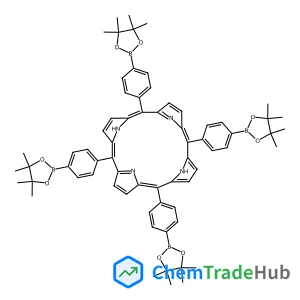
5,10,15,20-tetrakis(4-boronic acid pinacol ester phenyl) porphyrin
CAS Number:
1332748-00-1
Molecular Formula:
C68H74B4N4O8
Recommended Suppliers






Disclaimer
This page provides academic journal information for reference and research purposes only. We are not affiliated with any journal publishers and do not handle publication submissions. For publication-related inquiries, please contact the respective journal publishers directly.
If you notice any inaccuracies in the information displayed, please contact us at support@chemtradehub.com. We will promptly review and address your concerns.