












Studies on the oxidative N-demethylation of atropine, thebaine and oxycodone using a FeIII-TAML catalyst
Literature Information
Publication Date
2013-11-27
DOI
10.1039/C3GC41972J
Impact Factor
10.182
Authors
Duy D. Do Pham, Geoffrey F. Kelso, Yuanzhong Yang, Milton T. W. Hearn
View Original
Abstract
The reaction pathway and selectivity of the oxidative N-demethylation of the alkaloid atropine with H2O2 using a FeIII-TAML catalyst has been investigated. The conversion of atropine in ethanol with aqueous H2O2 produces noratropine as the main product and N-formyl-noratropine and other atropine derivatives involving carbon-hydroxylated tropane species as minor by-products. Comparative reactivity studies with noratropine, N-formyl-noratropine and atropine N-oxide demonstrated that the FeIII-TAML catalyses the N-demethylation of atropine by a biomimetic oxidation pathway involving the formation and then decomposition of a N-hydroxymethylnoratropine intermediate. The reaction selectivity for atropine N-demethylation versus N-methyl oxidation to N-formyl-noratropine was found to be sensitive to the structure of the alcohol co-solvent, the rate of H2O2 addition and the concentration of water, whereas temperature mainly affected the atropine conversion efficiency. The use of tert-butyl or cumene hydroperoxide as oxidants shifted the reaction selectivity toward N-methyl oxidation compared to aqueous H2O2. Various inorganic oxidants were found to be ineffective. The FeIII-TAML also catalysed the N-demethylation of the opiate alkaloids thebaine and oxycodone with aqueous H2O2 in higher conversion efficiencies compared to atropine but with lower selectivity. These investigations thus document key mechanistic features of the FeIII-TAML-catalysed N-demethylation of these alkaloids and provide insight into how this benign catalytic system could find broader utilisation for N-demethylation in general.
Recommended Journals
Related Literature
The effect of dielectrophoresis on living cells: crossover frequencies and deregulation in gene expression
Vahé Nerguizian, Ion Stiharu, Nosayba Al-Azzam, Bader Yassine-Diab
2019-04-23
Paper
DOI: 10.1039/C9AN00320G
A novel “signal-on” photoelectrochemical sensor for ultrasensitive detection of alkaline phosphatase activity based on a TiO2/g-C3N4 heterojunction
Feng Xia Wang, Cui Ye, Shi Mo, Liu Li Liao, Xiao Fang Zhang, Yu Ling, Lu Lu, Hong Qun Luo, Nian Bing Li
2018-06-05
Paper
DOI: 10.1039/C8AN00895G
Highly selective fluorescence ‘turn off’ sensing of picric acid and efficient cell labelling by water-soluble luminescent anthracene-bridged poly(N-vinyl pyrrolidone)
Rajshree Singh, Kheyanath Mitra, Shikha Singh, Sudipta Senapati, Vijay Kumar Patel, Sambhav Vishwakarma, Archana Kumari, Jaydeep Singh, Susanta K. Sen Gupta, Nira Misra, Pralay Maiti, Biswajit Ray
2019-04-25
Paper
DOI: 10.1039/C8AN02417K
Measuring and regulating oxygen levels in microphysiological systems: design, material, and sensor considerations
Kristina R. Rivera, Murat A. Yokus, Patrick D. Erb, Vladimir A. Pozdin
2019-04-02
Tutorial Review
DOI: 10.1039/C8AN02201A
Selection of DNA aptamers and establishment of an effective aptasensor for highly sensitive detection of cefquinome residues in milk
Lihui Wang, Chuchu Wang, Hao Li
2018-05-14
Paper
DOI: 10.1039/C8AN00709H
The facile and visualizable identification of broad-spectrum inhibitors of MDM2/p53 using co-expressed protein complexes
Yang Yang, Zhiqiang Dong, Hongze Hu, Junhui Peng, Yaping Sheng, Yang Tong, Siming Yuan, Zigang Li, Jiaxiang Yang, Thomas Wells, Yun Qu, Nicholas P. Farrell, Yangzhong Liu
2019-04-23
Paper
DOI: 10.1039/C9AN00350A
A near-infrared Nile red fluorescent probe for the discrimination of biothiols by dual-channel response and its bioimaging applications in living cells and animals
Jin-Shuai Lan, Rui-Feng Zeng, Yun Liu, Yan-Wei Xiang, Xiao-yi Jiang, Li Liu, Sai-Sai Xie, Yue Ding, Tong Zhang
2019-04-23
Paper
DOI: 10.1039/C9AN00280D
Antibody modified gold nanoparticles for fast colorimetric screening of rheumatoid arthritis
Ana Matias, Tomás Calmeiro, Elvira Fortunato, Alexandra R. Fernandes, Pedro Viana Baptista
2019-04-15
Paper
DOI: 10.1039/C9AN00319C
Fluorescence enhancement novel green analytical method for paraquat herbicide quantification based on immobilization on clay
Marina A. Dominguez, Matías Insausti, Romina Ilari, Graciela P. Zanini
2019-04-09
Paper
DOI: 10.1039/C9AN00387H
You might also like
Compound Q&A
What precautions should be taken when handling 4-Methyl-6-(trifluoromethyl)quinoline (CAS: 40716-16-3)?
When handling 4-Methyl-6-(trifluoromethyl)quinoline (CAS: 40716-16-3), safety go...
40716-16-34-Methyl-6-(trifluor...
Compound Q&A
What is 4-(3,5-Difluorophenyl)aniline (CAS: 405058-00-6)?
4-(3,5-Difluorophenyl)aniline is an aromatic organic compound with the CAS numbe...
405058-00-64-(3,5-Difluoropheny...
Compound Q&A
How is 5-{[4-(Trifluoromethyl)phenyl]sulfanyl}-1,2,3-thiadiazole-4-carboxylic acid (CAS: 338982-07-3) typically synthesized?
5-{[4-(Trifluoromethyl)phenyl]sulfanyl}-1,2,3-thiadiazole-4-carboxylic acid can ...
338982-07-35-{[4-(Trifluorometh...
Compound Q&A
What is the market or research trend for 4-Benzylaniline hydrochloride (CAS: 6317-57-3)?
The market for 4-Benzylaniline hydrochloride (CAS: 6317-57-3) is steadily growin...
6317-57-34-Benzylaniline hydr...
Compound Q&A
Is [3-(Diethylsulfamoyl)phenyl]boronic acid (CAS: 871329-58-7) safe?
[3-(Diethylsulfamoyl)phenyl]boronic acid is generally considered safe when handl...
871329-58-7[3-(Diethylsulfamoyl...
Compound Q&A
What are the main uses of 3-Bromo-2,5-dimethoxyaniline (CAS: 115929-62-9)?
3-Bromo-2,5-dimethoxyaniline is mainly used in the pharmaceutical and chemical i...
115929-62-93-Bromo-2,5-dimethox...
Compound Q&A
What regulatory guidelines apply to N-Methyl-1-(5-methyl-1H-indol-3-yl)methanamine (CAS: 915922-67-7)?
N-Methyl-1-(5-methyl-1H-indol-3-yl)methanamine (CAS: 915922-67-7) is subject to ...
915922-67-7N-Methyl-1-(5-methyl...
Compound Q&A
What industries use Carbamic acid, N-[(5S)-5,6-diamino-6-oxohexyl]-, 1,1-dimethylethyl ester (CAS: 24828-96-4)?
This compound is primarily used in the pharmaceutical industry for the synthesis...
24828-96-4Carbamic acid, N-[(5...
Compound Q&A
How should 2-Methyl-2-propanyl [(1S,3R)-3-aminocyclohexyl]carbamate (CAS: 1298101-47-9) be stored?
2-Methyl-2-propanyl [(1S,3R)-3-aminocyclohexyl]carbamate (CAS: 1298101-47-9) sho...
1298101-47-92-Methyl-2-propanyl ...
Compound Q&A
What industries use Ethyl 2-bromo-4,4,4-trifluorobutanoate (CAS: 367-33-9)?
Ethyl 2-bromo-4,4,4-trifluorobutanoate (CAS: 367-33-9) is utilized in the pharma...
367-33-9Ethyl 2-bromo-4,4,4-...
Source Journal
Green Chemistry

CiteScore:
16.1
Self-citation Rate:
7.5%
Articles per Year:
944
Green Chemistry provides a unique forum for the publication of innovative research on the development of alternative green and sustainable technologies. The scope of Green Chemistry is based on, but not limited to, the definition proposed by Anastas and Warner (Green Chemistry: Theory and Practice, P T Anastas and J C Warner, Oxford University Press, Oxford, 1998). Green chemistry is the utilisation of a set of principles that reduces or eliminates the use or generation of hazardous substances in the design, manufacture and application of chemical products. Green Chemistry is at the frontiers of this continuously-evolving interdisciplinary science and publishes research that attempts to reduce the environmental impact of the chemical enterprise by developing a technology base that is inherently non-toxic to living things and the environment. Submissions on all aspects of research relating to the endeavour are welcome. The journal publishes original and significant cutting-edge research that is likely to be of wide general appeal. To be published, work must present a significant advance in green chemistry. Papers must contain a comparison with existing methods and demonstrate advantages over those methods before publication can be considered. For more information please see this Editorial. Coverage includes the following, but is not limited to: Design (e.g. biomimicry, design for degradation/recycling/reduced toxicity…) Reagents & Feedstocks (e.g. renewables, CO2, solvents, auxiliary agents, waste utilization…) Synthesis (e.g. organic, inorganic, synthetic biology…) Catalysis (e.g. homogeneous, heterogeneous, enzyme, whole cell…) Process (e.g. process design, intensification, separations, recycling, efficiency…) Energy (e.g. renewable energy, fuels, photovoltaics, fuel cells, energy storage, energy carriers…) Applications (e.g. electronics, dyes, consumer products, coatings, pharmaceuticals, preservatives, building materials, chemicals for industry/agriculture/mining…) Impact (e.g. safety, metrics, LCA, sustainability, (eco)toxicology…) Green chemistry is, by definition, a continuously-evolving frontier. Therefore, the inclusion of a particular material or technology does not, of itself, guarantee that a paper is suitable for the journal. To be suitable, the novel advance should have the potential for reduced environmental impact relative to the state of the art. Green Chemistry does not normally deal with research associated with 'end-of-pipe' or remediation issues.
Recommended Compounds
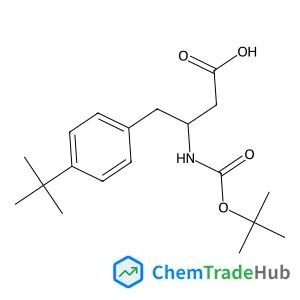
(S)-3-((tert-Butoxycarbonyl)amino)-4-(4-(tert-butyl)phenyl)butanoic acid
CAS Number:
403661-85-8
Molecular Formula:
C19H29NO4
![Methyl 3-({2'-[(E)-(hydroxyhydrazono)methyl]-4-biphenylyl}methyl)-2-oxo-2,3-dihydro-1H-benzimidazole-4-carboxylate structure](https://static.chemtradehub.com/structs/149/1499167-72-4-034a.webp "Methyl 3-({2'-[(E)-(hydroxyhydrazono)methyl]-4-biphenylyl}methyl)-2-oxo-2,3-dihydro-1H-benzimidazole-4-carboxylate structure")
Methyl 3-({2'-[(E)-(hydroxyhydrazono)methyl]-4-biphenylyl}methyl)-2-oxo-2,3-dihydro-1H-benzimidazole-4-carboxylate
CAS Number:
1499167-72-4
Molecular Formula:
C23H20N4O4
![(4aR,5S,6R,8aS)-5-[2-(3-Furyl)ethyl]-8a-(hydroxymethyl)-5,6-dimethyl-3,4,4a,5,6,7,8,8a-octahydro-1-naphthalenecarboxylic acid structure](https://static.chemtradehub.com/structs/184/18411-75-1-d4cd.webp "(4aR,5S,6R,8aS)-5-[2-(3-Furyl)ethyl]-8a-(hydroxymethyl)-5,6-dimethyl-3,4,4a,5,6,7,8,8a-octahydro-1-naphthalenecarboxylic acid structure")
(4aR,5S,6R,8aS)-5-[2-(3-Furyl)ethyl]-8a-(hydroxymethyl)-5,6-dimethyl-3,4,4a,5,6,7,8,8a-octahydro-1-naphthalenecarboxylic acid
CAS Number:
18411-75-1
Molecular Formula:
C20H28O4
Recommended Suppliers







Disclaimer
This page provides academic journal information for reference and research purposes only. We are not affiliated with any journal publishers and do not handle publication submissions. For publication-related inquiries, please contact the respective journal publishers directly.
If you notice any inaccuracies in the information displayed, please contact us at support@chemtradehub.com. We will promptly review and address your concerns.