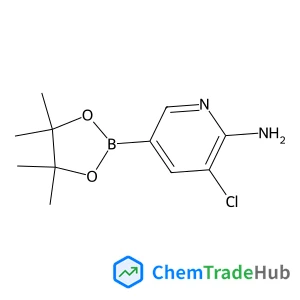
3-Chloro-5-(4,4,5,5-tetramethyl-1,3,2-dioxaborolan-2-yl)-2-pyridinamine
CAS Number:
1032758-99-8
Molecular Formula:
C11H16BClN2O2
The channel interference mechanism describes the two-photon absorption process in terms of the relative orientations of different transition dipole moment vectors (TDMVs) in a molecule. Controlling these interferences is a difficult but important task, because it can provide new information about such absorption/emission processes. The present contribution aims to explain the reversal in the nature of these interferences with the relative positions of the donor–acceptor groups in substituted biphenyl molecules. The results obtained from the linear and quadratic response theories indicate that having the donor at the para position leads to a constructive interference whereas having it at any of the other two positions results in a destructive interference. This is explained by a systematic analysis of the relative orientations of all the TDMVs involved in a three-state model.
Xian-Chao Jin, Bai-Hao Ren, Ge-Ge Gu, Tian-Jun Yue, Wei-Min Ren
DOI: 10.1039/D2PY00185C
Csilla György, Timothy Smith, David J. Growney, Steven P. Armes
DOI: 10.1039/D2PY00559J
Wiktoria Tomal, Patryk Szymaszek, Magdalena Bilut, Roman Popielarz, Tomasz Świergosz, Joanna Ortyl
DOI: 10.1039/D2PY00525E
Julien Thuilliez
DOI: 10.1039/D2PY00155A
Margaret C. Gerthoffer, Bohan Xu, Sikai Wu, Jordan Cox, Steven Huss, Shalisa M. Oburn, Steven A. Lopez, Elizabeth Elacqua
DOI: 10.1039/D1PY01387D
Jing Wan, Jiali Zhai, Nicholas Kai Shiang Teo, Andy Huynh
DOI: 10.1039/D2PY00701K
Tianbiao Wei, Shanqing Huang, Qingyuan Hu, Jue Wang, Zhongzhong Huo, Tongyang Zhu, Chi Wu, Hao Chen
DOI: 10.1039/D1PY01574E
Nicolas Illy, Emma Mongkhoun
DOI: 10.1039/D2PY00731B
Claudio Cappelletti, Luis M. Olaechea, Alessandro Ianiro, Cristina Prado-Martínez, Emad Oveisi, Christoph Weder, Stephen Schrettl
DOI: 10.1039/D2PY00071G
Naganatha Patil, Yves Gnanou, Xiaoshuang Feng
DOI: 10.1039/D2PY00442A
This compound is mainly used as an intermediate in the synthesis of antipsychoti...
Waste containing 1-(D-Ribofuranosyl)-1,4-dihydro-3-pyridinecarboxamide (CAS: 191...
2-Methyl-2-propanyl 3-bromo-3-(hydroxymethyl)-1-azetidinecarboxylate (CAS: 20079...
N-(4-Chloro-2-pyridinyl)acetamide (CAS: 245056-66-0) is a chemical compound with...
5-Chloro-2-hydroxybenzoic acid, also known as 5-chlorosalicylic acid, is an arom...
When handling 1,1-Dichloro-1-fluoroethane (CAS: 1717-00-6), it is important to u...
Fmoc-(2S,3R)-3-phenylpyrrolidine-2-carboxylic acid is a white crystalline solid ...
4-Amino-5-bromo-2-pyridinecarboxylic acid is primarily used as a precursor in th...
Handling this compound should be done with personal protective equipment (PPE) i...
When handling 8-bromo-2,2-dimethyl-3,4-dihydro-2H-1,4-benzoxazin-3-one, use prop...

Physical Chemistry Chemical Physics (PCCP) is an international journal co-owned by 19 physical chemistry and physics societies from around the world. This journal publishes original, cutting-edge research in physical chemistry, chemical physics and biophysical chemistry. To be suitable for publication in PCCP, articles must include significant innovation and/or insight into physical chemistry; this is the most important criterion that reviewers and Editors will judge against when evaluating submissions. The journal has a broad scope and welcomes contributions spanning experiment, theory, computation and data science. Topical coverage includes spectroscopy, dynamics, kinetics, statistical mechanics, thermodynamics, electrochemistry, catalysis, surface science, quantum mechanics, quantum computing and machine learning. Interdisciplinary research areas such as polymers and soft matter, materials, nanoscience, energy, surfaces/interfaces, and biophysical chemistry are welcomed if they demonstrate significant innovation and/or insight into physical chemistry. Joined experimental/theoretical studies are particularly appreciated when complementary and based on up-to-date approaches.