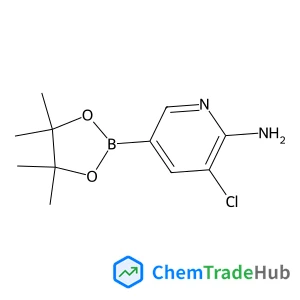
3-Chloro-5-(4,4,5,5-tetramethyl-1,3,2-dioxaborolan-2-yl)-2-pyridinamine
CAS Number:
1032758-99-8
Molecular Formula:
C11H16BClN2O2
Wiktoria Tomal, Patryk Szymaszek, Magdalena Bilut, Roman Popielarz, Tomasz Świergosz, Joanna Ortyl
Herein, the performance of a series of 2-amino-4,6-diphenylbenzene-1,3-dicarbonitrile derivatives in the role of fluorescent molecular sensors for monitoring progress of various photopolymerization processes by the Fluorescence Probe Technique (FPT) has been evaluated. It was found that all of the derivatives studied, except for the one containing a nitro substituent in its structure, showed high enough sensitivity and stability to be applied as versatile sensors for both cationic and free-radical polymerization processes. Next, the applicability of the sensors was applied for study of hybrid polymerization processes (i.e., both cationic and free radical polymerization reactions occurring simultaneously). The hybrid photopolymerization of pure glycidyl methacrylate (GlyMA) and the mixtures of GlyMA with 3,4-epoxycyclohexylmethyl 3,4-epoxy-cyclohexanecarboxylate (CADE), or CADE with trimethylolpropane triacrylate (TMPTA) was studied. It was found that during the hybrid photopolymerization of CADE/TMPTA mixtures, each monomer polymerized independently to form an interpenetrated polymer network (IPN). On the other hand, hybrid photopolymerization of GlyMA/CADE mixtures leads to a copolymer, where final functional group conversions are higher than those achievable by the corresponding photopolymerizations of pure GlyMA and CADE monomers. The use of m-terphenyl sensors allows for real-time monitoring of various hybrid polymerization processes and provides key information on the processes, which was not previously possible.

Journal of Organometallic Chemistry

Kinetics and Catalysis

Science

Israel Journal of Chemistry

Molecular Pharmacology

Fibre Chemistry

Journal of Physics and Chemistry of Solids

European Journal of Wood and Wood Products

Proceedings of the National Academy of Sciences of the United States of America

Organic Preparations and Procedures International
J.M. Granadino-Roldán, M. Fernández-Gómez, Lin-Wang Wang
DOI: 10.1039/C1CP20329K
I. Panas
DOI: 10.1039/C0CP02132F
Xavier Aparicio-Anglès, Anna Clotet, Josep M. Poblet
DOI: 10.1039/C0CP02602F
Artur Ratkiewicz
DOI: 10.1039/C1CP21229J
Sebastian Krapf, Maria Schill, Sebastian Krötz, Thorsten Koslowski
DOI: 10.1039/C1CP21274E
Yoshinobu Akinaga, Jaewoon Jung, Seiichiro Ten-no
DOI: 10.1039/C1CP21001G
Florian Colléaux, James M. Ball, Paul H. Wöbkenberg, Peter J. Hotchkiss, Seth R. Marder, Thomas D. Anthopoulos
DOI: 10.1039/C1CP20769E
Juan Pablo Catalán
DOI: 10.1039/C1CP21380F
Tomoya Uruga, Hajime Tanida, Yasuko Terada, Yasuhiro Iwasawa, Shin-ichi Ohkoshi
DOI: 10.1039/C1CP20895K
This compound is mainly used as an intermediate in the synthesis of antipsychoti...
Waste containing 1-(D-Ribofuranosyl)-1,4-dihydro-3-pyridinecarboxamide (CAS: 191...
2-Methyl-2-propanyl 3-bromo-3-(hydroxymethyl)-1-azetidinecarboxylate (CAS: 20079...
N-(4-Chloro-2-pyridinyl)acetamide (CAS: 245056-66-0) is a chemical compound with...
5-Chloro-2-hydroxybenzoic acid, also known as 5-chlorosalicylic acid, is an arom...
When handling 1,1-Dichloro-1-fluoroethane (CAS: 1717-00-6), it is important to u...
Fmoc-(2S,3R)-3-phenylpyrrolidine-2-carboxylic acid is a white crystalline solid ...
4-Amino-5-bromo-2-pyridinecarboxylic acid is primarily used as a precursor in th...
Handling this compound should be done with personal protective equipment (PPE) i...
When handling 8-bromo-2,2-dimethyl-3,4-dihydro-2H-1,4-benzoxazin-3-one, use prop...

Polymer Chemistry welcomes submissions in all areas of polymer science that have a strong focus on macromolecular chemistry. Manuscripts may cover a broad range of fields, yet no direct application focus is required.
![6-Benzyl-4,5,6,7-tetrahydro-1H-pyrazolo[3,4-c]pyridin-3(2H)-one structure](https://static.chemtradehub.com/structs/909/909187-64-0-f54f.webp "6-Benzyl-4,5,6,7-tetrahydro-1H-pyrazolo[3,4-c]pyridin-3(2H)-one structure")