


Thiolactone chemistry, a versatile platform for macromolecular engineering
Literature Information
Publication Date
2022-07-25
DOI
10.1039/D2PY00731B
Impact Factor
5.582
Authors
Nicolas Illy, Emma Mongkhoun
View Original
Abstract
Thiolactones are often described as latent thiols. They can be ring-opened by hydroxy or amine groups releasing thiols, which can further react with a large variety of functional groups. Based on this one-pot cascade reaction, versatile and powerful tools have been developed for macromolecular engineering. This review covers the different uses of γ-thiobutyrolactones in polymer chemistry either as thiolation agents, as linkers, as ring-opening polymerization monomers, as reactant in stepwise polymerization, as components of initiating systems, or as functional handles for double post-modification reactions.
Recommended Journals

European Journal of Wood and Wood Products

Proceedings of the National Academy of Sciences of the United States of America

Israel Journal of Chemistry

Journal of Physics and Chemistry of Solids

Science

Helvetica Chimica Acta

Journal of Heterocyclic Chemistry

Fibre Chemistry

Russian Chemical Reviews

Journal of Medicinal Chemistry
Related Literature
Multiscale quantum mechanics/electromagnetics simulation for electronic devices
ChiYung Yam, Lingyi Meng, GuanHua Chen, Quan Chen, Ngai Wong
2011-06-10
Paper
DOI: 10.1039/C1CP20766K
A theoretical study of pure and mixed caesium clusters and cluster ions, CslHmO 0/+n, l ≤ 5: geometry, energetics and photofragmentation
Sebastian Krapf, Maria Schill, Sebastian Krötz, Thorsten Koslowski
2011-07-14
Paper
DOI: 10.1039/C1CP21274E
Photoinduced work function changes by isomerization of a densely packed azobenzene-based SAM on Au: a joint experimental and theoretical study
N. Crivillers, A. Liscio, F. Di Stasio, C. Van Dyck, S. Osella, D. Cornil, S. Mian, G. M. Lazzerini, O. Fenwick, E. Orgiu, F. Reinders, S. Braun, M. Fahlman, J. Cornil, V. Palermo, F. Cacialli, P. Samorì
2011-06-22
Paper
DOI: 10.1039/C1CP20851A
Photo-deactivation pathways of a double H-bonded photochromic Schiff base investigated by combined theoretical calculations and experimental time-resolved studies
Carlos Randino, Marcin Ziółek, Ricard Gelabert, Juan Angel Organero, Michal Gil, Miquel Moreno, José M. Lluch, Abderrazzak Douhal
2011-07-14
Paper
DOI: 10.1039/C1CP21039D
Spin seebeck coefficient of a molecular spin pump
Jonas Fransson, Michael Galperin
2011-06-07
Paper
DOI: 10.1039/C1CP20720B
Assessment of an effective quasirelativistic methodology designed to study astatine chemistry in aqueous solution
Andrea Sabatié-Gogova, Eric Renault, Gilles Montavon, Nicolas Galland
2011-07-18
Paper
DOI: 10.1039/C1CP20512A
Hierarchical micro/nano structures of carbon composites as anodes for microbial fuel cells
Yong Zhao
2011-07-25
Paper
DOI: 10.1039/C1CP21813A
Polarization induced water molecule dissociation below the first-order electronic-phase transition temperature
Andrew Das Arulsamy, Zlatko Kregar, Kristina Eleršič, Martina Modic, Uma Shankar Subramani
2011-07-21
Paper
DOI: 10.1039/C1CP20138G
Bias-controlled selective excitation of vibrational modes in molecular junctions: a route towards mode-selective chemistry
Roie Volkovich, Rainer Härtle, Michael Thoss, Uri Peskin
2011-07-20
Paper
DOI: 10.1039/C1CP21161G
π-Stacking between Casiopeinas® and DNA bases
Rodrigo Galindo-Murillo, Joseelyne Hernandez-Lima, Mayra González-Rendón, Lena Ruíz-Azuara, Rafael Moreno-Esparza
2011-07-12
Paper
DOI: 10.1039/C1CP20183B
You might also like
Compound Q&A
What are the main uses of 1-(3-Aminophenyl)-3-[(3R)-1-(3,3-dimethyl-2-oxobutyl)-2-oxo-5-(2-pyridinyl)-2,3-dihydro-1H-1,4-benzodiazepin-3-yl]urea (CAS: 155412-88-7)?
This compound is mainly used as an intermediate in the synthesis of antipsychoti...
155412-88-71-(3-Aminophenyl)-3-...
Compound Q&A
How should waste containing 1-(D-Ribofuranosyl)-1,4-dihydro-3-pyridinecarboxamide (CAS: 19132-12-8) be handled?
Waste containing 1-(D-Ribofuranosyl)-1,4-dihydro-3-pyridinecarboxamide (CAS: 191...
19132-12-81-(D-Ribofuranosyl)-...
Compound Q&A
What regulatory guidelines apply to 2-Methyl-2-propanyl 3-bromo-3-(hydroxymethyl)-1-azetidinecarboxylate (CAS: 2007919-81-3)?
2-Methyl-2-propanyl 3-bromo-3-(hydroxymethyl)-1-azetidinecarboxylate (CAS: 20079...
2007919-81-32-Methyl-2-propanyl ...
Compound Q&A
What is N-(4-Chloro-2-pyridinyl)acetamide (CAS: 245056-66-0)?
N-(4-Chloro-2-pyridinyl)acetamide (CAS: 245056-66-0) is a chemical compound with...
245056-66-0N-(4-Chloro-2-pyridi...
Compound Q&A
What is 5-Chloro-2-hydroxybenzoic acid (CAS: 321-14-2)?
5-Chloro-2-hydroxybenzoic acid, also known as 5-chlorosalicylic acid, is an arom...
321-14-25-Chloro-2-hydroxybe...
Compound Q&A
What precautions should be taken when handling 1,1-Dichloro-1-fluoroethane (CAS: 1717-00-6)?
When handling 1,1-Dichloro-1-fluoroethane (CAS: 1717-00-6), it is important to u...
1717-00-61,1-Dichloro-1-fluor...
Compound Q&A
What are the physical and chemical properties of Fmoc-(2S,3R)-3-phenylpyrrolidine-2-carboxylic acid (CAS: 281655-32-1)?
Fmoc-(2S,3R)-3-phenylpyrrolidine-2-carboxylic acid is a white crystalline solid ...
281655-32-1Fmoc-(2S,3R)-3-pheny...
Compound Q&A
What are the main uses of 4-Amino-5-bromo-2-pyridinecarboxylic acid (CAS: 1363381-01-4)?
4-Amino-5-bromo-2-pyridinecarboxylic acid is primarily used as a precursor in th...
1363381-01-44-Amino-5-bromo-2-py...
Compound Q&A
What precautions should be taken when handling (S)-tert-butyl 2-((2-(4-bromophenyl)-2-oxoethyl)carbamoyl)pyrrolidine-1-carboxylate (CAS: 1007881-98-2)?
Handling this compound should be done with personal protective equipment (PPE) i...
1007881-98-2(S)-tert-butyl 2-((2...
Compound Q&A
What precautions should be taken when handling 8-bromo-2,2-dimethyl-3,4-dihydro-2H-1,4-benzoxazin-3-one (CAS: 688363-73-7)?
When handling 8-bromo-2,2-dimethyl-3,4-dihydro-2H-1,4-benzoxazin-3-one, use prop...
688363-73-78-bromo-2,2-dimethyl...
Source Journal
Polymer Chemistry

CiteScore:
8.6
Self-citation Rate:
7.3%
Articles per Year:
457
Polymer Chemistry welcomes submissions in all areas of polymer science that have a strong focus on macromolecular chemistry. Manuscripts may cover a broad range of fields, yet no direct application focus is required.
Recommended Compounds
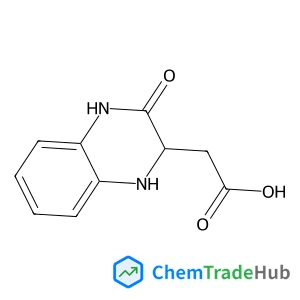
(3-Oxo-1,2,3,4-tetrahydro-2-quinoxalinyl)acetic acid
CAS Number:
136584-14-0
Molecular Formula:
C10H10N2O3
Recommended Suppliers







Disclaimer
This page provides academic journal information for reference and research purposes only. We are not affiliated with any journal publishers and do not handle publication submissions. For publication-related inquiries, please contact the respective journal publishers directly.
If you notice any inaccuracies in the information displayed, please contact us at support@chemtradehub.com. We will promptly review and address your concerns.