












Network formation mechanisms in conjugated microporous polymers
Literature Information
Publication Date
2014-07-21
DOI
10.1039/C4PY00647J
Impact Factor
5.582
Authors
Andrea Laybourn, Rob Clowes, Tom Hasell, Andrew I. Cooper, Yaroslav Z. Khimyak, Dave J. Adams
View Original
Abstract
We discuss in detail the mechanism of formation of a highly microporous polymer, CMP-1, formed mainly via Sonogashira–Hagihara coupling. We demonstrate how the microporosity evolves with time, and discuss the importance of alkyne homo-coupling on the microporosity.
Related Literature
Facile routes to star polymersvia an organocatalytic approach
Daniel J. Coady, Amanda C. Engler, Yi Yan Yang, James L. Hedrick
2011-09-16
Paper
DOI: 10.1039/C1PY00272D
Pepsin-inspired polyurethanes containing a tyrosine–fumaric acid–tyrosine segment
Haoxiang Lu, Wei Wang, Zhen Zheng, Peiyu Sun, Xinling Wang, Feng-Chih Chang
2011-12-15
Paper
DOI: 10.1039/C2PY00481J
The co-curing process of a benzoxazine-cyanate system and the thermal properties of the copolymers
Xiaodan Li, Yi Gu
2011-10-19
Communication
DOI: 10.1039/C1PY00379H
Synthesis, characterization, fluorescence labeling and cellular internalization of novel amine-functionalized poly(ethylene glycol)-block-poly(ε-caprolactone) amphiphilic block copolymers
Zhaoyang Ye, Houyong Luo, Min Chen, Yan Zhou, Wensong Tan, Yan Xiao, Yan Zhang
2011-04-12
Paper
DOI: 10.1039/C0PY00391C
Stable azlactone-functionalized nanoparticles prepared from thermoresponsive copolymers synthesized by RAFT polymerization
Martin E. Levere, Hien The Ho, Sagrario Pascual, Laurent Fontaine
2011-10-17
Paper
DOI: 10.1039/C1PY00320H
Photocrosslinking the polystyrene core of block-copolymer nanoparticles
Siyan Zhang, Douglas H. Adamson, Robert K. Prud'homme
2010-12-20
Paper
DOI: 10.1039/C0PY00350F
Synthesis of multi-block copolymer stars using a simple iterative Cu(0)-mediated radical polymerization technique
Cyrille Boyer, Aurelia Derveaux, Per B. Zetterlund, Michael R. Whittaker
2011-09-30
Paper
DOI: 10.1039/C1PY00384D
Tunable absorption and emission wavelength in conjugated microporous polymers by copolymerization
Jessica Brandt, Johannes Schmidt, Arne Thomas, Jan Dirk Epping, Jens Weber
2011-07-08
Communication
DOI: 10.1039/C1PY00217A
Design and synthesis of new anionic “polymeric ionic liquids” with high charge delocalization
A. S. Shaplov, M. Armand, E. I. Lozinskaya, D. O. Ponkratov, I. A. Malyshkina, F. Vidal, O. V. Okatova, G. M. Pavlov, C. Wandrey, I. A. Godovikov, Y. S. Vygodskii
2011-08-25
Paper
DOI: 10.1039/C1PY00282A
Efficient dual radical/cationic photoinitiator under visible light: a new concept
Jacques Lalevée, Nicolas Blanchard, Mohamad-Ali Tehfe, Mathieu Peter, Fabrice Morlet-Savary, Didier Gigmes, Jean Pierre Fouassier
2011-06-13
Paper
DOI: 10.1039/C1PY00140J
You might also like
Compound Q&A
What is 3-Fluoro-2-methylbenzylamine (CAS: 771573-36-5)?
3-Fluoro-2-methylbenzylamine is an organic compound with the CAS number 771573-3...
771573-36-53-Fluoro-2-methylben...
Compound Q&A
Is Tert-butyl 2-(oxetan-3-ylidene)acetate (CAS: 1207175-03-8) safe?
Tert-butyl 2-(oxetan-3-ylidene)acetate is considered safe for its intended uses ...
1207175-03-8Tert-butyl 2-(oxetan...
Compound Q&A
What precautions should be taken when handling 4-Acetyl-2-fluorobenzonitrile (CAS: 214760-18-6)?
Proper personal protective equipment (PPE) such as gloves, goggles, and a lab co...
214760-18-64-Acetyl-2-fluoroben...
Compound Q&A
How is 2-Ethyl-4-methyl-1,3-thiazole (CAS: 15679-12-6) typically synthesized?
2-Ethyl-4-methyl-1,3-thiazole is commonly synthesized via the reaction of thiour...
15679-12-62-Ethyl-4-methyl-1,3...
Compound Q&A
How should 5',5''-([2,2'-Bithiophene]-5,5'-diyl)bis(([1,1':3',1''-terphenyl]-4,4''-dicarboxylic acid)) (CAS: 1227780-71-3) be stored?
This compound should be stored in a cool, dry place away from direct sunlight an...
1227780-71-35',5''''-([2,2'-Bith...
Compound Q&A
What regulatory guidelines apply to L-Lysine Acetate Salt (CAS: 52315-92-1)?
L-Lysine Acetate Salt (CAS: 52315-92-1) is subject to various regulatory guideli...
52315-92-1L-LYSINE ACETATE SAL...
Compound Q&A
Is 6-Fluoro-3-hydroxy-2-pyrazinecarboxamide (CAS: 259793-96-9) safe?
6-Fluoro-3-hydroxy-2-pyrazinecarboxamide (CAS: 259793-96-9) is generally conside...
259793-96-96-Fluoro-3-hydroxy-2...
Compound Q&A
What are the physical and chemical properties of 1,1'-Sulfonylbis(1H-imidazole) (CAS: 7189-69-7)?
1,1'-Sulfonylbis(1H-imidazole) is a crystalline solid with a molecular weight of...
7189-69-71,1'-Sulfonylbis(1H-...
Compound Q&A
What industries use 4-methyl-7-nitro-1H-indole-3-carbonitrile (CAS: 289483-82-5)?
4-Methyl-7-nitro-1H-indole-3-carbonitrile (CAS: 289483-82-5) is primarily used i...
289483-82-54-methyl-7-nitro-1H-...
Compound Q&A
How should waste containing 5-Bromo-3-indolyl-beta-galactoside (CAS: 97753-82-7) be handled?
Waste containing 5-Bromo-3-indolyl-beta-galactoside (CAS: 97753-82-7) should be ...
97753-82-75-Bromo-3-indolyl-be...
Source Journal
Polymer Chemistry

CiteScore:
8.6
Self-citation Rate:
7.3%
Articles per Year:
457
Polymer Chemistry welcomes submissions in all areas of polymer science that have a strong focus on macromolecular chemistry. Manuscripts may cover a broad range of fields, yet no direct application focus is required.
Recommended Compounds
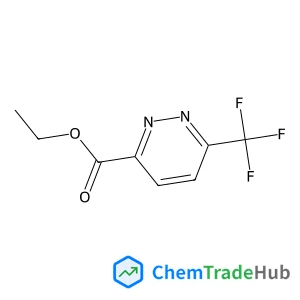
Ethyl 6-(trifluoromethyl)pyridazine-3-carboxylate
CAS Number:
1192155-06-8
Molecular Formula:
C8H7F3N2O2

Recommended Suppliers








Disclaimer
This page provides academic journal information for reference and research purposes only. We are not affiliated with any journal publishers and do not handle publication submissions. For publication-related inquiries, please contact the respective journal publishers directly.
If you notice any inaccuracies in the information displayed, please contact us at support@chemtradehub.com. We will promptly review and address your concerns.